The Political Systems We Live Inside Actually Do Look a Lot Like 'Star Wars'
By Natalie McCarty
Politics have never been more theatrical, duplicitous, and cult-like than they are now.
The odds have never felt more stacked against us–as power grows more expansive, more coordinated, and more entrenched—aligning itself across institutions and borders in ways that feel increasingly difficult to fully grasp… sound familiar?

Star Wars (1977)
This May the Fourth (Be With You), it’s worth talking about why Star Wars has never been more important than it is right now.
What has long been framed as a distant, mythic universe is, in practice, one of the most resonant political texts we have: a story about what it means to exist under systems that feel immovable, about the often improbable work of resisting them, and about the fragile but necessary belief that even the most dominant forces are not permanent.
It is not just a story about an empire; it is a story about what it feels like to be up against one. And up against one we are. The power at be is vast, organized, deceitful, and deeply embedded into the structures we move through every day, but there are more of us than there are them.
And in a moment like this—where the powers that be feel expansive, entrenched, and increasingly difficult to defeat—that feeling, and that call to resist it, matters.

The Empire Strikes Back (1980)
I. “The Dark Side” Is Akin to MAGA’s Political Logic.
I’d argue that Star Wars gives us a language for corruption. Sure, it may sound simplified in the phrase “the dark side,” but how perfectly adequate is that? Looming, enforced through fear, the dark side (or MAGA’s political ecosystem) operates on the belief of a nation’s insecurity—exploited through control and dissent against the voice of the people.
The dark side, and everything it represents, is in many ways the same political strategy being used by Trump and his cronies. It is not identical in form (as I’d argue that what Vader and his crew got going on is far tamer), but it is structurally aligned in logic: power built through grievance, loyalty, and the systematic erosion of trust in shared institutions.
In Revenge of the Sith, Palpatine does not seize power outside the system—he works through it until he effectively exploits it, erasing all sense of normalcy through deliberate, incremental corruption. What begins as emergency governance becomes permanent consolidation. Military authority is expanded through procedure. The Senate votes to grant extraordinary powers. Institutions authorize their own weakening in the name of stability.
And eventually, that accumulation resolves into totalitarian control.
In our present political landscape, the resemblance is not subtle: power increasingly operates through narrative control, loyalty enforcement, and the framing of institutional legitimacy as something to be dismantled rather than trusted.
Systems do not collapse overnight—they are hollowed out from within, step by step, until what remains is control that no longer needs to disguise itself.
II. The Sacrificial Lamb of an Overambitious and Naive Tribute: Anakin Skywalker and the Engineering of Fear

Sourced Through Pinterest
The dark side actively recruits by preying on the overambitious and the naïve. Anakin Skywalker is a case study in how systems produce vulnerability. He is not an anomaly within the system, rather he is one of its most legible outputs: an individual shaped by contradiction, pressure, and institutional instability until those pressures become exploitable.
Across Attack of the Clones and Revenge of the Sith, Anakin is formed inside structural tension: a Jedi Order that preaches detachment while exercising control, a Republic that claims democratic legitimacy while expanding emergency authority as a governing norm, and a personal identity built on exceptionality without emotional or institutional containment.
By the time Palpatine fully enters his orbit, the system has already produced the conditions for capture.
What Palpatine offers is some false ideology to mask his real goal: total power and control for himself and himself alone. You are nothing but a tribute, but a pawn in his game.
He reframes institutions as untrustworthy, fear as rational, and consolidation of power as the only remaining form of stability. In Revenge of the Sith, he does not seize power outside the system, but he works through it until it is fully reoriented toward total consolidation.
This is how authoritarian logic actually functions in practice: through the gradual redefinition of what feels stable, trustworthy, or even real.
And it works most effectively in environments where existing systems are already producing contradiction, instability, or mistrust.
Anakin does not simply choose domination; he is guided into a framework where domination is presented as the only path forward–spoiler: it is NOT! You’re just marching yourself, your family, and your country into the throes of a crazy person who somehow weaselled his way to the top.
Also, let me be clear, I think genuinely no one in Trump's ridiculous cabinet (or former members who've since been ousted by their king, (looking at you, Kristi Noem!)), possesses genuinely any humanity or empathy… so we can't necessarily draw the parallel to the complicated character that is Anakin. However, I think if someone with half a brain cell barely left (ICE agents, republicans, etc.) could read this, it might be eye-opening! You mean NOTHING to your “king”, btw.
III. Padmé Amidala and the Failure of Institutional Politics

Star Wars: Episode III – Revenge of the Sith (2005)
Which brings me to my next point: if Anakin represents susceptibility to power, Padmé Amidala represents faith in systems that are already structurally failing. Padmé is the most explicitly political (obviously, as an elected official), and is its institutional ideal: a senator committed to diplomacy, procedure, and the belief that governance can restrain excess.
But Attack of the Clones and Revenge of the Sith make something increasingly explicit: she is operating inside a Republic that is transitioning, in real time, from democratic structure to emergency governance. The creation of the Grand Army of the Republic is not a coup; it is a vote. The expansion of executive power is not a seizure; it is authorization. The erosion of institutional restraint does not happen violently at first; it happens procedurally, under the language of necessity.
Padmé sees it clearly: liberty is being traded for security, fear is being weaponized, and democratic norms are being hollowed out from within. But clarity is not control of the situation, let alone advocacy or the ability to fight against it. And Star Wars is unusually honest about this: even an accurate diagnosis does not guarantee the ability to intervene. Padmé’s tragedy is that she represents the collapse of procedural politics under conditions of structural escalation.
Like, come on, guys, are you really not seeing the parallels by now? Hello, with the SAVE Act… people, please pay attention!
IIII. The Rebellion, Leia Organa, and the Infrastructure of Resistance
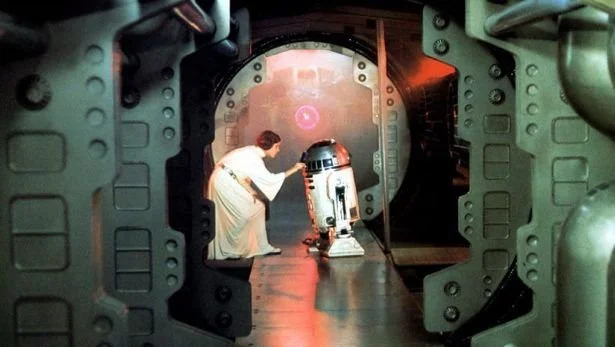
Star Wars (1977)
If Padmé represents the failure of institutional politics under pressure, Leia Organa represents what comes after: the necessity of building something outside of it.
Because by the time we reach A New Hope, the Republic is gone completely, and in its place is total consolidation: an Empire that does not pretend to be democratic, that does not seek consensus, that governs through force, surveillance, and fear.
And yet, the Rebellion exists (and persists at that) under conditions where success is not guaranteed, and failure is often fatal.
Leia is a new hope (see what I did there?), and a strategist operating within scarcity–already embedded in a network that requires complete trust, precision, and constant risk within her fellow man. This is an organized, deliberate, and sustained resistance–and at the helm is a woman, no less.
And that is fucking powerful.
Even as a kid, what a really motivating concept it was, that regular people, normal civilians, could overthrow the most evil of forces and win. That we could surmount the odds, and we still can!
IV. Luke Skywalker and the Refusal of Absolutism

Sourced Through Pinterest
If Leia represents the structure of resistance, Luke Skywalker represents its ideological boundary.
Arguably, the most dangerous part of authoritarian logic is that it reshapes how people understand power altogether. It presents domination as clarity, control as stability, and violence as necessity.
Luke is offered that framework repeatedly.
In The Empire Strikes Back, he is pushed toward urgency, toward reaction, toward acting out of fear. In Return of the Jedi, that pressure becomes explicit: the Emperor tries to blatantly convert Luke, utilizing one of his greatest vulnerabilities—his paternal connection. Anything to make him believe that power, once obtained, must be used absolutely.
That is the final stage of the dark side’s logic: not just control of systems, but control of your mind and spirit, where no alternative to domination even seems possible.
And Luke refuses, which is why he is such a powerful antidote to the current societal climate compounded by political stress.
We must disrupt the assumption that power must escalate to be effective. It rejects the idea that the only way to confront authoritarianism is to mirror its methods.
Luke wins by refusing to validate its logic and by finding empathy in the lost souls to the dark side, all while remaining strong, true, and confident in the face of contradiction. To be willing to sacrifice everything to end the cycles of evil.
V. What Star Wars Ultimately Understands About Power
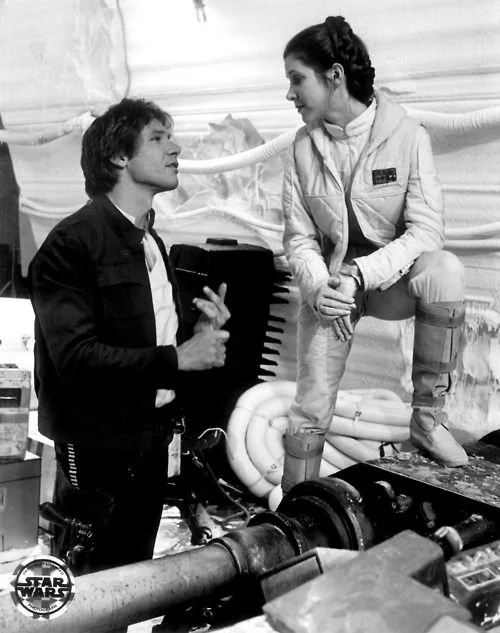
Sourced Through Pinterest
Though this is just the tip of the iceberg on what we could cover, taken together, these characters are important lessons to us all.
Anakin Skywalker represents how systems produce vulnerability and then exploit it—how fear can be reorganized into obedience, how domination can be reframed as clarity. Padmé Amidala represents the limits of institutional faith, the belief that systems can be reasoned with even as they are actively restructuring themselves beyond recognition. Leia Organa represents what comes after that realization: the necessity of building resistance outside of systems that are no longer accountable. And Luke Skywalker represents the final, most difficult step—the refusal to replicate the very logic you are trying to dismantle.
Because what Star Wars understands, with a level of clarity that feels almost unsettling right now, is that power does not collapse in a single moment. It does, however, expand through permission, procedure, and the slow normalization of what once would have been unthinkable. It embeds itself into institutions, dialogue, and everyday life, until it becomes difficult to even recognize as something that can be resisted.

Sourced Through Pinterest
And yet, it also insists on something equally important: that no system, no matter how expansive or entrenched, is immune to pressure.
But that pressure does not come from one place. It comes from our elected officials, it comes from the media, and, most importantly, it comes directly from the people.
The point is not that “they” are susceptible and “we” are not.
The point is that these systems rely on conditions that can exist anywhere—fear, instability, mistrust—and that, without awareness of how those conditions are manipulated, they will continue to reproduce themselves.
That is what makes Star Wars feel like a recognition of our times.
It is a tremendous acknowledgment that even the most dominant systems are not permanent, no matter how much they insist that they are.
Because they aren’t. And they never have been.