Title IX Wife: How Eroticism and Consent Fall Short in Netflix’s 'Vladimir'
By Reese Carmen Villella
Vladimir stars Rachel Weisz — one of the sexiest people alive — in what might be the least sexy show about sex Netflix has ever produced.
The show is marketed as steamy. Erotic. Sensual. A slow-burn drama about desire and obsession in the world of academia. A respected professor develops an obsession with a charismatic new colleague while her husband faces accusations of sexual misconduct with students. On paper, it sounds fun, sensual, and scandalous. Instead, we get a Netflix drama about sex that’s afraid of sexuality.
The eight-episode miniseries follows M (Weisz), a professor at a liberal arts college who begins the semester under enormous pressure. Her husband, John (John Slattery), also a professor at the same institution, is preparing for an upcoming Title IX hearing regarding his relationships with undergraduate students. All eyes are on M as she stands by her man, disregarding his wrongdoing.

Weisz and Slattery as M and John. Via IMDb.
Under this pressure, M becomes increasingly fixated on Vladimir (Leo Woodall), a new assistant professor. What follows is supposed to be a gradually building erotic obsession, a psychological unraveling driven by desire. But the affair that anchors the show is surprisingly tepid. The flirtation drifts without urgency, the sexual tension rarely escalates, and by the time the relationship finally culminates late in the series, the audience has already lost interest.
One of the greatest pitfalls of Vladimir, of which there are many, is that the central relationship between M and Vladimir is so strangely inert that nearly every B-plot (most of which remain unresolved) ends up being more compelling than the main narrative.
Even the Parents Guide on IMDb classifies the show’s sex and nudity as “mild,” which feels like an insult to something marketed as a provocative erotic drama. It’s the kind of descriptor you might expect for a network procedural, not a show whose entire premise revolves around sexual obsession and power.
The result is a series that repeatedly gestures toward danger without ever actually embracing it.

Via TechRadar.
Rachel Weisz, to be clear, is not the problem. She’s gorgeous, charismatic, and a compelling performer. She absolutely fits the attractive older-woman role. God, just talking about her has me itching to rewatch The Favourite. The problem lies in how the show chooses to deploy her.
Throughout the series, M frequently breaks the fourth wall to address the audience directly. These moments are clearly meant to create intimacy between the protagonist and the viewer, but the device feels extremely forced.
Rather than emerging organically from the narrative, the fourth-wall breaks often read as attempts to mimic Fleabag's tone. The comparisons are hard to ignore: a sexually complicated female protagonist narrating her internal life directly to the audience, blending humor, confession, and self-awareness. The difference is that in Fleabag, the technique was a part of the character’s psychology. It functioned as a defense mechanism, a way of controlling how the audience perceived her vulnerability.
In Vladimir, the device feels decorative rather than necessary. It’s too tongue-in-cheek to read as a manipulation tactic, which I believe is its purpose (to establish M as an unreliable narrator). Much of the fourth-wall break dialogue is, I imagine, pulled directly from the first-person narration of the novel the series is based on. I understand that this can be difficult to translate to the screen, especially if you’re trying to show us that the character is an unreliable narrator. I imagine another famous Vladimir would probably have a lot to say on that very subject, but I digress…

Julia May Jones, author of the novel. Via Simon & Schuster.
Instead of deepening our understanding of M, the takes to the audience often interrupt the narrative rhythm. Rather than drawing the audience closer to her, the moments feel like the show winking at us, as if to say, “See? We’re clever too.” And you can tell that Weisz knows this — that, even though she’s giving the script the best she can, she, too, knows this is a cheap trend.
Casting-wise, I also struggle with Leo Woodall as the titular Vladimir. Woodall is a perfectly competent performer, but he has always read to me as more adorable than dangerously attractive. The show, however, expects the audience to believe that M is willing to jeopardize her marriage and professional reputation for this man. That’s a difficult leap to make when the character doesn’t project the kind of destabilizing magnetism the narrative requires.
Woodall plays the role earnestly, but the performance never quite achieves the level of intensity the story demands. The casting choice has the unmistakable vibe of “Netflix casting” — an actor who isn’t necessarily ideal for the role but already exists within the platform’s ecosystem.
As a result, the chemistry between Woodall and Weisz never quite clicks. Their interactions feel tentative and, at times, mundane. The banter that is clearly meant to signal intellectual flirtation doesn’t land. I believe this is likely due to both actors being oddly uncomfortable in their characters. Weisz plays M with a kind of restrained uncertainty, as if the show never quite decides how reckless she is supposed to be, while Woodall’s Vladimir never settles into the magnetic presence the narrative keeps attributing to him. The result is a relationship in which both performers feel slightly out of sync with the roles they inhabit.
By the time the show finally commits to their relationship, it feels like a mere narrative obligation.

Weisz and Woodall. Via NYTimes.
At a glance, Vladimir gestures toward a premise that has fascinated filmmakers for decades: an older, repressed woman becomes involved with a younger man. That’s the very kernel of Michael Haneke’s The Piano Teacher, a masterpiece that interrogates desire, power, repression, and psychological violence. Haneke’s film is claustrophobic, disturbing, and precise.
Vladimir, by contrast, takes the bare bones of that narrative structure and runs it through a Netflix filter. What should be complex, morally fraught, and erotically charged is rendered bland, polished, and oddly inert. Sexual desire is not what this show is about; it is merely a narrative prop rather than a force with real stakes, and ethical transgressions are treated with the lightest possible touch.
Vladimir gestures at challenging material but transforms it into something almost comedic in its banality: a story about sexual repression and transgression stripped of the psychological, emotional, and ethical weight that makes it compelling in the first place. It’s the skeleton of a provocative idea dressed in a Netflix-friendly veneer.
Vladimir's pacing, too, compounds these problems. The show moves slowly, which in theory should work to its advantage. Erotic storytelling often thrives on delayed gratification. But instead of building anticipation, Vladimir simply drifts.
The relationship between M and Vladimir doesn’t meaningfully progress until the later episodes. What fills the intervening space are scattered glimpses of M’s sexual fantasies — short, stylized flashes. The problem is that these fantasies are fleeting to the point of absurdity.
This is a show that advertises itself as erotic, yet it repeatedly cuts away from eroticism the moment it begins to materialize. The audience is told that desire is simmering beneath the surface, but we are rarely allowed to experience that tension in a sustained way. Perhaps this restraint is the result of Netflix’s particular brand of television. Unlike HBO, the platform often prefers suggestion to explicitness. Whatever the reason, the effect is that Vladimir becomes a show about sexual obsession that feels curiously unstimulating (Unstimulating? What are we, in a fucking Jane Austen novel?).
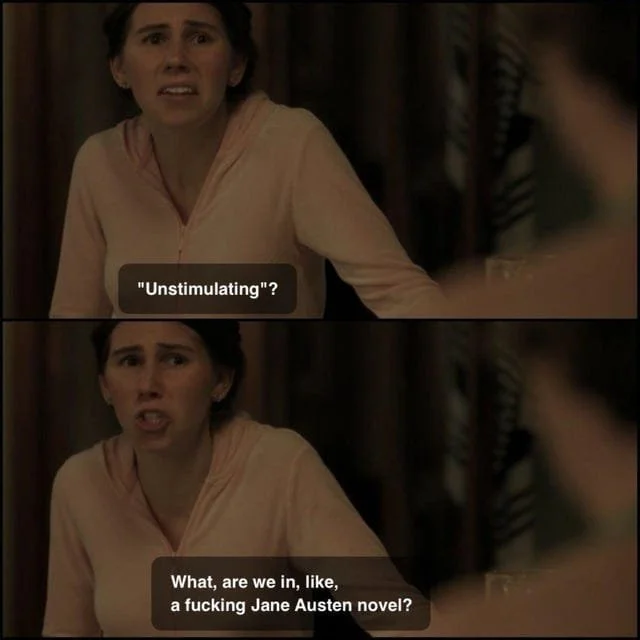
Courtesy of Girls. Via Pinterest.
Another character who suffers from the show’s reluctance to develop its ideas fully is Vladimir’s wife, Cynthia.
Cynthia exists largely within the confines of a familiar archetype: the inconvenient spouse whose mental health struggles make her a burden to the more dynamic male protagonist, thus motivating his infidelity. Cynthia is socially awkward, emotionally fragile, and recently sober. Her struggles with mental illness shape much of how other characters perceive her.
The narrative repeatedly positions her as someone who makes Vladimir’s life more difficult. At one point, Vladimir even frames her suicide attempt as a form of abandonment — an act that forced him to shoulder additional responsibilities as a husband and father. This framing is revealing, as it suggests Vladimir’s role as the understanding/loving husband is more of a performance than we thought, but the show never interrogates it.
The most interesting thing Cynthia does occurs during a brief interaction with M. Despite M’s awkward attempts to cultivate a friendship with her, Cynthia initially keeps her distance. But in a moment of solidarity, she helps M destroy evidence that could be used in the Title IX investigation. For a brief moment, the show seems poised to explore the possibility of a complicated alliance between these two women.
But the storyline disappears almost as quickly as it appears. M’s growing obsession with Vladimir quickly eclipses any potential exploration of female companionship.

Jessica Henwick as Cynthia. Via MarieClare.
Ironically, the subplot involving John’s Title IX investigation is significantly more compelling than the central romance.
John’s relationships with undergraduate students are repeatedly framed as affairs rather than abuses of power. M herself appears largely unfazed by the revelation that her husband has been sleeping with students for years. She knew he was unfaithful and simply chose not to care. This was their “arrangement.”
When the investigation begins, she immediately adopts his defense. Her argument is familiar: the students were adults. Everything was consensual. Technically speaking, this may be true. But the argument also reveals a deeply troubling way of thinking about power.1 Just because two individuals are adults does not mean they occupy equal positions within a relationship. A professor holds enormous influence over a student’s academic future: grades, recommendations, research opportunities, and scholarships can all hinge on that relationship.
The imbalance is obvious to the students themselves. At one point, students directly question M about this dynamic. Her response is startling in its casualness. Is anyone ever truly equal in a relationship? she asks. It’s a rhetorical maneuver that reframes the issue entirely (I hate to say “moving the goalpost” ‘cause I’ll sound like such a debate bro, but that’s what it is). By suggesting that perfect equality is impossible, she implicitly argues that power imbalances are simply part of human relationships. She reminds us that “it was a different time,” and that when she was a college student, it was actually really cool to sleep with your professor.
M’s role as the “Title IX Wife” frames her ethics. She functions as a textbook example of a phenomenon that rarely gets named: the woman who defends her man through allegations of misconduct, and in doing so, becomes complicit in these very abuses.
I’ve always found this interesting and have even considered writing a play about something like this — a woman whose husband faces allegations, she defends him, and what the aftermath of that is. Would she rather defend him and stay ignorant or know the truth and leave him? M does the secret third option: publicly standing by John AND exhibiting similar behaviors (which I’ll elaborate on shortly).
M positions herself not as a voice of ethical conscience, but as an enabler, offering justification for her husband.
The “Title IX Wife” is a familiar figure in both fiction and reality. She is the partner who refuses moral scrutiny because her loyalty has become transactional: defending the man she loves is more important than interrogating the harm done to others. In M’s case, her complicity is compounded by her sexual obsession with Vladimir.
The show does not interrogate this, though. Instead, we are asked to cheer, empathize, or even fantasize alongside a woman who aligns herself with predatory behavior. Netflix’s Instagram captions about the show say it all: “The mothering of Rachel Weisz is upon us.” I’m not perfect — I have called Lydia Tár “mother” more times than I can count — but I’m not sure if this is the way to market a character who is a rape culture apologist.
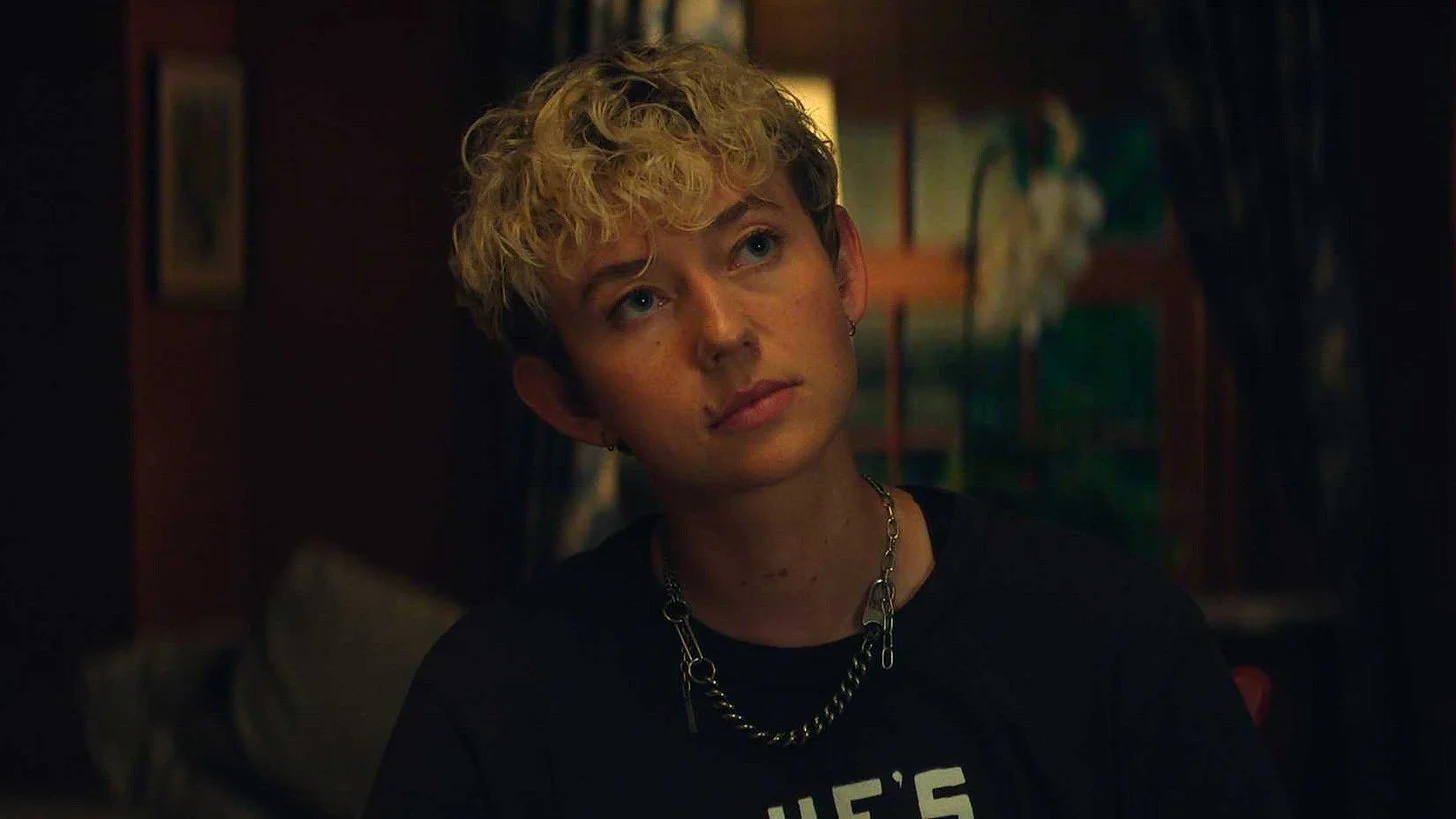
Ellen Robertson as Sid. Via ScreenRant.
The show’s other intriguing but underdeveloped storyline belongs to Sid, the 27-year-old daughter of M and John. Sid enters the narrative almost like an interruption. She exists largely outside her parents’ carefully constructed academic world, living in the city and maintaining a separate life.
When she discovers John’s investigation, she reacts with visible distress. But the distress does not read as the grief of a close family imploding. Instead, it feels like the shock of being forced back into a family dynamic she had already distanced herself from.
Sid is volatile, impulsive, and emotionally unpredictable. Her relationship with her girlfriend is unstable, and she eventually admits to having cheated. These details hint at a deeper story. If M and John represent a world of intellectualized morality, Sid appears to embody its emotional consequences. She is what happens when you grow up inside a family that rationalizes everything.
Because Sid is a lawyer, she becomes directly involved in helping her father navigate the Title IX investigation. She reviews documents, explains legal procedures, and helps him prepare for testimony. And with that, something resembling reconciliation begins to take shape. Sid spends time with her father, engages with her mother, and appears more integrated into the family than she has likely been in years.
But the closeness turns out to be conditional. Sid’s role in the family exists because there is a problem to solve. Once the legal process approaches its conclusion, that role disappears. Before the verdict is delivered, Sid leaves, telling her father that he doesn’t need her there for that part.
What she seems to be saying is that she was willing to help him survive the legal process, but she is not willing to stand beside him for the moral reckoning that follows. She returns to the city and reconciles with the girlfriend she previously cheated on, a resolution that unfolds largely offscreen.
Sid’s storyline ultimately feels like a fragment of a much larger narrative about the generational impact of the way M and John intellectualize their moral compromises. Sid lives inside the emotional instability those compromises produce. In another version of Vladimir, she might have been the character who forced the story to confront its ethical contradictions. Instead, she disappears before that confrontation can occur.
And, in the final episodes of Vladimir, things take an even stranger turn.
M invites Vladimir to lunch. When he attempts to leave, she tells the waiter to hold the check so they can continue talking. She then invites him to her upstate cabin, claiming that there is no cell reception or Wi-Fi there. Once they arrive, she drugs his drink. He wakes up the next morning chained to a chair. M claims that Vladimir had previously expressed interest in being sexually dominated and that they both passed out before anything actually happened.
If I may… what the hell?
What began as a restrained erotic drama suddenly becomes a story about kidnapping. And yet the show refuses to treat the moment with the gravity it deserves. Vladimir does not react with fear or anger. Instead, he later sleeps with M as though the entire situation were merely awkward rather than criminal.
The escalation reaches its peak when John suddenly arrives at the cabin. What follows is the kind of confrontation the show has been circling all season: husband, lover, and protagonist finally forced into the same space.
But even here, Vladimir manages to sidestep the emotional and moral implications that it has spent eight episodes building toward. The men argue once Vladimir discovers that John has been doing drugs with Cynthia (who, you know, is sober… was). M, too, accused Cynthia and John of having an affair, which turns out not to be the case. But instead of working any of that out, both men, standing in the aftermath of a situation that should have completely detonated their relationships with M, proceed to present her with competing visions of the future.
John offers what reads as a desperate attempt at restoration. He promises to recommit to their marriage and to monogamy. The implication is that the chaos of the investigation and the threat of losing his career have finally forced him to reconsider the life he has been living. How sweet! All it took was a few decades of sleeping around to figure that out!
Vladimir’s proposal, meanwhile, is almost comically transactional. Instead of romance or reconciliation, he offers M a kind of standing arrangement: a once-weekly sexual meeting, stripped of emotional obligations or domestic entanglements. This would be one thing if Vladimir were just some guy on the outskirts of M and John’s open marriage. But Vladimir is a coworker with a suicidal wife and toddler.
It is an oddly clinical moment. The men are not fighting for M so much as presenting competing lifestyle options. And yet the show refuses to let the scene develop into an actual decision.
Before M has to choose between them or confront the implications of what she has done, the cabin catches fire, because of course it does. Instead of resolving the conflict, M simply walks away from the burning cabin, abandoning both men inside and effectively removing herself from the consequences of the entire situation.
And I get it: it’s a metaphor. The protagonist literally exits the scene of destruction, leaving everyone else behind. I’m so bored. Let actions have consequences!

Via FandomWire.
In theory, this moment might have functioned as a powerful statement about M’s character. After eight episodes of watching her rationalize her husband’s behavior, pursue an ethically dubious obsession, and ultimately cross the line into outright coercion, the fire could have served as the moment where everything collapses around her. But the show once again avoids the reckoning it has set up.
The pattern becomes impossible to ignore. Throughout the series, every character finds a way to rationalize or escape the moral implications of their actions. John reframes his relationships with students as consensual affairs, and his Title IX is dismissed. M defends him while simultaneously pursuing her own ethically compromised obsession. Vladimir shrugs off behavior that should be deeply alarming. Sid withdraws from the family before she has to confront the investigation's outcome.
In the end, Vladimir seems deeply conflicted about what it wants to say. The show repeatedly raises questions about power, but every time those questions approach a genuine moral reckoning, the narrative retreats into ambiguity. Perhaps that is the most revealing aspect of Vladimir. Beneath its attempts at erotic intrigue, the series becomes an accidental portrait of a particular academic pathology: the ability to intellectualize anything.
Ultimately, Vladimir is a series that promises sensuality, chaos, and catharsis. However, what it actually delivers is a concept of eroticism that falls short. Instead of leaving viewers with the complexity of a pro-antagonist or exploring consequences, the show consistently defends M’s actions. The Title IX Wife becomes a predator herself, yet Netflix portrays this as “unhinged” and a form of “mother” behavior. While I am supportive of the “good for her” narrative in film and television, and I will always root for characters like Amy Dunne and Carrie White (and, obviously, Lydia Tár), I must draw the line when “good for her” and the unhinged girlboss tropes devolve into actions like roofying a coworker. In such cases, I will pass.