Why Is 'Heated Rivalry' So Sexy?
By Carolina Dionísio
About a month ago, someone published the following on Reddit: “Is Heated Rivalry even that good? I keep seeing hetero girls obsessed with it.” The post garnered around 300 replies, most of which centered on two recurring themes: consent and masculinity.
What immediately caught my attention was the use of the word hetero, as if a show about two gay men could only ever appeal to the queer community. While distasteful, it also prompted a deeper question: why are heterosexual women so obsessed? The answer lies in a third, almost invisible reason: power.
Heated Rivalry has officially turned the internet upside down.

Courtesy of HBO Max
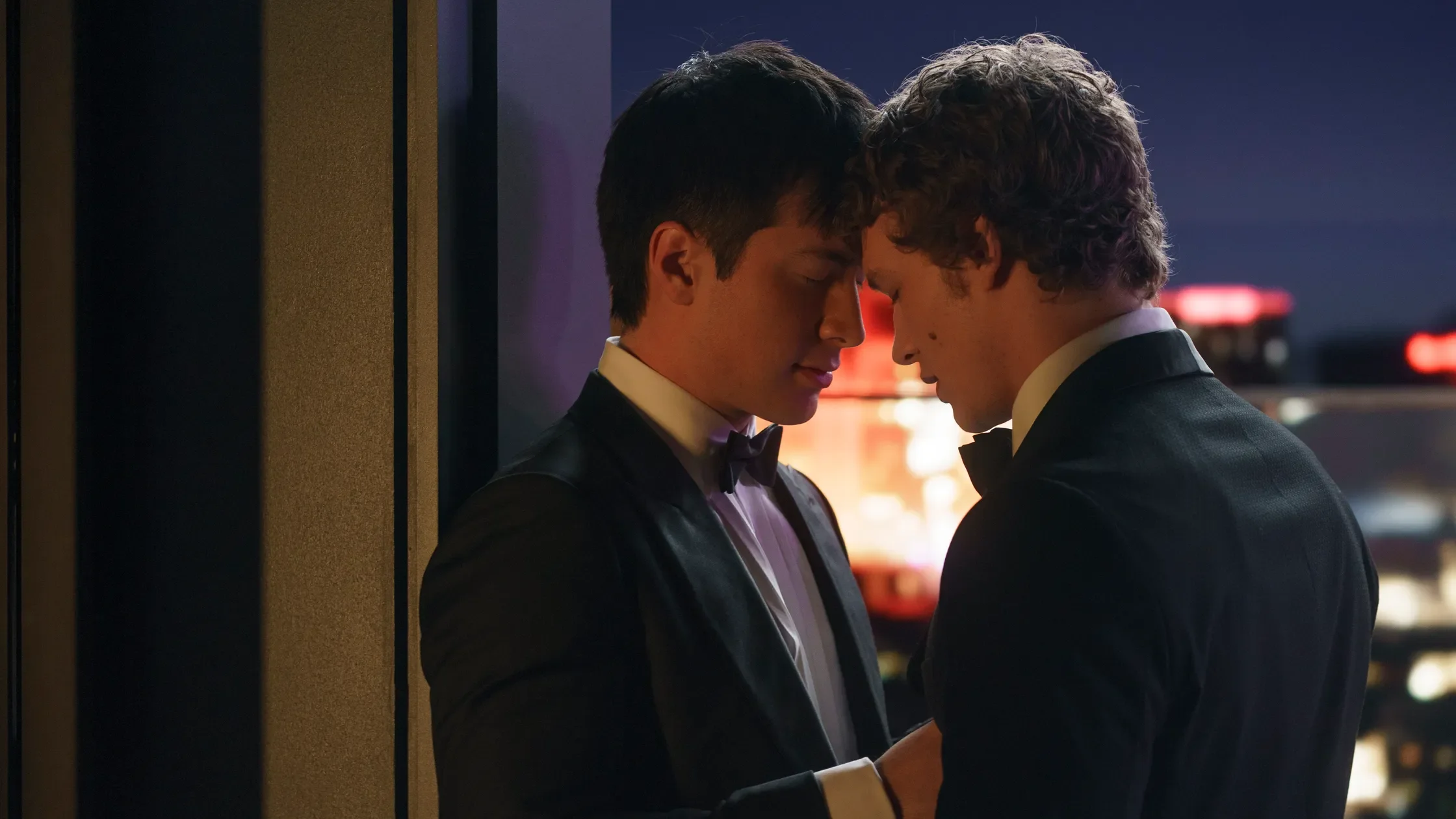
Based on Rachel Reid’s Game Changers novel series, Crave’s hit show follows two professional hockey players: Canadian Shane Hollander (Hudson Williams), captain of the Montreal Voyageurs, and Ilya Rozanov (Connor Storrie), a Russian star for the Boston Bears. On the ice, they are sworn rivals; off it, they hide a secret, passionate romance.
Directed by Jacob Tierney, the six 40-minute episodes were enough to catapult both the characters and the actors into overnight fame. Just two months after its release, nearly every corner of social media has encountered the show in some capacity. Williams and Storrie even performed a comedic bit live from the Golden Globes stage and were later “honored” with carrying the Olympic Flame for Milano Cortina.
The series delivers a diverse cast, sports drama, tension, romance, and a generous share of steamy scenes—so thoughtfully choreographed that I found myself stopping in genuine surprise. Why? Because Heated Rivalry centers on something rarely developed with care: consent.
The Globe and Mail published an article titled “Heated Rivalry proves that consent is sexy,” and they couldn’t be more right. Consent is sexy, and Chala Hunter, the intimacy coordinator behind the show’s most intimate moments, makes that abundantly clear. These sex scenes have depth and dialogue—elements still surprisingly rare in queer media, or media in general.
“It feels important and exciting because it’s about representation. The story is ultimately about celebrating that with these characters,” Hunter told ELLE. “I’m really proud to be a part of a story that is pushing that forward.”
Before becoming an intimacy coordinator, Hunter was an actor herself and had participated in numerous intimate scenes. When productions began approaching her for guidance during the rise of the #MeToo movement, she initially hesitated. Instead, she chose to further her education, training with Intimacy Coordinators and Directors International, the largest organization certifying intimacy professionals worldwide.
This is exactly the level of dedication we need when navigating intimate spaces on screen.
It is crucial to break the stigmatization and poor sexual representation often found in LGBTQ+ media without erasing sexuality altogether by portraying characters as sanitized or prudish. Hunter’s work establishes boundaries while returning full agency over the body to the performers, modeling what healthy sexual communication actually looks like.
When Jacob Tierney first contacted Reid after reading a Washington Post article about hockey romances, he was already listening to the audiobook and eager to explore adaptation possibilities. Still, he questioned whether the story could retain the books’ sexually explicit content on screen.
Although queer romances like Netflix’s Heartstopper had surged in popularity, Tierney had no interest in softening the narrative to match a more chaste tone. He wanted a real relationship—unfiltered, imperfect, and honest. “The thing that is so fundamentally different in Heated Rivalry is sex,” he said. “And so I was like, ‘Okay, will anyone want this with that?’”
For Tierney, sex was inseparable from character development. Yet when pitching the show, he and co-producer Brendan Brady received studio notes suggesting they “fundamentally change the story or the tone.”
“It’s not just a random sex scene in every episode,” Tierney explained. “The characters learn about each other and themselves through this.”
Still, when a show centers queer characters—one of whom is of mixed background—and places them in a traditionally hyper-heterosexual environment like professional sports, there is little room in the industry for nuance, let alone explicit intimacy that challenges convention.
After the overwhelming success of the Fifty Shades franchise (2015–2018), audiences grew accustomed to sex scenes that were silent, aggressive, and chaotic. This portrayal is dangerous. Sex does not need to be a rollercoaster, and it certainly should not be silent or communicated solely through dominance.
It is okay to slow down. It is okay to speak. Shane and Ilya show us exactly that.
Courtesy of HBO Max
Their intimacy is sometimes messy and frantic, other times slow and tender. They ask questions. They check in. They hesitate, confirm, and ask again. This, perhaps more than anything, explains why so many heterosexual women are drawn to the show, because, for many of us, consent has never looked like this.
Too often, consent is treated as something implied or permanently granted, like a subscription you sign up for once and never revisit. Sex becomes transactional: If I do this for you, you owe me that. Desire becomes obligation.
Shane and Ilya represent something the entertainment industry is afraid to portray honestly. Not just because they are queer, but because explicit, verbal consent disrupts traditional masculine ideals. If this were placed in a mainstream heterosexual blockbuster, many men—raised on pornography and unchecked entitlement—would reject it outright. To them, reassurance is unnecessary, rejection is inconvenient, and consent is overrated.
Studios know this. And because they need box office returns, they would rather cut to a gratuitous close-up than spend time modeling respect.
So Heated Rivalry becomes fantasy—not because of its sex, but because of its equality. Consent that is spoken without shame. Desire that is mutual and affirmed.
The show is undeniably sexy, but its eroticism is rooted in genuine romance that transcends physical attraction. Yes, the chemistry is electric, and yes, the leads are beautiful, but there is far more happening beneath the surface.
Which brings us to masculinity.
Shane and Ilya dismantle the tired archetype of the emotionally unavailable man. Contrary to what many writers seem to believe, women are not drawn to coldness—we are drawn to yearning. To vulnerability. To men who can articulate emotion without fear.
Rozanov and Hollander’s tension stems not from indifference, but from pressure: hiding their sexualities within a ruthless sports industry. Rozanov, a Russian celebrity, fears retaliation from his home country. Hollander, meanwhile, wrestles with his own uncertainty and self-discovery.
Yet we watch them grow. We root for them. We learn alongside them.
Williams has shared that closeted professional athletes have reached out to the cast and to Reid since the show’s release. Former multi-league hockey player Jesse Kortuem recently credited Heated Rivalry with inspiring him to come out publicly. That impact is monumental.

Courtesy of HBO Max
The show offers young men an alternative to the toxic masculinity that still dominates locker rooms. Through Shane and Ilya, masculinity is reclaimed not as dominance, but as emotional honesty. They cry. They hesitate. They wait. They reassure. They long. They grow. And that is powerful.
Which leads us to the final, invisible thread tying everything together: power.
Heteronormative relationships are shaped by deeply ingrained power imbalances between men and women—so normalized they often go unnoticed. Men are expected to lead, fix, and provide. Women are expected to accommodate, nurture, and follow.
Not here. In Heated Rivalry, vulnerability, responsibility, and authority are not gendered. The relationship is built on equality.
This is why the show resonates so strongly with the female gaze. It offers a rare depiction of a partnership where no one holds inherent dominance—physically, emotionally, or socially.
Both Shane and Ilya lead. Both yield. Both apologize. Both succeed. Both cry.
They are equals.
Many women have expressed that watching the show feels like seeing their desires reflected at them—not through fantasy, but through fairness.
Unlike traditional rom-coms that center on imbalance or dependency, Heated Rivalry presents a future unconstrained by prescribed roles. One that does not demand marriage or children as the ultimate reward. Shane can be a captain. Ilya can be a celebrity. They can be ambitious, loving, competitive, and soft—all at once. And even if they are fictional men, they embody the kind of equality we long to live ourselves.
Heated Rivalry opens a new door for queer media and for healthier depictions of intimacy. It proves that consent enhances desire, that masculinity can be tender, and that representation does not have to be limiting to be powerful.
It is not just about sex, queerness, or hockey. It is about the right to exist fully—without masks, without restriction—while doing what you love.
If more creators took this risk, how much richer could our stories become? And how much change could follow?