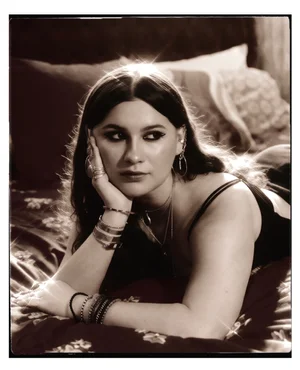
1984 Reimagined
By CG Morand
Imagine you are 16 again. You already feel as though everyone is watching you; every conversation, every bad haircut, every stupid comment you’ve ever made is being dissected under a microscope. That is the beautiful anarchy of adolescence. Now, imagine this feeling isn’t paranoia, but a reality.
All the school field trips, failed tests, and friend outings. Every mistake and every awkward phase. A camera lingers everywhere you go, documenting your life before even having the chance to figure out who you are. Not only that, but millions of strangers are watching you grow up in real time, commenting on your body, your relationships, and your worth. You never get to make a mistake in private because privacy was never an option.
How would that change the person you become? Would you ever stop feeling as though everyone is watching you?

Credit: @kyliejenner
For Kylie Jenner, that was not a thought experiment; that was childhood.
Jenner was just 9-years-old when Keeping Up With The Kardashians started filming. By the time she was a teenager, paparazzi, fans of the show, and the entirety of the internet felt that her life was as much theirs as it was hers.
This level of visibility did not end when the cameras stopped rolling. Her fame was even more pronounced with her online persona— we all remember King Kylie, and the more intimate glimpses into the social media starlet’s life through Snapchat stories and Instagram posts. Years later, Jenner describes the experience as something she has never truly been able to escape.
On Jake Shane’s podcast, Jenner laments about how suffocating and invasive the paparazzi was at such an impressionable age. “It used to be so insane… The things that they [paparazzi] would say to me and how they would treat me as a child was diabolical. I would be coming out of a thing, and they would be like ‘you fucking slut’”.
Those stories and experiences come from someone who understands, perhaps better than anyone, what it feels like to lose control over your own image. When your life is subjected to the opinion of someone else. Which is why Jenner’s recent partnership has struck such a nerve.
Kylie Jenner’s partnership with Meta glasses has sparked a great deal of controversy. Backlash and protests have not only erupted online, but can recently be seen at bus stops in London. Protesters of the new AI glasses put up a parody ad featuring a skeletal Kylie Jenner with the phrase “we’re always watching” plastered across the screen. Talk about a George Orwell fever dream.
The criticism is not exclusively about celebrity endorsement, but who is delivering the message. Jenner has spent her entire life describing the psychological toll of growing up in the public eye. The now 28-year-old said to Shane, “When I’m in LA, it’s hard for me to leave the house… I think that’s because, honestly, paparazzi… In LA, it’s easier to be spotted.”
Yet, now she is aiding in promoting a technology that makes everyday surveillance easier and more accessible. Beyond the irony of Jenner’s personal history, these new glasses raise eyebrows concerning consent and public safety.
Callie Burch, writing for the Minnesota Daily, reports that Meta glasses could normalize discreet recording in public spaces, leaving people unsure whether they are being filmed without their knowledge. This doubt particularly affects women.
Burch discusses “male pick-up content”, in which men record purposely awkward and clumsy interactions with women intended as flirting. This content is then uploaded online without the women being “hit on” having any say.
For someone like Kylie Jenner, who has endured years of harassment from crazed fans and paparazzi, the hypocrisy of promoting a brand that disproportionately harms women and women’s safety is an understatement. However, for Mark Zuckerberg, the CEO and founder of Meta, this partnership could not be more profitable and fashionable.
In recent years, the world has watched Meta’s founder go through a real glow-up. Since first making a name for himself, Zuckerberg was known as the tech nerd who struck gold by “founding” Facebook (we’ve all seen The Social Network). He dropped out of Harvard, quickly made millions of dollars, and could be seen covered in zinc sunscreen surfing along the California Coast or wearing the same grey T-shirt for years straight.
Though around the 2024 presidential election, Zuckerberg got… cool? And now, has a real interest in fashion. Or at least, he ditched his sunscreen, got a perm, and started wearing a chain. Now, Zuckerberg attends fashion week; he attended the 2026 Met Gala (but skipped the red carpet), and with his new Meta glasses launch, fashionability is a priority.
On an Instagram post, Zuckerberg says that these glasses are intended to be “fashion first, and technology second. Integrate technology into something that is good glasses first.” All in all, he wants to be a fashion diva. Standing next to Kylie Jenner, Zuckerberg certainly suggests he knows where the fashion expertise begins—and ends.
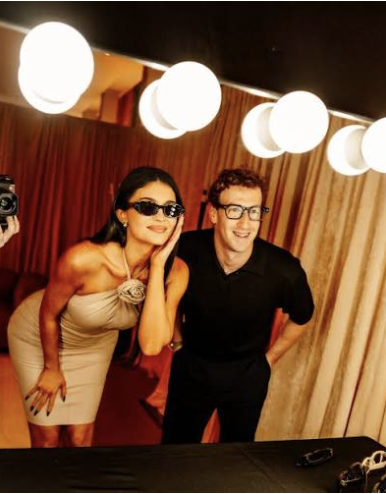
Credit: Rolling Stone
Zuckerberg’s change in appearance and his emphasis on promoting Meta glasses have come at a time when Meta has reported a huge loss in earnings. In 2025, Meta’s Reality Labs division lost $19.2 billion and laid off 1,000 employees. Reality Labs started as the company’s metaverse division; at first focused on creating VR headsets. Though after seven years, and a total operational loss of $90 billion, the company appears to have shifted its focus.
After partnering with Ray-Ban, Oakley, and even talks about collaborating with Prada, Zuckerberg has found a new flagship product: smart glasses for $300 to $400 (which is a comparable price to what someone would already pay for designer glasses), making these glasses far more accessible than the company’s earlier metaverse ambitions.
The glasses’ affordable price point coupled with Kylie Jenner’s endorsement and influence opens up the market for Zuckerberg to attract a new kind of customer: Gen Z.
However, it is uncertain if Zuckerberg’s newest launch will garner as many sales as it has attention from AI skeptics who think that this latest technology will do more harm than good. Especially when it comes to collecting more data and information about its users, and the danger it poses to women going about their day-to-day lives. For example, 28-year-old Cassidy Anderson, who works in digital marketing, says she even feels that the “glasses are more invasive than innovative.”
Whether or not Meta’s gamble on its latest glasses launch will succeed is yet to be seen. However, the conversation surrounding the glasses has exposed a deeper cultural shift. Surveillance is something no longer imposed solely by the government or corporations; it is progressively marketed as a lifestyle accessory.
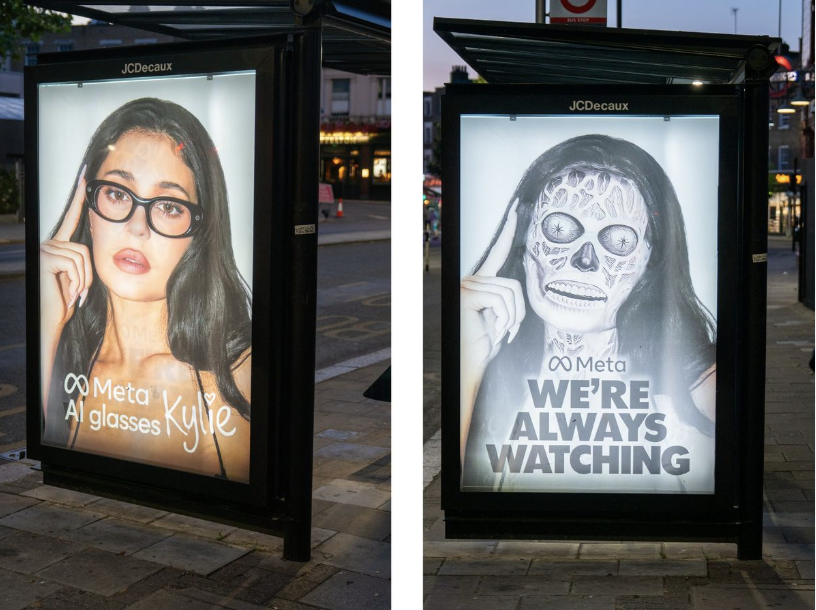
Credit: Hyperallergic
This is what makes the backlash so striking. George Orwell imagined a future in his dystopian novel 1984 where Big Brother watched everyone. Meta’s version is something even more unsettling: a world where people willingly become Big Brother for one another. Cameras no longer exist exclusively on street corners, but they are perched on our faces, wrapped in designer frames, and sold to us as fashion, convenience, and connection.