By Natalie McCarty
If you came across one of Emily Marijka’s paintings while scrolling through your feed, you might wonder when it was made. Her work brings to mind the 1960s, the era of Bob Dylan, Beatlemania, and a generation pushing against the conventions that came before it. Yet the images never feel like straightforward recreations of the past. There is something distinctly contemporary in the way Marijka approaches them, particularly in her depictions of women and the tensions that shape their lives.
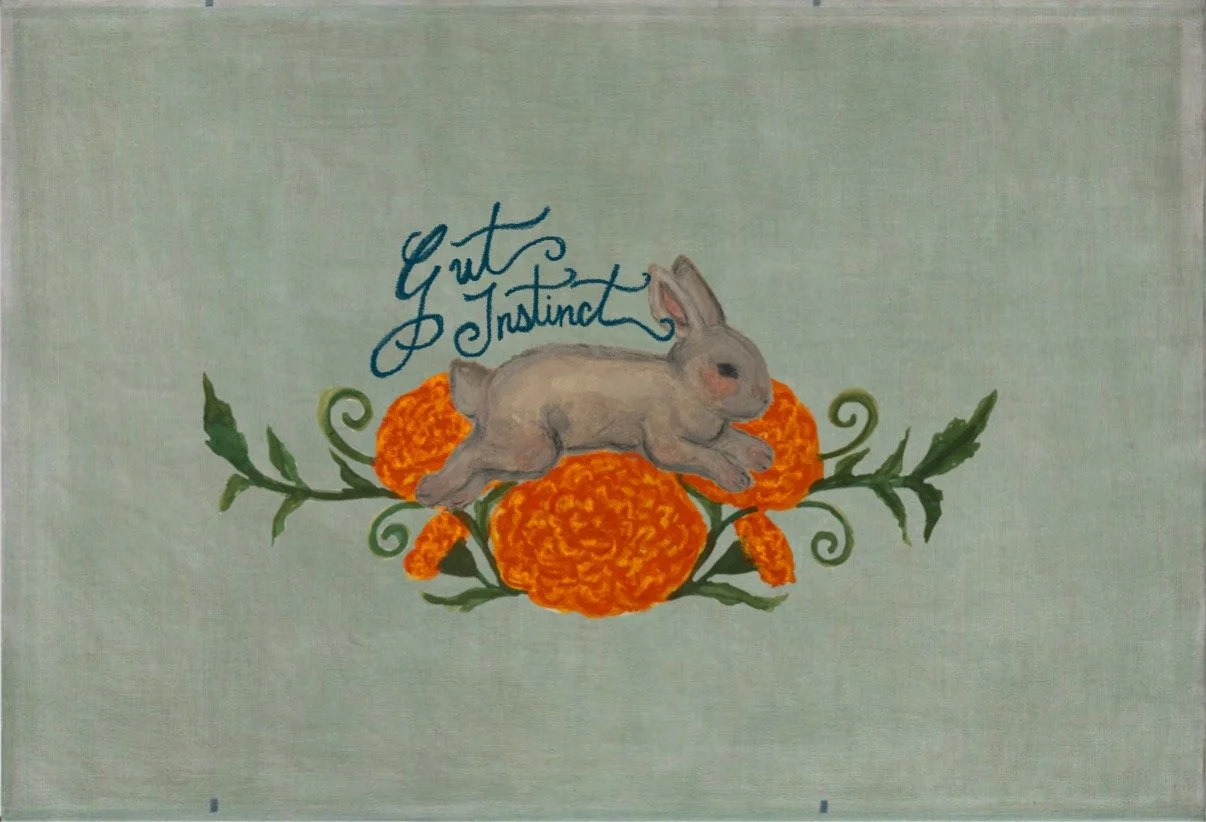
@islandmoore x Gut Instinct Media.
A graduate of Central Saint Martins, where she studied Fine Art, Marijka draws on music, fashion, political history, and the imagery she has encountered throughout her life. Working across oil painting and digital art, she returns to familiar visual references while asking what they can mean to us now.
“As an artist, I believe that I am made up entirely of art that has inspired me,” she says. “No artist can create something entirely original; rather, originality lies in their unique interpretation and personal response to existing ideas.”
Influence, for Marijka, is not something to hide or leave behind. It is the starting point. She is drawn to what she calls “themes of rebellion through creating”, from the musical and cultural shifts of the 1960s to fashion that presents women as liberated, and even to architecture designed to oppress. Though these references come from different places, they share an interest in resistance and in the ways people push back against the structures around them.
“All of these themes speak to my own personal experiences, or have been passed down by generations of women before me,” she explains.
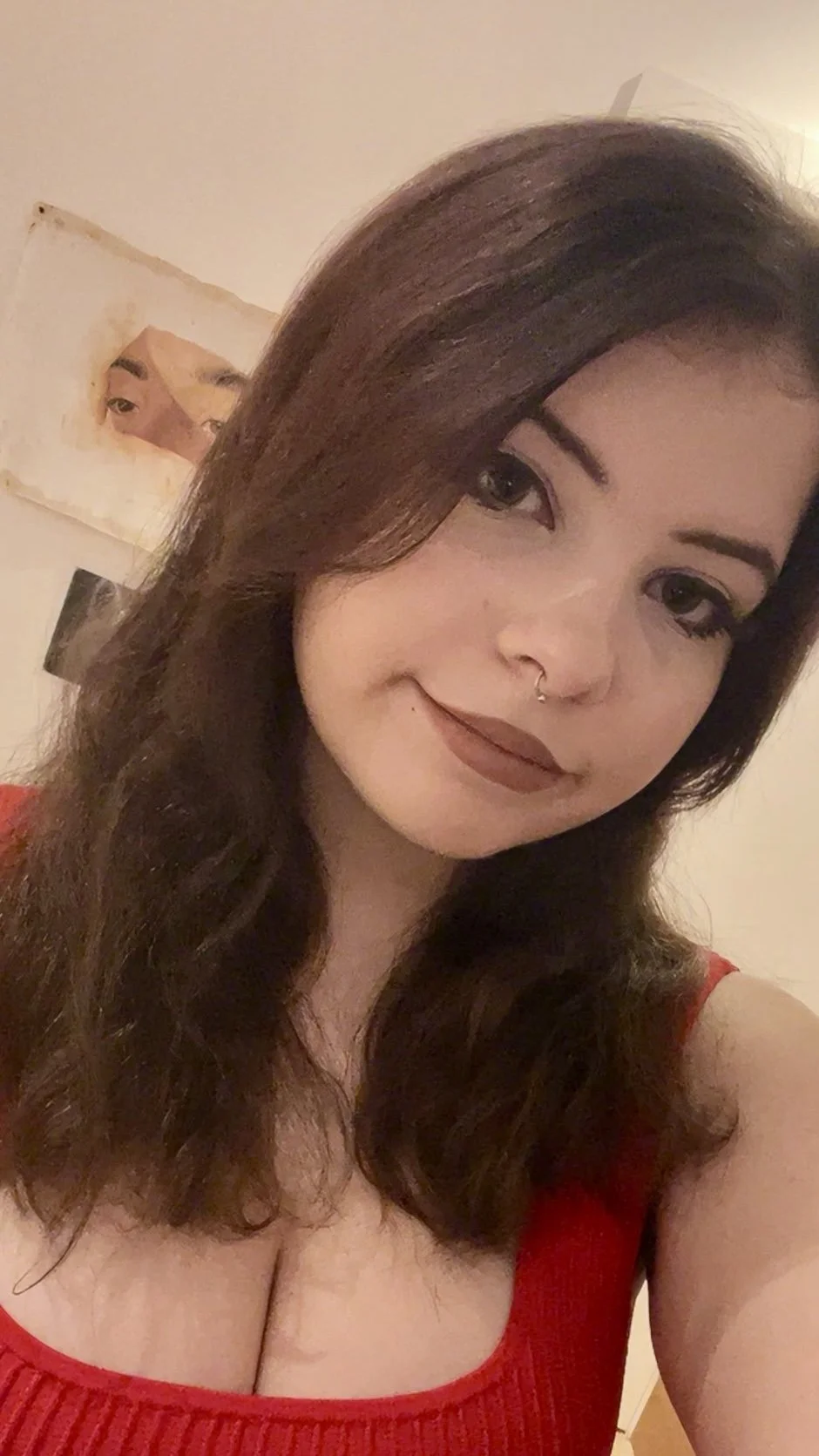
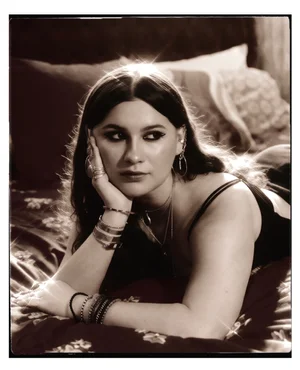
Emily Marijka; Image Provided by @islandmoore.
Her desire to create began long before she developed these particular interests. Art was part of her childhood, and, as she grew older, her love for it only deepened. Making work gives her a way to respond to what she sees and feels, as well as to address what she believes is missing from a conversation.
“I have always felt the need to depict what I see, say what I feel, and create what I believe is missing from the conversation,” she says. “It’s such a cathartic and reflective process that helps ground me and fuel me simultaneously.”
She traces the motivation behind her work to “the overwhelming need to create something beautiful, even out of feelings that are the exact opposite”. It is an idea that helps explain the balance in her paintings: they may draw on the romance of another era, but they are not simply exercises in nostalgia. Beauty can sit alongside discomfort, and an appealing image can hold more complicated feelings beneath its surface.
Much of the work that goes into a painting happens before Marijka touches the canvas. She spends time considering the subject, pose, and composition, adjusting the details until each element feels right. By the time she begins painting, she has already worked through much of what she wants the image to convey.
“When I start a new piece, in terms of actually putting paint to canvas, I have already completed more than half of my process,” she explains. “My paintings are usually always completed in one or two sittings, as I paint quickly and confidently due to all the planning that comes before.”
The paintings may come together in a sitting or two, but the decisions behind them take much longer. As Marijka explains, “Even a seemingly simple portrait has gone through many stages of readjusting so that I feel as though every element I have applied to it brings out their unique essence, but also tells a story beyond what you see.”
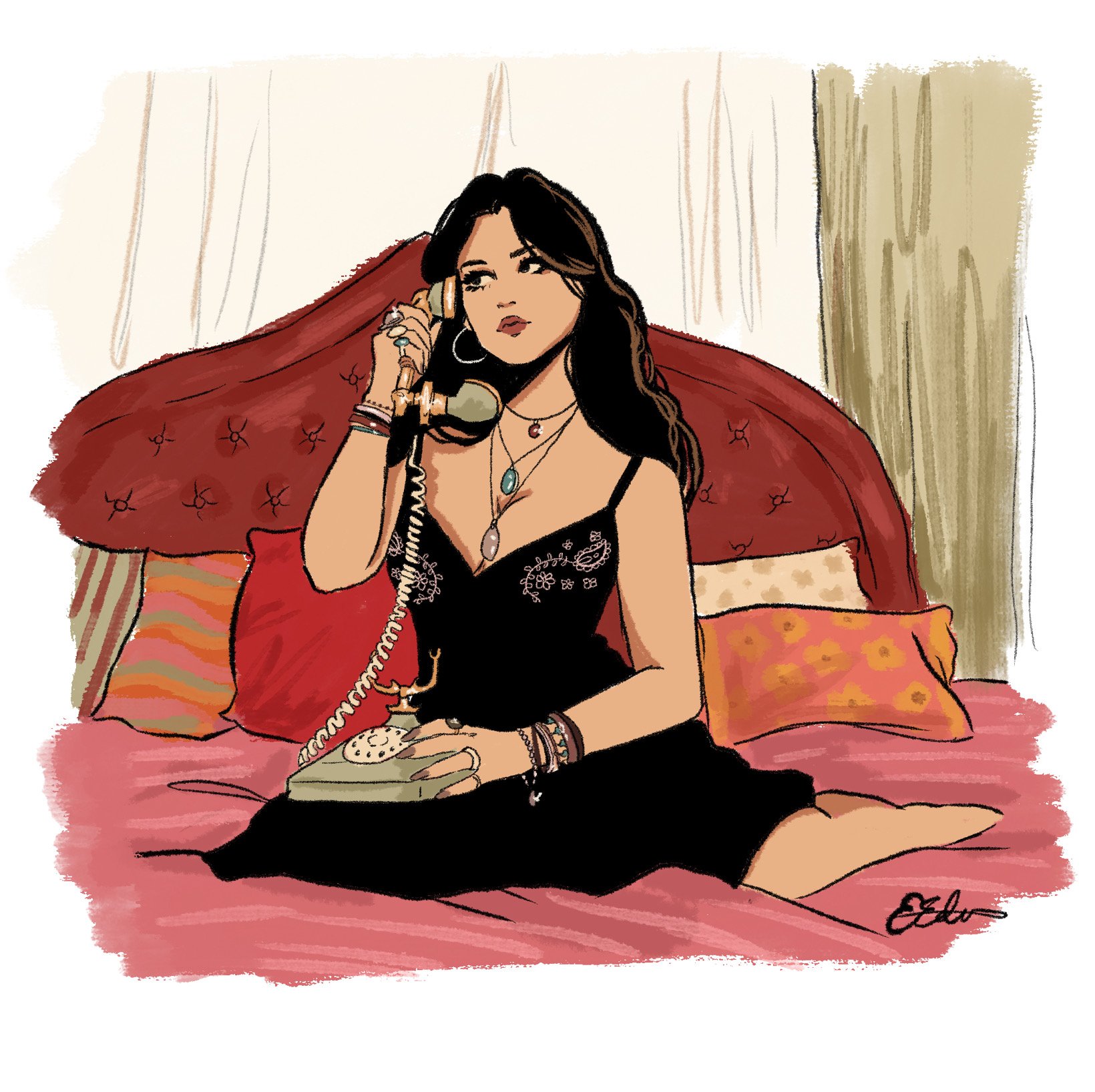
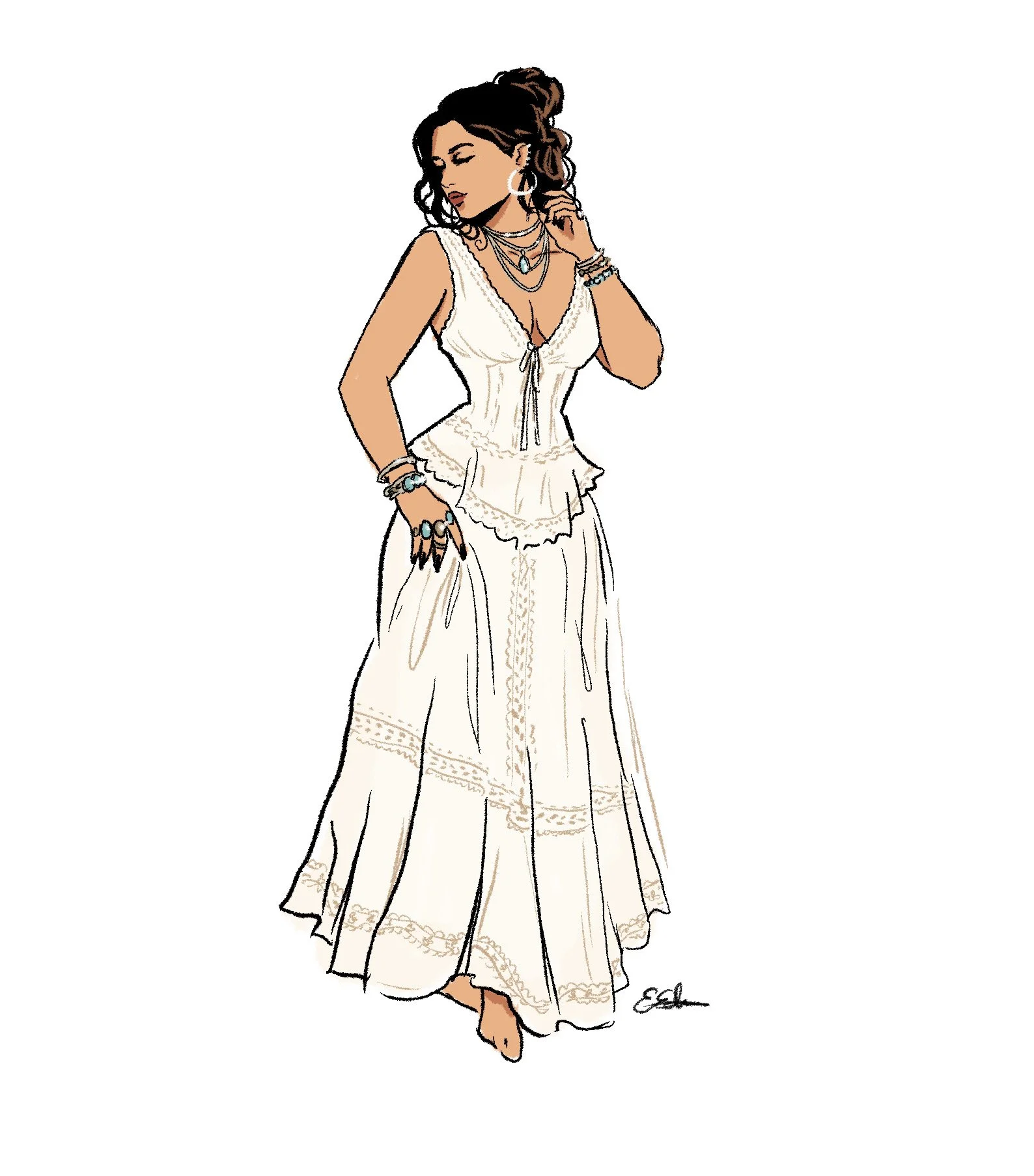
Her digital work develops differently. Rather than spending as much time planning each detail in advance, she tends to start with an image or motif that catches her attention. It might be a vintage sewing pattern, Soviet fashion propaganda, or a photograph of Paul McCartney in an especially eclectic outfit in a Beatles music video. Digital drawing gives her room to experiment, adjust, and follow an idea as it takes shape.
In particular, The Beatles have had a lasting influence on her work, introducing her to ideas around resistance, social change, and challenging established power. She is also drawn to the design of the period, particularly mid-century modernism. Her visual style continues to change as she discovers new artists and ideas, and she sees that willingness to evolve as an important part of being an artist.
“My artistic style is constantly changing and evolving, and I think that’s one of the most important aspects as an artist to really embrace,” she says.
Marijka’s British-Ukrainian heritage brings another dimension to her interest in history. During her studies, she explored Soviet motifs and culture, including Russification, the historical and political process of enforcing Russian language, culture, and political dominance over non-Russian groups. These references are not simply an aesthetic choice. They connect the imagery she uses to questions of identity, inheritance, and power.
“Being a very proud feminist, vegetarian, and advocate for social change has created a powerful and nuanced lens for me to create artwork through, but so has my heritage as a British-Ukrainian woman,” she says. “I use both personal and societal history in order to depict individual yet universal experiences.”
She sees it as important that these different parts of her identity remain visible in her work. “I feel it is desperately important to elevate all these different parts of myself, for my art to truly represent me as a person.”
These influences come together most clearly in her depictions of women. One of her more unexpected points of reference is LeRoy Neiman’s Femlin, a twelve-inch-tall pin-up character that appeared in Playboy for more than fifty years. Marijka does not identify with the publication’s ethics or attitudes, but she has long been interested in the character itself. She admires how Neiman could suggest the female form with just a few brushstrokes while giving the figure enough personality to imply a larger story.
Marijka’s own work offers a response to that tradition. She wants her female figures to have more agency and independence, beginning with a seemingly simple decision: giving them clothes rather than leaving them naked apart from stockings.
“This starts, quite literally, by giving them clothes rather than leaving them naked apart from stockings,” she explains.
She describes feeling “an odd sense of responsibility towards these two-dimensional women: a desire to protect them without making them victims, and to allow them to occupy the image on their own terms.”
For Marijka, that instinct extends beyond the canvas. “Perhaps that instinct is a microcosm of my desire to protect and empower women more broadly, or perhaps, more personally, it reflects my own experience of navigating and protecting myself as a woman in our current society.”
Her figures are not there simply to be looked at; she wants them to feel like people with their own lives and interior worlds. The question is not just how women are represented, but how much space they are given to exist beyond someone else’s expectations.
This concern is central to That’ll Be All (2025), an oil painting that Marijka describes as a defining point in her career. The work centres on dismissal and the power dynamics that can hide beneath ordinary politeness. Its title suggests that a woman has been told her presence is no longer required, with someone else deciding when her participation begins and ends.
“The title comes from what I imagine may have just been said to the woman. She has been dismissed, and someone else is deciding when her presence and participation are required,” Marijka explains.
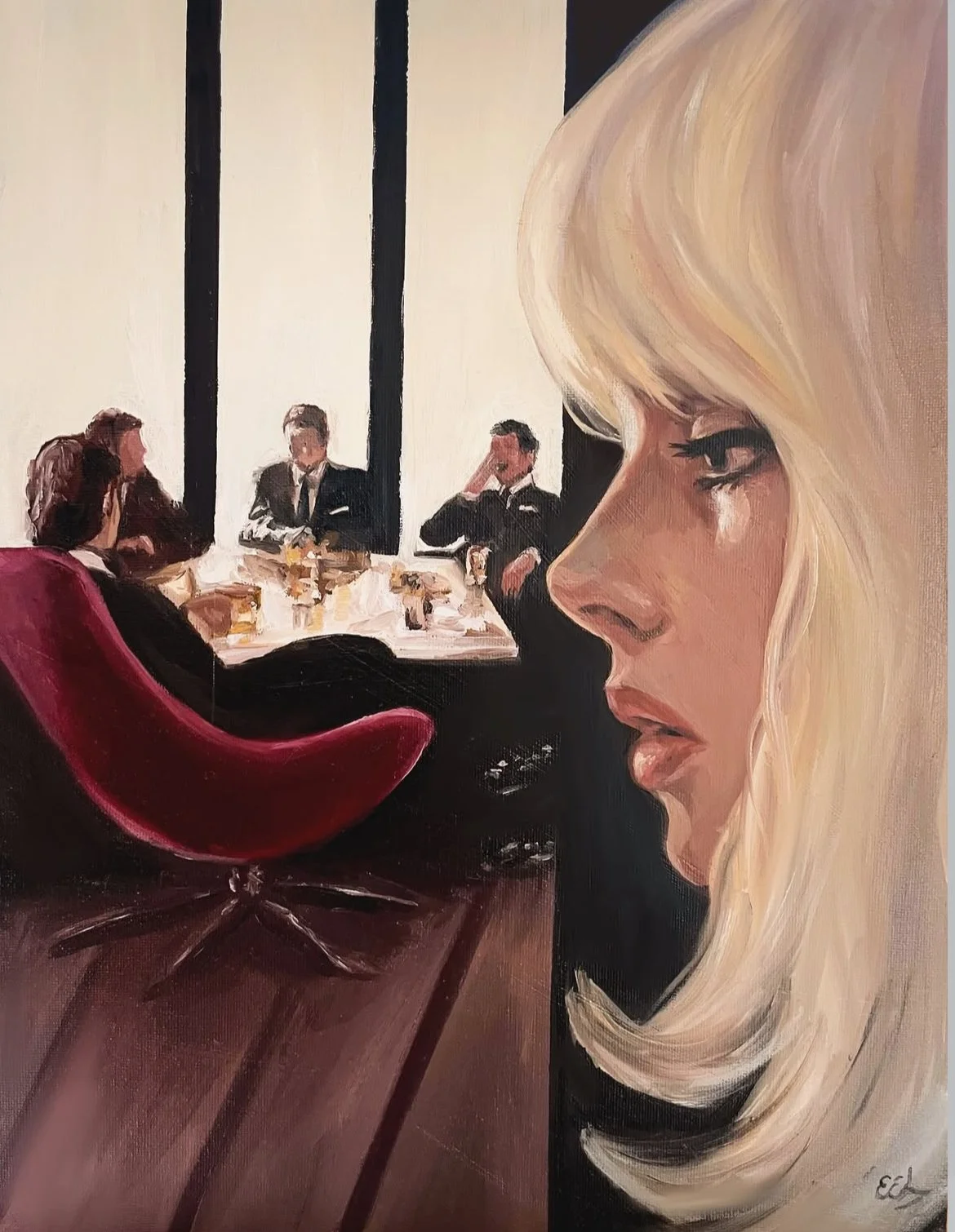
‘That’ll be All’ — Oil on Canvas(2025); Image Provided by @islandmoore.
That’ll Be All is not simply a picture of someone being dismissed, though. The woman looks back, aware of what is happening. Her expression complicates the authority being exercised over her.
“She isn’t presented simply as a victim; she looks back with an awareness of exactly what is happening,” Marijka says. “There’s an assertion in that gaze, even when she isn’t the person controlling the conversation.”
The woman may not have control over the situation, but she has not surrendered her understanding of it. As Marijka puts it, the work explores “the difference between having power over someone and having power over how they see, understand, and respond to that power”.
Her interest in what lies beneath appearances is personal, too. Although her paintings often centre on other people, Marijka sees them as a reflection of herself.
“I love to find the person within my painting— to capture their core, their true self, and the pure nature of their character is what appeals to me the most,” she says. “Perhaps that is because I myself feel some subconscious desire to feel truly seen rather than observed, and so I strive to do so in those that inspire beauty in my world.”
The desire to understand her subjects goes beyond their appearance on the canvas; it speaks to the difference between being noticed and being understood. Her figures may belong to a visual world shaped by the past, but their presence raises questions that remain very much alive in the present.
Across her oil paintings and digital drawings, Marijka approaches these ideas through different styles. She describes her oil work as suited to romantic and nostalgic themes, while her digital drawings allow for a more playful, simplified approach. Both share what she calls a “retro, memory-infused atmosphere”, with a focus on “life, love, and war through a female lens”.
Nostalgia, however, is not the final destination. Marijka also hopes her work leaves viewers with “a visceral feel of the present”. The familiar imagery may draw people in, but what they find in it is not necessarily familiar or comfortable. A painting can evoke another era while asking the viewer to reconsider the assumptions that era left behind.
That question of what makes an image meaningful also informs Marijka’s view of artificial intelligence. She finds it surprising that the arts are often expected to suffer most from AI, although she is clear that generative AI can be deeply damaging to artists and the creative industries.
Her objection is not that art must be created without influence. Her own work is built on a conversation with the music, images, and histories that have shaped her. The distinction, for her, lies in the human experience behind the work.
“I find it surprising that people often think that the arts are going to be taking the biggest hits from the development of AI,” she says. “That isn’t to say that generative AI isn’t intensely detrimental to the arts and artists alike, but rather that art holds and conveys something so extraordinarily human, that its one of the few things that AI could never truly take over.”
She is unequivocal about where she stands: “I don't believe ‘AI art’ is even ‘art’, and authentic artwork is a language only humans can understand, not machines.”
It’s a position that connects with the way she approaches her own practice; Marijka acknowledges the images and ideas that came before her while making something personal from them. The references matter, but so does the person interpreting them: her experiences, her convictions, and the questions she brings to the canvas.
@islandmoore x Gut Instinct Media.
When asked what legacy she hopes to leave behind, Marijka admits she hasn't thought much about it. Her answer brings together many of the ideas that run through her work.
“I don’t suppose I've ever thought much about leaving a legacy behind, but I suppose it would centre on the act of holding hands with the past, present and future simultaneously, allowing them all to have a conversation. I see time more as a spiral than a line, and so I would want my art’s legacy to encompass both nostalgia and moving forward–to bring the beautiful parts of the past into the present–and to use this lens to create a better future.”
It is an apt way to understand Marijka’s relationship with the past. The images and histories that influence her work do not remain untouched; they change as she returns to them, bringing her own experiences and perspective to what she finds.
Her paintings may recall another time, but they do not ask us to stay there in memory. They invite us to look again, to notice what we might have missed, and to consider what familiar images can mean when seen from a different point of view. For Marijka, looking back is not the opposite of moving forward: the two are part of the same journey.