Let the Girls Be Terrible: 'Meet Me in Five' Refuses to Make Its Female Characters Likable
By Reese Carmen Villella
In Becca Carter Freeman’s Meet Me in Five, five college juniors move into their first off-campus apartment and mistake the new address for proof that they have arrived at adulthood. Ingrid, Harper, Lucie, Remi, and Sascha toast to autonomy and the life they will build together. Over the course of a volatile semester, however, hookups, jealousy, ambition, spiritual rituals, a possible haunting, and unspoken trauma begin to fracture the group.
Directed by Emma Garner and produced by Cherubs Productions, the production runs September 10-12 and 17-19 at ARTXNYC. Its ensemble includes Kaci Walfall as Harper, Lilia Buckingham as Ingrid, Shahadi Wright Joseph as Lucie, Isa Barrett as Remi, Maddie Schumacher as Sascha, Adrien Rolet as J, and Kelsey Pietropaolo as Herbert. Buckingham, Barrett, and Schumacher are also among the production’s producers.
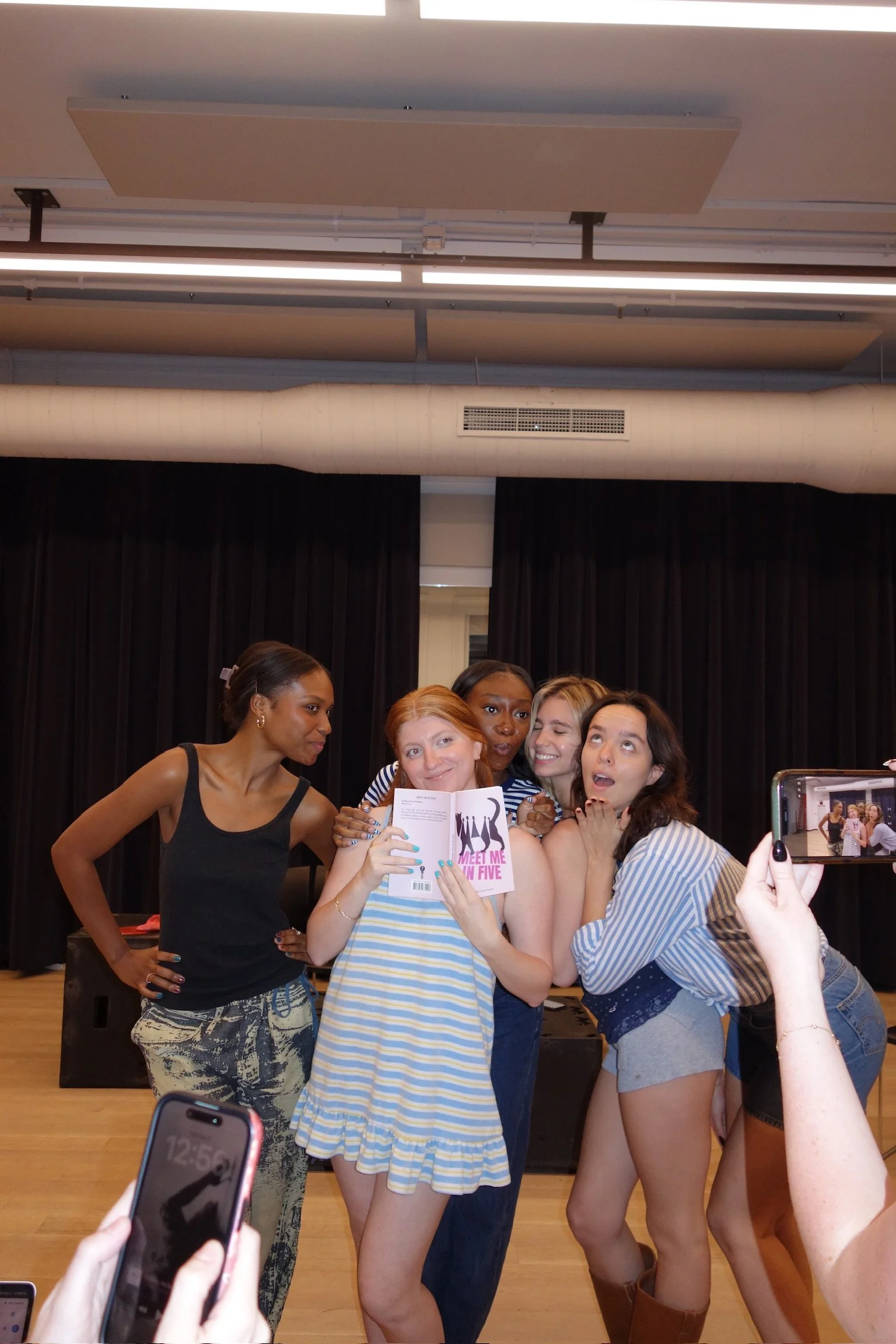
From left to right: Walfall, Schumacher, Joseph, Buckingham, and Barrett
My Interview with the Girls
Before seeing the show on September 12th, I attended a Designer Run and spoke with Kaci, Lilia, Shahadi, Isa, and Maddie about the show.
If you’ve read any of my previous work for Gut Instinct, you know I’m drawn to horror, surrealism, and the unusual, which is why I began my conversation with the apartment’s possible haunting. Although Meet Me in Five never fully crosses into horror or thriller, its reality becomes increasingly unstable. Isa described the surrealist sections as akin to reliving a memory, particularly one shaped by an emotionally complicated relationship.
“When you have complicated relationships with women, where there’s a lot of emotion involved, it can be really easy to forget what really happened and what didn’t,” she said.
As reality fractures, the play shows how memories can warp depending on who is doing the remembering. Each woman constructs her own version of what happened, leaving the truth increasingly ambiguous. The ghost is therefore less a traditional haunting and more a looming embodiment of the women’s anxieties about their friendship and its future.
Sexuality is another central topic in Meet Me in Five, and the play intentionally resists presenting queerness as a single, easily defined experience. Isa was drawn to how each character’s relationship with sexuality is shaped individually rather than forced into a particular archetype. The women are not embodiments of topical ideas; they are college students trying on identities while still “half an adult and half a kid,” Isa said.
I asked why Isa’s character, Remi, is jokingly referred to as the group’s “real gay.” Isa understands Remi’s certainty about her sexuality as a form of overcompensation. After being rejected by Ingrid, whom Isa imagines as the first girl Remi has seriously wanted, Remi turns sexuality into something she can define, defend, and use to judge others. Her confidence disguises a deeper insecurity about herself.
Lilia connected Ingrid’s story to compulsory heterosexuality and the pressure to organize her future around men. Although Ingrid tries to perform that expected version of adulthood, her feelings for Remi keep disrupting it. As a lesbian herself, Lilia said she recognized Ingrid’s struggle to distinguish what she genuinely wants from what she has learned to perform for men.
The other women’s stories further complicate any single idea of sexual freedom. Harper’s sexual reputation threatens to become her identity. Sascha is male-centered, but her desire, intentions, and actions become painfully misaligned as her mental health deteriorates. Lucie, newly outside a five-year relationship, discovers autonomy partly through a private sexual life she does not immediately share with her friends. Shahadi sees Lucie’s private sexual life as part of that search for autonomy. After recognizing how much she compromised herself for a man, Lucie chooses freedom without asking her friends to validate or approve of that choice.
The company repeatedly returned to the ugliness the play permits its characters. Kaci said Freeman is not interested in the now-familiar shorthand of “female rage.” Meet Me in Five rejects the polished pop-feminist fantasy in which women wear pink, talk about pegging the patriarchy, and disappear into a Barbie-pink sunset while Taylor Swift’s “The Life of a Showgirl” plays in the background. Its characters are embarrassing, hysterical, needy, judgmental, sexual, and unkind. They turn against one another, cause real harm, and are not always easy to defend.
Crucially, the play does not frame those imperfections as proof that the women are undeserving of empathy or that their love for one another was false. It lets them be fully human without turning every mistake into either an empowering act or a moral lesson. “The beauty of this show is how, for lack of a better term, ugly these girls get,” Kaci said. “There are moments that are not pretty, but they’re just so human.”
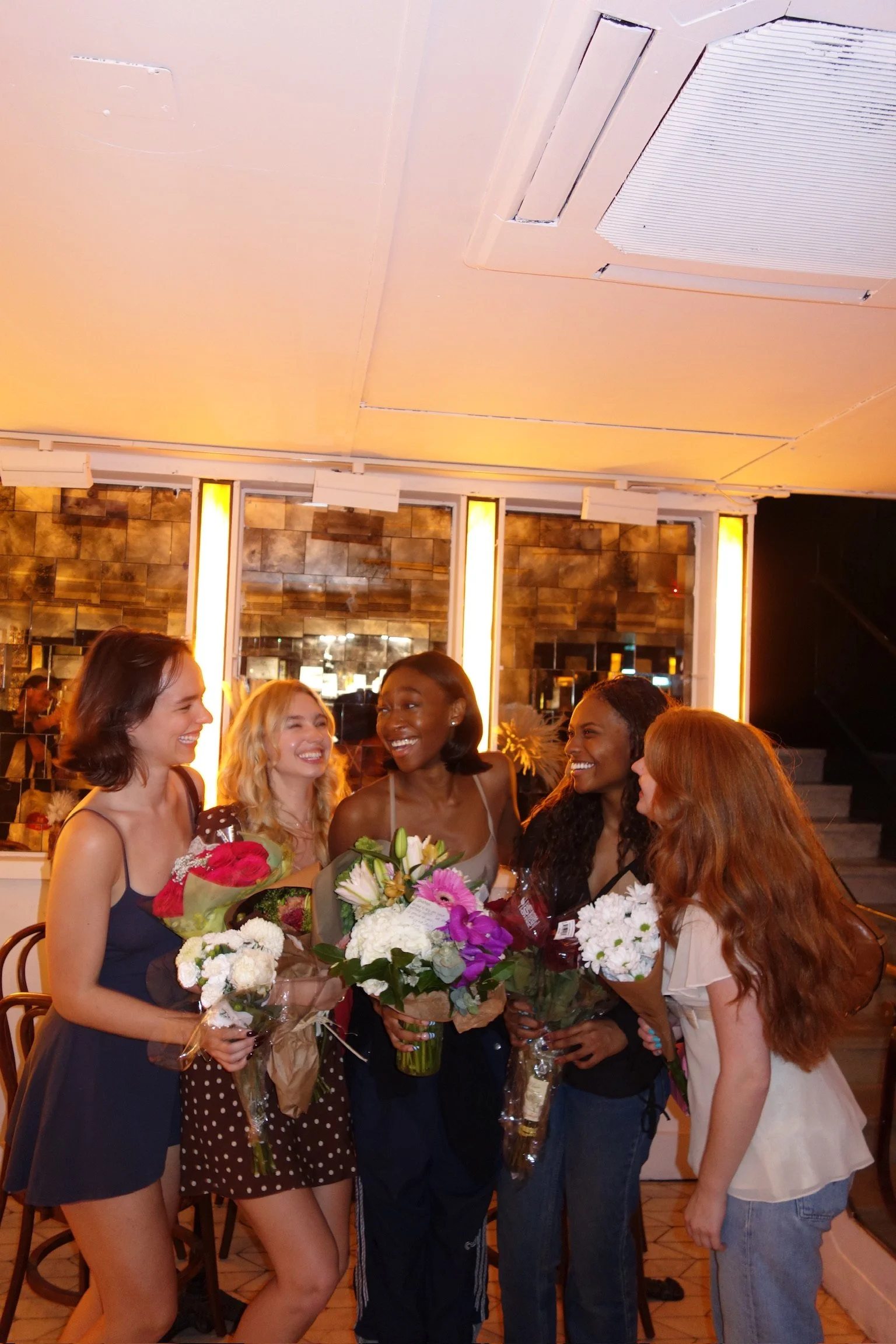
On select nights, Meet Me in Five does not end when the actors take their bows. ARTXNYC gradually transforms into a nightlife space where audience members can drink, linger, and continue engaging with the community surrounding the production. Kaci and Isa explained that the idea was partly inspired by London theatre culture, where audiences often stay at the venue for hours before and after a performance rather than leaving immediately after curtain call.
The premiere is intended as a beginning rather than a self-contained endpoint. The play is being published, and the company hopes other young theatre artists will eventually perform it. During our conversation, they also discussed a film adaptation as one possibility they have been exploring. Leaving the apartment could offer greater insight into who these women are outside the group and how differently they move through the world when they are not constantly reflected through one another. “It really feels like the beginning of something intangible,” Isa said. “I’m just excited to see where this takes all of us and how this story gets to keep going.”
For now, however, the production uses its single setting to its advantage. Inside the apartment, the women can believe their shared lives constitute an entire universe. The audience watches that universe form, collapse, and survive only through their competing memories.
My Review of The Show
On September 12, I was lucky enough to attend Meet Me in Five with one of my best friends. The experience begins before the play itself. Upon entering ARTXNYC, audience members are met with a carefully curated extension of the production’s aesthetic: a Cherubs Productions photo backdrop, copies of the play available for purchase, and candy courtesy of BonBon.
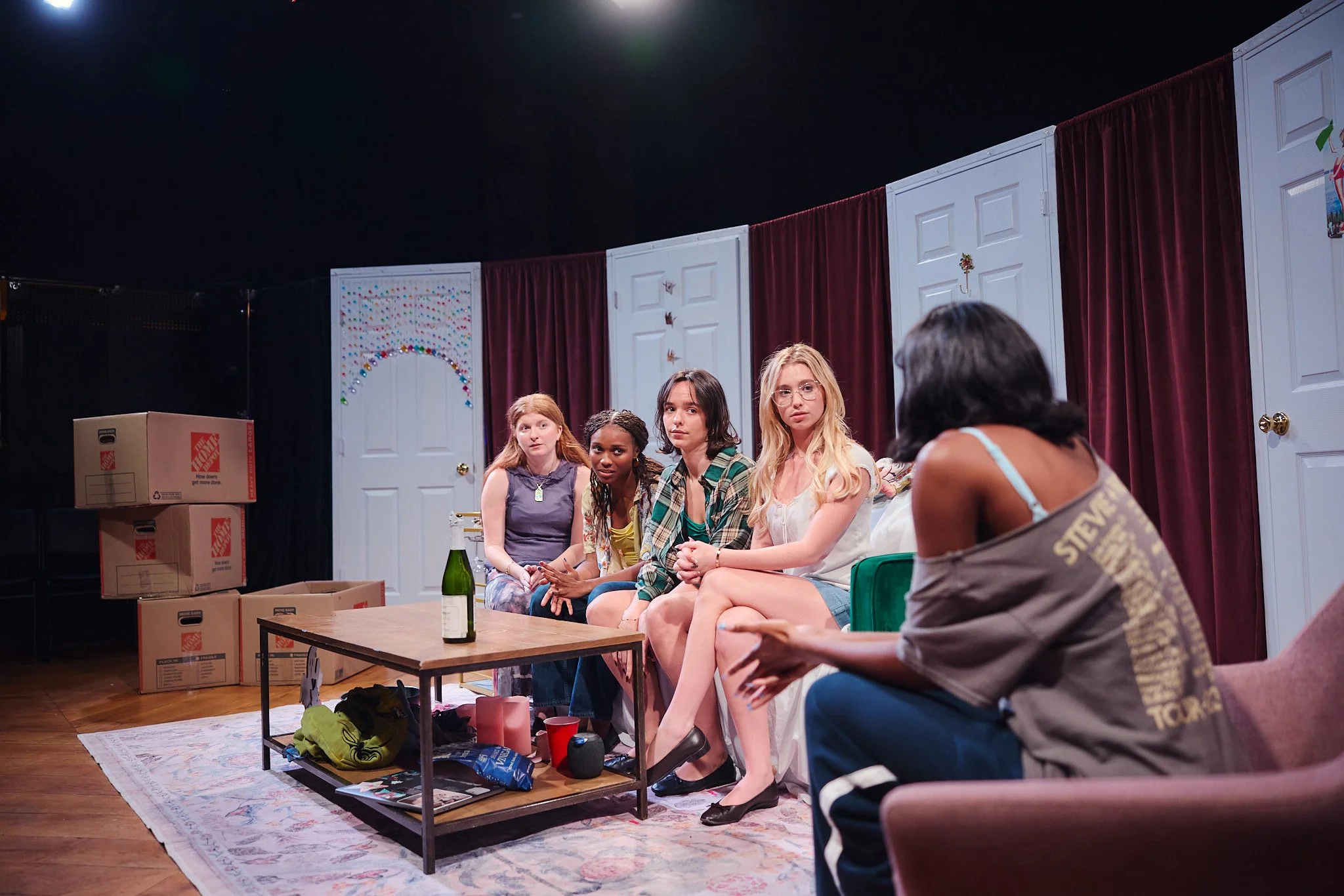
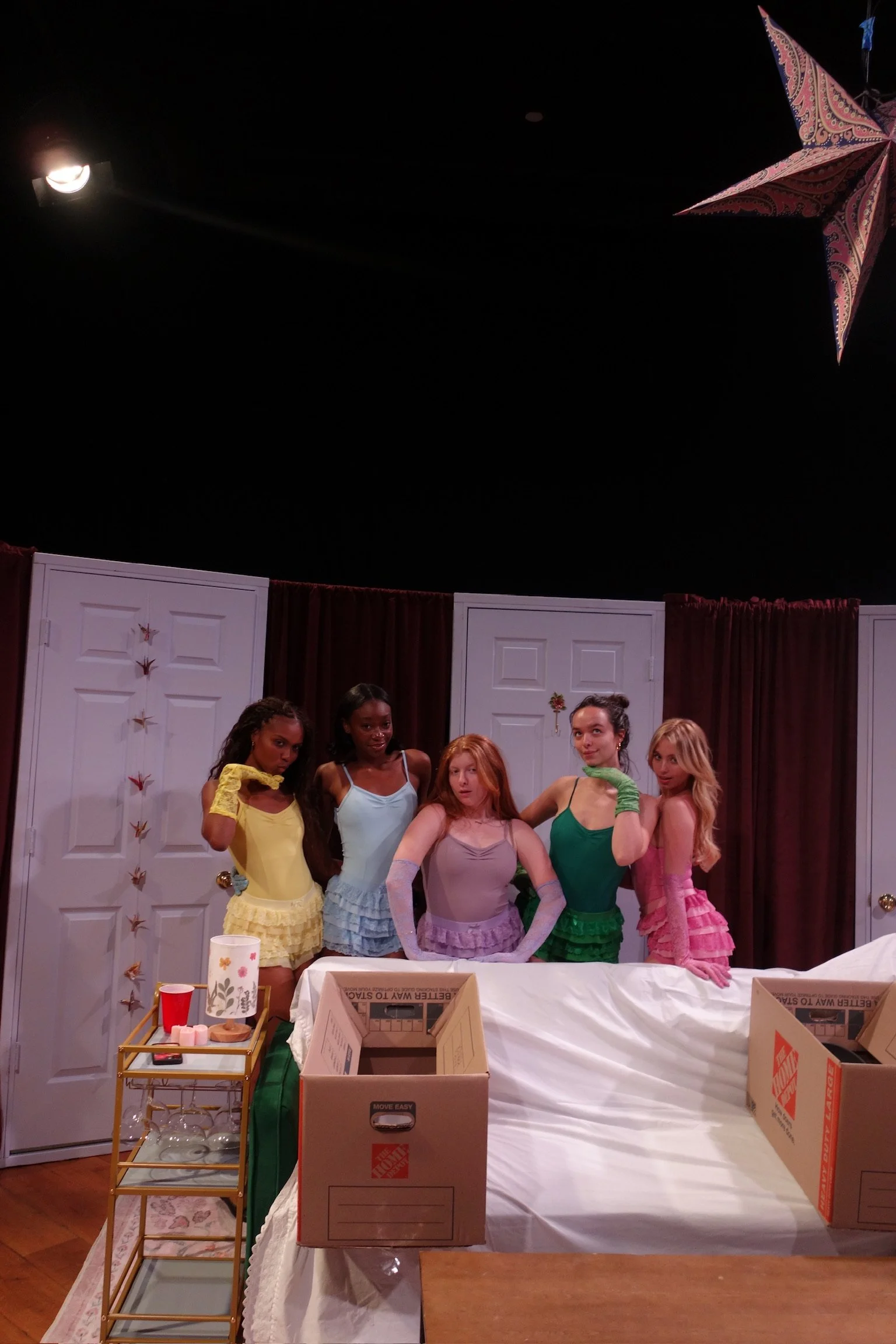
I had already read the script and watched much of it on its feet during the designer run, but seeing the finished production felt entirely new. Meet Me in Five does not require elaborate scenery or extensive technical effects. It takes place in a single apartment and uses relatively few non-diegetic sound cues. Still, the play benefits enormously from having a clearly defined physical environment. The doors leading to each woman’s bedroom give the apartment an essential geography, particularly in a story structured around entrances, exits, overheard conversations, and the tension between shared and private space.
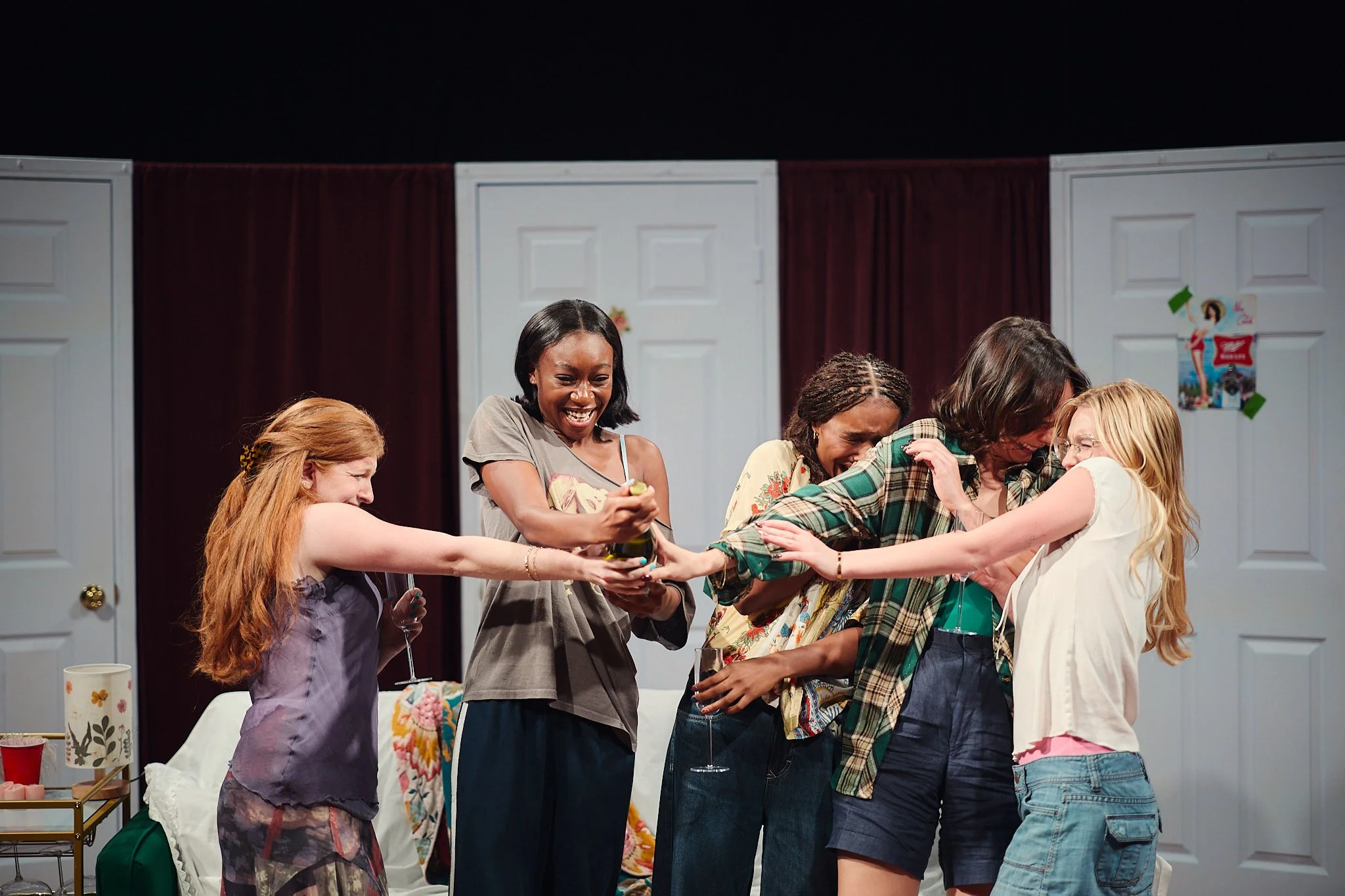
Production stills by Ken Yotsukura
Structurally, the play is deeply slice-of-life. There is little resembling a conventional inciting incident or singular catalyst. Instead, we are dropped into the women’s daily lives and watch small tensions accumulate until the world they have created becomes unsustainable. To be frank, this is not usually the kind of structure to which I am naturally drawn. I am a sucker for Freytag’s pyramid. Here, however, the looseness largely serves the production. The play’s resistance to a straightforward cause-and-effect trajectory allows the friendships to gradually unravel. It will not be everyone’s cup of tea, but its unconventional structure is central to what the production is attempting.
Maddie Schumacher’s Sascha emerges as the heart of the show. Schumacher is delightfully funny and grounded, lending significant depth to a character who could easily be dismissed as the “boy-crazy” one. Her bright, excitable energy makes Sascha immediately lovable, while the vulnerability beneath it prevents her eventual unraveling from feeling like a sudden transformation. Lilia Buckingham is also wonderful as Ingrid. She brings a warm, buoyant presence to the stage that immediately draws the audience toward her. Her costuming, easily my favorite in the production, further captures the carefully composed identity Ingrid is trying to maintain.
Kaci Walfall is a particularly strong performer whom I found underutilized, through no fault of her own or Garner’s direction. Harper is frequently positioned as a witness or reactor to the other women’s drama rather than a force driving the story herself. We receive glimpses of her interiority, most powerfully in her response to the destruction of her artwork, but her arc ultimately feels less consequential to the central action. Whenever Walfall is allowed to take focus, however, she is magnetic. Her performance left me wanting the play to give Harper more space.
Shahadi Wright Joseph is similarly outstanding. I was so wowed by her performance and presence that I temporarily forgot how to speak English when I spoke with her at the afterparty. Like Harper, however, Lucie is somewhat restricted by the play’s single-location structure. Much of her development occurs through the private sexual encounters she conceals from friends who believe she is still devastated by the end of her five-year relationship. Because those experiences happen outside the apartment and are revealed relatively late, the audience sees less of Lucie’s individual transformation than it does of Sascha’s or Remi’s. The intimate ensemble and contained setting serve the production extremely well, but they occasionally limit our ability to understand who these women are outside their relationships with each other.
Production stills by Ken Yotsukura
The show’s most compelling sequence is the final argument between Remi and the other women. Adrien Rolet initially plays J as an adorably awkward, unassuming “nice guy.” After Remi rejects him, however, he later corners Sascha and kisses her without her consent. When Sascha breaks down and tells the others what happened, Remi responds by lashing out at her.
Isa Barrett’s performance in this scene is one of the production’s standouts. It is the moment when Remi, previously defined by her contrarianism and pessimism, finally breaks. The writing is also at its most challenging here. The women do not immediately rally around Sascha or offer the response an audience might hope to hear. Remi is furious. Ingrid attempts to reassure Sascha by saying that “at least [she] thought he was cute” and expressing relief that J “respected [her] enough” not to go further. These are upsetting, inadequate, and painfully believable reactions from young women who do not yet possess the language or emotional tools to process what their friend has disclosed.
The scene refuses to transform Sascha’s experience into a tidy lesson. Instead, it exposes how badly people can fail one another at the moment their professed love is tested. Some audience members may resist both the characters’ responses and the lack of closure Sascha receives, but that discomfort is precisely what makes the sequence so effective. It reflects the reality that coercion is not always followed by recognition, accountability, or the correct words from the people we trust.
As the title promises, the women meet five years after leaving the apartment. They have graduated, moved to new cities, and become entirely new people. Their decision to return does not erase what happened, restore the friendship, or establish a shared version of the past. The play refuses to reward the audience with a clean reconciliation. Instead, we must sit with the fact that these women loved one another, harmed one another, and may never fully resolve the distance between those truths.
Meet Me in Five has four remaining performances at ARTXNYC from September 16 through 19. Tickets are available through Ticket Tailor, and you can follow the production on Instagram at @meetmeinfiveplay.