'NAZA' Is the Banality of Evil
By Madelyn May
It can’t be a coincidence that NAZA, a documentary about the machinery of mass killing, is kind of… boring?
I mean this as a compliment.
For most of the film, no action transpires. We don’t see explosions or soldiers charging into buildings. Or death or bodies. The visual language we’ve come to associate with contemporary films about war, documentaries, and otherwise, is absent.
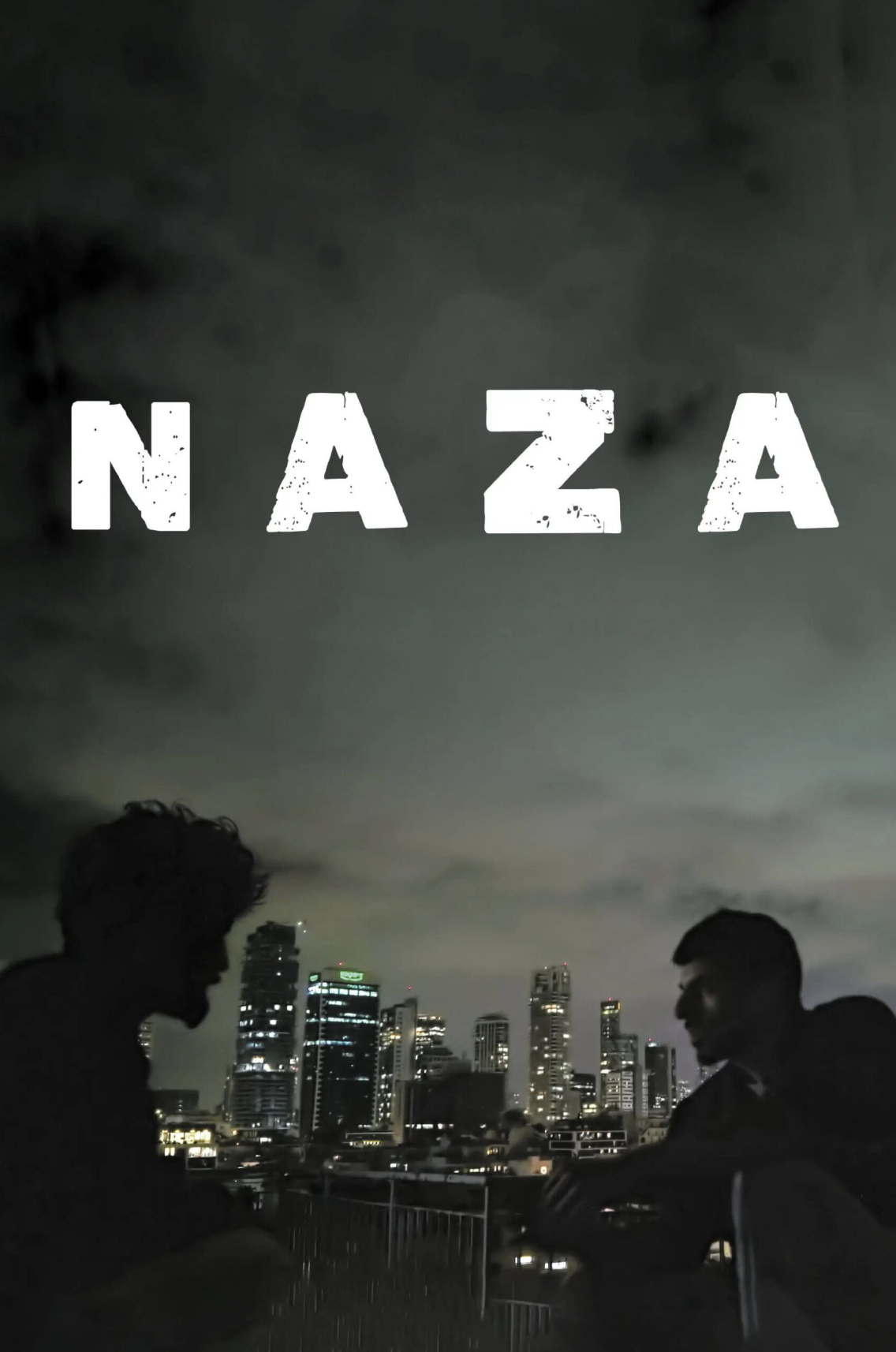
‘NAZA’ Film Poster; Courtesy of The Guardian.
Instead, NAZA, directed by the same filmmakers behind the Oscar-winning No Other Land, Yuval Abraham and Rachel Szor, is set on Tel Aviv's rooftops. It’s night. We see apartment buildings. Traffic. Offices. Planes inching across the sky. Occasionally, the camera looks through the windows to find people eating dinner, watching television, cuddling, doing yoga. The whole city is bright and expensive-looking and, crucially, civilized and peaceful.
On the rooftop, Yuval Abraham sits with former Israeli soldiers and intelligence officers and just asks them questions… for the whole movie.
They are not introduced by name, and their faces have been digitally obscured, their voices altered, but they talk about the systems they used during the war in Gaza: surveillance, targeting, AI, to identify suspected members of Hamas, and calculate how many civilians might be killed in a strike. This is where the title comes from: nezek agavi, a Hebrew term for “collateral damage,” shortened to “NAZA” in military speak.
These are their jobs. And the subjects speak mostly in the language of people describing their jobs. When Abraham pushes his interviewees, each one diffuses personal responsibility as simply a cog in a greater machine. The same way you might follow the orders of your boss you don’t agree with.
This is what makes the film so frightening. Horror is part of the workday.
Someone explains how a building is numbered and a target is identified. Another draws a diagram. Someone else describes a system that could determine when a suspected target was home by monitoring the phones of his children.
The details add up without the visual punctuation we expect: no swelling score telling us that this is the moment we should be horrified. Instead, we are given Tel Aviv, glowing at night.
It is difficult to think of another recent film in which geography has been used so quietly. Gaza, which is only about 40 miles outside of Tel Aviv, is kept largely outside of frame. Tel Aviv is where these systems were remotely designed and continue to be operated. The center of Tel Aviv is where the Israeli military has its headquarters. The distance is not just geographic but psychological. A short drive, an enormous imaginative leap.
NAZA uses these interviews, the setting, and visual language to draw comparisons to the iconography of Holocaust cinema and explore its interest in the people who keep a system functioning. It is interested in the administrative side of violence. The person who enters data. Monitors a phone. For lack of a better term: the banality of evil.
Almost absurdly, the camera at one point passes the Tel Aviv Cinematheque. Its marquee, unlike other Hebrew writing we see throughout the film, is translated via subtitles: an advertisement of a tribute to Claude Lanzmann, whose 1985 film Shoah rebuilt how we view the Holocaust through primary source testimony.
The reference is so pointed it feels like a footnote.
In Shoah, Lanzmann famously refused historical reenactments and instead opted to simply hear people talk, survivors and perpetrators alike. The horror was approached through memory, evasions, expressions, gestures, pauses. Interview.
NAZA uses this same technique. Abraham and Szor show us almost nothing and ask us to see everything.
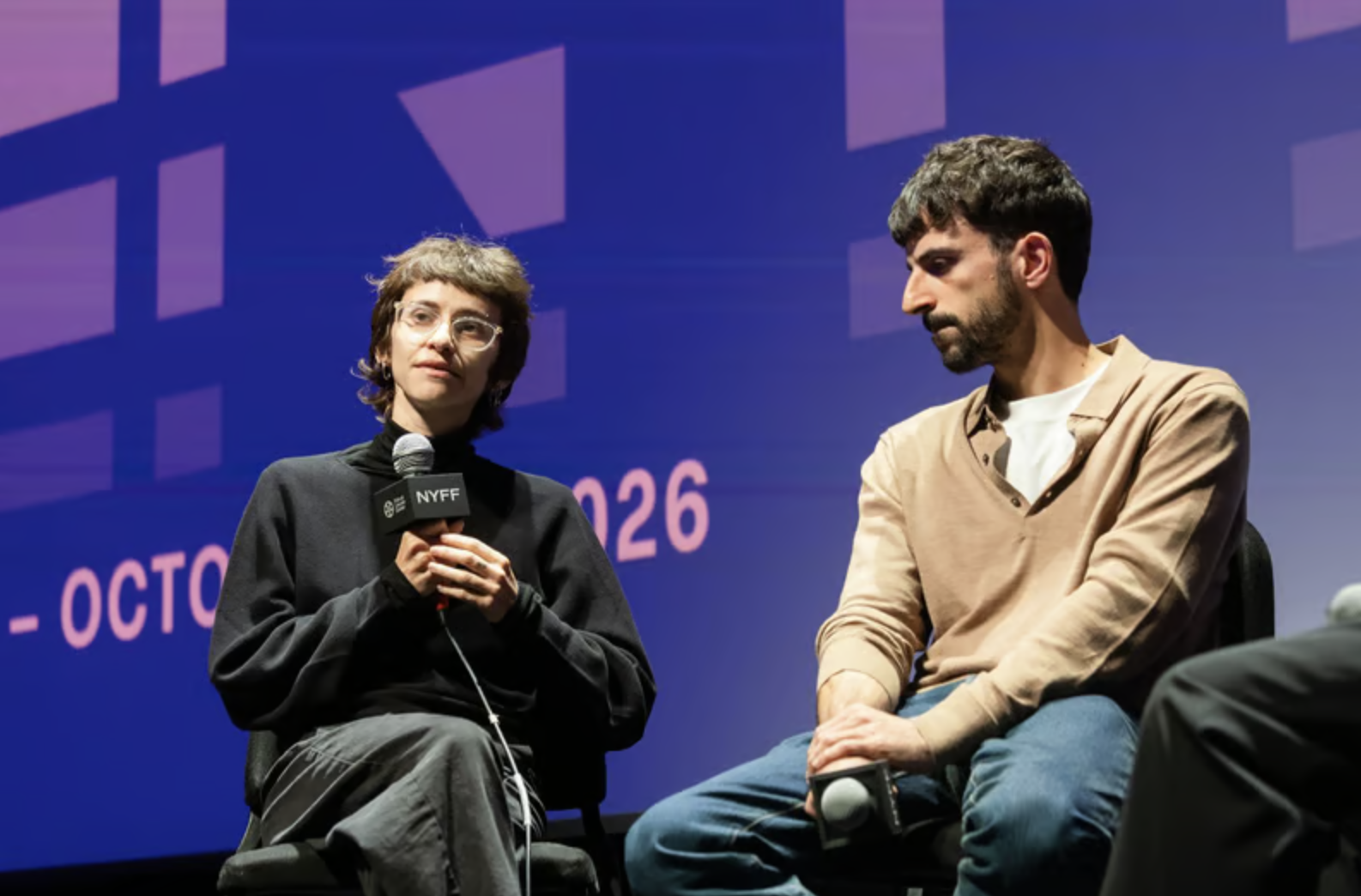
Yuval Abraham and Rachel Szor, at NYFF.
This is especially effective because the machinery being discussed itself is invisible. The systems are all digital. The surveillance is remote. The targets: data. The physical violence is simply the final stage in a process that has already taken place somewhere inside a computer in Tel Aviv. The filmmakers, therefore, make an odd decision: not to visualize the technology, but to visualize the people explaining it. Again, and again, and again.
Again, we see a person sitting in complete darkness, with Abraham beside them. The camera is fixed, each voice is distorted, each background is the glow of Tel Aviv, each face is shadowed. There’s a distinct visual rigidity that makes the people begin to feel almost interchangeable. Of course, their experiences aren’t identical, and the filmmakers don’t suggest it. But the film is most interested in exploring the way a bureaucratic institution can make individual actions almost feel interchangeable. Twenty-four people describe their roles as different parts in the same machine. The sameness is the point. The boredom is the horror.
It reminds me of The Zone of Interest, another film that understands the violence can be the most frightening when it's on the outer edge of the frame. Jonathan Glazer’s film about the machinery of Auschwitz is about the domestic life of commandant Höss and his family. We hear trains, gunshots, screaming, faint industrial noise. What becomes unbearable for the viewer is how ordinary life continues through it.
NAZA does the same thing; only the violence isn’t heard, it’s explained. And the ordinary life surrounding Abraham and the subject is what we see. Traffic. A skyscraper. A workout. Dinner. TV. All captured like surveillance.
Similarly, the way the film uses technology is as poignant as it is unnerving. Not only because the surveillance-like images of Tel Aviv citizens mirror the same technology being used in the NAZA system in Gaza, but because the human simplicity of these images contrasts with how contemporary warfare has been designed to make murder less personal. There is something so clean and frictionless about algorithms deciding who lives and dies. The witnesses only occasionally interrupt.
One describes overhearing the last moments of a person’s life. The screams of a family when a child was killed. Someone else recalls visiting Poland as a schoolchild and wondering how the Nazis could have lived with themselves, only to wonder in the documentary what his own participation made him.
It is in these moments, where pride, duty, vengeance, shame, and regret start to leak through the technical language attempting to contain it, that the abstraction starts to break.
These are not cartoon villains. They are ordinary people who actively participated in something they gradually came to understand another way.
It is the most unsettling thing NAZA borrows from classic Holocaust testimony: how an ordinary person can participate in something terrible and still experience themselves as ordinary.
The film’s visual darkness is also key here. Yes, the darkness can be attributed to the fear these soldiers and intelligence officers have of repercussions from the Israeli government. But also, by obscuring the faces of these subjects, the film’s real subject becomes the psychological distance between an act and its consequence. The system works precisely because of its anonymity, because it takes place in Tel Aviv, and not Gaza, because we can’t actually see who hit the strike button.
The setting supports this by making everything else small. The streets look like lines. Cars are little lights. Buildings are shapes. Gaza? A coordinate. A target. A string of numbers far, far away.
This arrangement breaks at the film’s finale, where NAZA finally shows the consequences directly: footage from Gaza of a father calling into a destroyed building for his children, with bodies visible beneath rubble. It’s so simple yet so effective because for nearly its entire runtime, NAZA asks us to imagine, and then very suddenly, it doesn't. And the video of legs peeking out from under the destruction reminds every viewer of every Holocaust film they’ve ever seen.
Boredom is NAZA’s most unique tool. Films about war, films that are important, films with something to say often make it known through acceleration. Acceleration of footage, testimony, images, information. NAZA slows down and does the opposite and then repeats itself. It lets people talk. It stares at windows and waits. The waiting is actually the point.
Mass violence requires mass administration. The great achievement of NAZA is that it understands the banality of that image without allowing the banality to become the excuse.