Reprogramming Vogue: Malle Wear and 'A Cyborg Manifesto'
By Luna O’Brien
Let the record show I cancelled my Vogue subscription back in 2023. The affair ended with increasing underwhelm upon unwrapping each issue to find pure mediocrity; an ugly reality of high fashion’s falsified dreams. I was bored with the covers and their contents and Wintour’s cuddling up to Bezos. Imagine my suspicion when a new salutation blinked in my Promotions inbox.
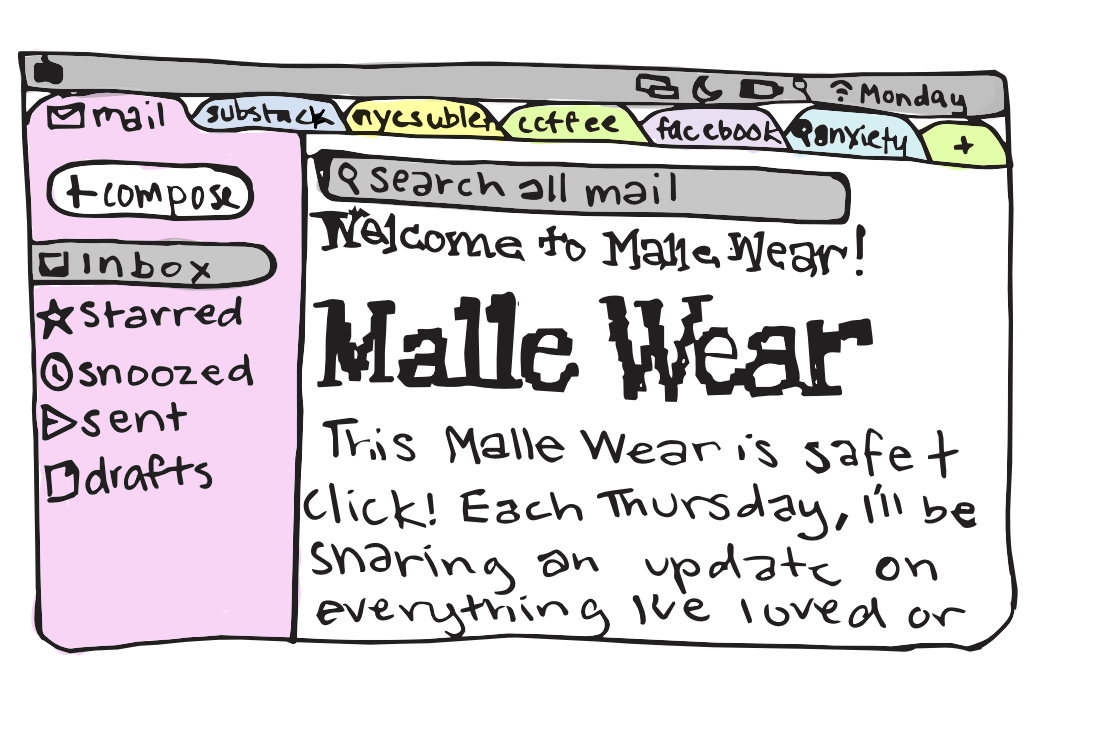
This Malle Wear is safe to click! Each Thursday, I’ll be sharing an update on everything I’ve loved or can’t stop thinking about in the world of Vogue and beyond.
Chloe Malle, Head of Editorial Content for Vogue US, has taken the pages of Vogue Daily’s diary and transformed it into her new brand of digital influence: Malle Wear. It includes brief snippets of Vogue’s latest editions, her children’s weekend activities, motifs she’s loved from the runways, her skincare shelf’s shiny additions. Each time I click the tiny moonbeam that is “why this ad?”, I am redirected to a dark screen and a textbox labeled blank.com. My grayscale reflection stares back at me.
Alex Plants (@alexplantsss) for Gut Instinct Media.
Of course, interviews with Malle highlight her emphasis on “keeping it real”. She’s the kind of friendly millennial with a fabulous professional title that you can still say Hi to at kindergarten drop-off—in her own words. Her inbox interests are most probably made with the intent to connect to Vogue’s contemporary audience, perhaps largely previously mentioned mommy millennials, those who are still wrapped up in the dream that Vogue has created at the crux of its interest, not consumption.
There are a plethora of cases against curated living; I need not plead mine. I both rebuke and reproduce the odd commodification of pleasure as a material resource at best, purchasable product at worst, and curation is a dualist offshoot of this struggle. How appealing it seems to neatly package your loves and hates and woes in an aesthetically pleasing pictorial; to skim the surface of style, art, and creation, fish up what differentiates your taste from the mainstream, and share it for the sake of sensualism. Lest we forget Kate Crawford’s aesthetic flattening and the algorithm of it all, I’d dare say this editorial monolith is mainstream.
But in truth, I am not friends with many mothers in real life, thus the appeal to her children is lost on me. The fashion-focused portions of Malle Wear cause my eyes to glaze over. Nothing new, just short letters of adoration to spring trends (Royale Purple) and the silver screen (Wuthering Heights, a whitewashed spectacle for the distracted modern-day bodice ripper). At the bottom of the page, Shop My Wishlist Here sits like a puppy, wags its tail, begs to be clicked.
Reproducers of Culture: Cyberfeminism and Dissonant Fashion
The genesis of Vogue was in the controlled flame of 19th-century New York high society. It documented its soirées, socialites, and high fashion scene. Condé Nast swept in on its acquisition in the early 20th century, hence its directive shifted from reporting on fashion to attempting (and succeeding) to define it. The product was labeled luxury; its focus narrowed on beauty, composure, and etiquette. First magazine with a colored print cover, first EIC to shift body trends towards starvation. The entrance of Wintour shifted the magazine into celebrity-centrality, and the CFDA solidified Vogue as an industry development driver.
Pop culture is a mode, the mode of political reproduction. Thus, it is also a site for political examination. In the digital sphere, specifically in a weekly email, the political boundaries of the site are blurred. Perhaps due to the fact that the internet-self is an unfocused space to inhabit, the limits of presence and physicality—identity—are bent. The walls or boundaries of the scene are carpeted by shrines to commercialization, which reproduces capitalist ideals surrounding said identity. It does so under the guise of choice and free will. In the digital sphere, we become disembodied.
If disembodied space then allows the dissolution of connection and binary logic, cyberfeminism calls us to examine how our selves—and lived experience—move between both sites. How these scenes variegate like specimens under a teleidoscope. A valid critique of cyberfeminism is that it is too essentialist. With the crushing waves of digital addiction, discernment is key; in late-stage capitalism, we are increasingly shoved towards hyper-individualism.
Thus, the self produced on the screen is both true and false. Its dichotomy is joined at the center of imagination and material reality. It lives within a liminal space, which allows for complete transformation.
Malle’s half-smile absorbs the blue light of my screen, a tiny picture being the personification of Vogue’s directive, ready to gift me her personal artifacts in return for clicks.
Ironic Faith: The West’s Domination of Abstract Individuation
In Donna Haraway’s A Cyborg Manifesto, a cyborg sits at the center of her ironic, blasphemous faith to feminism, socialism, and materialism. Read her introductory paragraph for further explanation. A cyborg is cybernetic, meaning structured by circular feedback of inputs and outputs that influence action. It is “a hybrid of machine and organism, a creature of social reality as well as a creature of fiction.”
In international women’s movements, the construction of lived experience became a collective key to mobilization. In cyberfeminism, the cyborg invokes the question of our individual and collective identity. Its existence changes what “counts” as lived experience.
In the tradition of Western (racist, sexist) capitalism, now omnipresent in the very structure of the digital sphere, selves are reproduced at the speed of reflections. The machine functions as a means of production, and organisms are shot down by transgressions they do not even see. Influencers are cogs; imagination is a byproduct.
Technology has become the power source that recrafts our perception of ourselves, and hence, it has become the vital instrument in producing and reproducing meaning.
Systems of Myth and Meaning
Alex Plants (@alexplantsss) for Gut Instinct Media.
In reality, how meaning is ascribed is widely varied, but in the market, meaning is something manufactured. When Vogue dispatches Malle Wear each Thursday as their new form of advertisement, they are shaping digital supply, and in turn shaping digital market interest, demand, and meaning–all with Malle at the crux of its ironic faith. I suppose at this point in time, it is better to say catering to rather than shaping. But why this case, this individuation? Why should we pay attention to what Malle has to offer—because I don’t want to—other than the fact that she’s the new head editor?
Vogue is not an ambivalent entity. Ephemerality is a separate reality to its historic production. It avoids ambiguity entirely. Meaning is not mediated because Vogue’s offerings are inherently worthwhile or divine, but because Vogue mechanizes meaning in association with its supply.
In Haraway’s words, cyborgs are not reverent—they do not remember the cosmos. Cyborgs are wary of holism, the philosophical concept that individual parts of a system cannot be fully comprehended singularly, but require the context of the whole system they encompass. Despite this, cyborgs are needy for connection and attention. Their desire is a united front without any actual innovators.
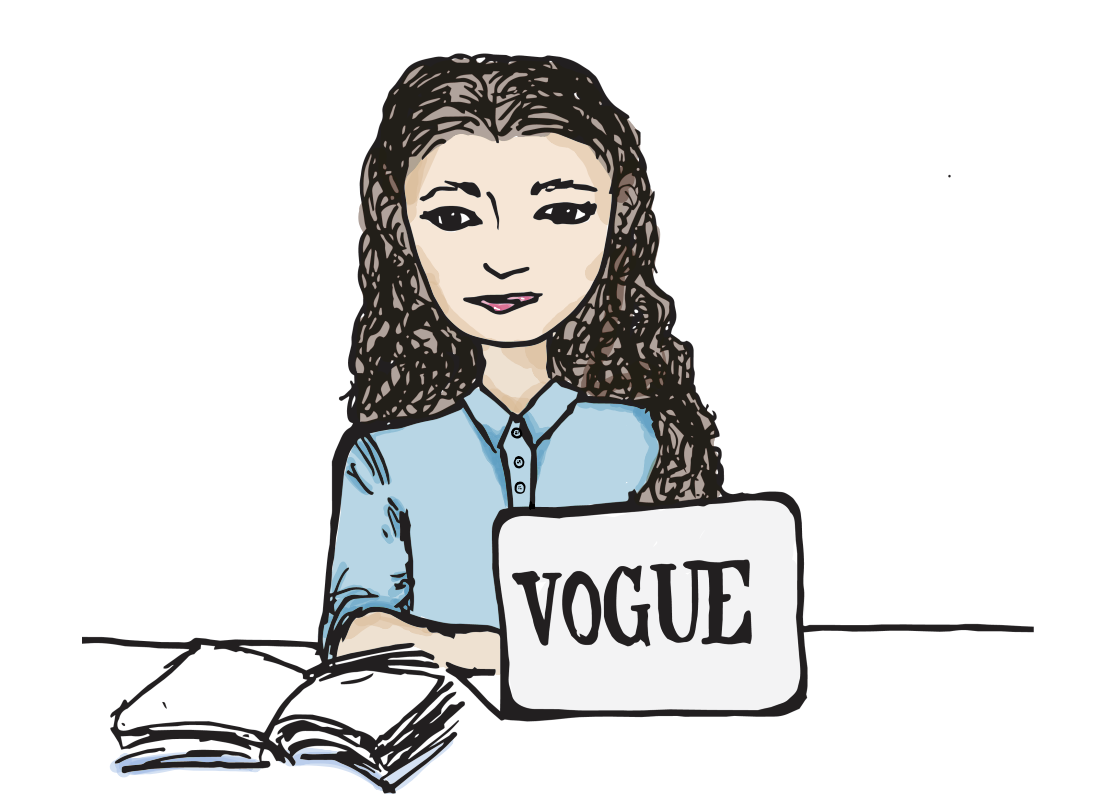
In my computer’s Malle Wear, Chloe sits on a desk and crones to me about her children. Of the top articles they ran last week. Of the books, all of New York’s It-Girls are reading on set. Of her podcast on cognitive dissonance in fashion amidst regional wars, and the supermodel co-host who joined her conversation. She raps her nails against the fiberglass. She insists over the speakers: “Sometimes in fashion people can be too cool, unavailable...and for me, I am just never going to be that person.” Her bright blue pixel logo blinks on the white backdrop.
I have a suspicion that the new Devil Wears Prada film will be Malle propaganda. I have a suspicion that Malle will propagate this nice-mommy-millennial persona to usher in affection for Vogue’s primary consumers, to signal a “shift” in representational power, whilst continuing exactly as Condé Nast pleases. I have a suspicion that by forming an inbox curative connection, Malle hopes to make her audience feel personally touched, to make you feel warm and fuzzy while you click “purchase,” and someone else gets all the money.
REFERENCES: “A Cyborg Manifesto: Science, Technology, and Socialist-Feminism in the Late Twentieth Century” Donna Haraway, Simians, Cyborgs and Women: The Reinvention of Nature (New York; Routledge, 1991) The Anarchist Library
“Cyberfeminism, Popular Culture, and Why Feminism Still Matters - Dr Robyn Timothy | Interview” Sintiga Brence, Grunge Included on Substack
“The Gaze Arrives First: Subversive Abstraction in the Age of Post-Recognition Surveillance” Nada Meshal, Becoming Press
“Vogue's 'Head of Editorial Content' Era Commences with Chloe Malle” Amy Odell, BackRow on Substack
“Watch: A Conversation With Anna Wintour and Her U.S. Vogue Successor, Chloe Malle” Jessica Testa, The New York Times