Richard Kelly’s absurdist horror lets questions linger two and a half decades down the line
By Zara Dosanjh
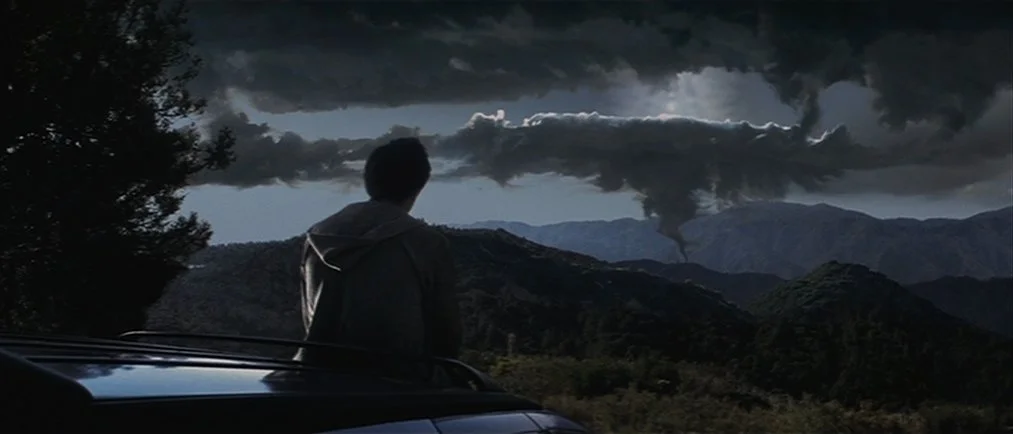
Donnie Darko (2001)
Donnie Darko is a film where the viewer decides its destiny. Is it a story of a teen paranoid schizophrenic on the loose, bereft of any meaningful intervention? Or are we watching a disturbing coming-of-age that defiles and defies the rigidity of suburban America? Richard Kelly lets the audience figure it out, with winding subplots and cryptic characters that lay the architecture of a film bursting with philosophy. The film is deliberately difficult to pin down, slipping between psychological horror, science fiction, and an altogether stranger meditation on growing up, as though the confusion of adolescence itself has begun to warp the fabric of reality.
Donnie Darko follows its eponymous protagonist, Donnie (Jake Gyllenhaal), a troubled high schooler seized by dreams and blurred visions of a man named Frank, who wears a bunny costume and has come to warn him of the end of the world, naturally. Donnie becomes captivated by his delusions and quickly comes to wholeheartedly believe time travel is real and that we have extra-dimensional life energies that flow out of our chests, connecting us to the future. Besides these revelations, he’s awkward in love, disruptive at school, and an all-around mannerless son and brother. He is also, in many ways, an ordinary teenager who has become increasingly alienated from the world around him, frustrated by the hypocrisies of the adults meant to guide him and unable to find a language for what he is experiencing. The film's strange cosmology gives that alienation a shape, even if it never offers an entirely reliable explanation for it.
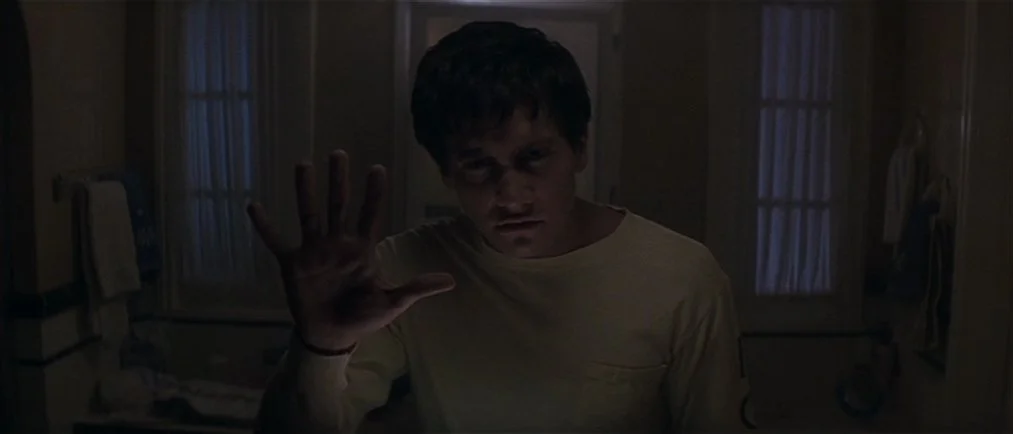
Donnie Darko (2001)
Kelly’s impetus is this: what happens when we submit to every dark impulse? And what if a seemingly fragmented psyche begins to manifest itself in the real world? We wonder if we can trust Donnie, if what’s unfolding on our screens has been warped by our unreliable narrator. The rationalist in me seeks to explain away everything that happens to Donnie. So what if there happens to be another guy at school called Frank, wearing a Halloween costume that likely initially caught Donnie’s eye in Walmart? Surely, the simplest explanation is that Donnie is projecting meaning onto a series of otherwise ordinary events. But the film keeps pushing against that interpretation, introducing coincidences and revelations that make it harder to dismiss his experiences as the product of a troubled mind. The more we try to rationalize what we’re seeing, the more the film seems to slip through our fingers.
By the film’s end, we’re exhausted by Donnie Darko’s delirium and the constant, begging question of what has or hasn’t really happened throughout the film. I think the best way to interpret Donnie Darko is to understand it as a surrealist dreamscape. Donnie’s mind is playing out his last moments as he dies, a sort of death dream, all of the things he didn’t do when he was alive: saying whatever he wants to his stuck-up teacher, kissing the pretty new girl, and burning down a house. Donnie Darko is a procession of an unlived life, and we see it played out in a haunted imagining of an otherwise paradisical suburbia. In this version of reality, Donnie gets to act on his anger, indulge his curiosity, and pursue the things that might otherwise have remained out of reach. The dream becomes a space where he can confront the people and institutions that have failed him, even as it threatens to consume him entirely. Perhaps that is why the film feels so much like adolescence itself: the sense that everything is unbearably significant, that the world is hiding something from you, and that you might be the only person capable of seeing it.
There’s something subversive and thoroughly Lynchian about Donnie Darko that refuses to age, from the character of Grandma Death to its washed, ambient aesthetic. It isn’t a flawless film, of course. I don’t fully understand Drew Barrymore’s role as a fairly flagrant teacher, nor that infamous breakdown of Smurf lore. But even these oddities contribute to the film’s peculiar atmosphere, where the absurd and the disturbing sit side by side without much warning. Kelly seems less interested in making every detail fit neatly into place than in creating a world where even the most mundane conversation can feel faintly sinister. The result is a film that makes suburban normalcy feel less like a refuge than a performance, with everyone playing their part and Donnie being the one person unwilling, or unable, to play along.
Donnie Darko (2001)
A sequence bound to spook any first-time viewer is the cinema scene, where Gretchen (Jena Malone) falls asleep while watching a movie, and Donnie’s hallucination of Frank takes hold once more. The reveal of Frank’s grotesque face behind the mask sucks the air out of the scene. The lines between reality and delusion blur yet again, while you can’t help but feel for Gretchen as she sleeps, completely unaware of just how unhinged Donnie has become. There is something particularly unsettling about the scene’s intimacy. Gretchen is right there beside him, close enough to touch, while Donnie seems to be slipping further into a reality that she cannot access. Again, are we watching a mentally ill teenager spiral out in real time, or is this someone’s version of enlightenment that the rest of the world simply can't process? The film offers no comfortable answer, and perhaps that uncertainty is the point. What looks like madness from the outside might feel like revelation from within, and Donnie Darko leaves us suspended somewhere between the two.
Donnie Darko was a 27-year-old Kelly’s feature debut, and 25 years later, you can still feel a fresh vigour in his creation of something as jarring and outlandish as Donnie Darko. It’s philosophical finery; everywhere you look, there are densely layered questions pondering life, religion, time, love, sex, and morality, dressed up in a bunny suit to make it all that harder to digest. Ultimately, the film's scenes are like fragments of a dream that feel impossible to explain but impossible to forget.