By Ambre Savagnac
While their music is not traditional folklore, Stevie Nicks and Florence Welch are modern-day storytellers who draw upon the beliefs and aesthetics of that heritage as a major artistic influence. The former has played a pivotal role in Fleetwood Mac since 1975, while the latter has been the voice of the band Florence and the Machine since 2007. Forty years separate the beginnings of their respective careers, yet both the American and the English artists tap into the fascinating, historic realm of witches, mythology, and paganism through theatrical musical performances.
With their gothic aesthetics, stage rituals, and lyrics steeped in mysticism, these musicians fully inhabit their personas, and esotericism plays no small part in this: their songs often recount modern legends, dark fairy tales, and stories of ghosts or rituals. Whether with Fleetwood Mac or as a solo artist, Stevie Nicks embodies a unique, mystical aesthetic that has profoundly influenced Florence Welch, who is frequently described as a "pop witch."
The bewitching work of Stevie Nicks and Florence Welch stands at the crossroads of music, magic, and mystery. Both music-making and magic-making are forms of storytelling. Much like magic, music takes the shape of its creator. It is a mode of expression—a vessel into which we pour our desires, worries, curiosities, anger, and love. It can serve as an act of rebellion or a challenge to authority, a way to share one’s own truth using a language of one’s own invention. How do these female musicians manage to cast a spell over us through their lyrics, using the medium of music as a conduit for their proclamations?
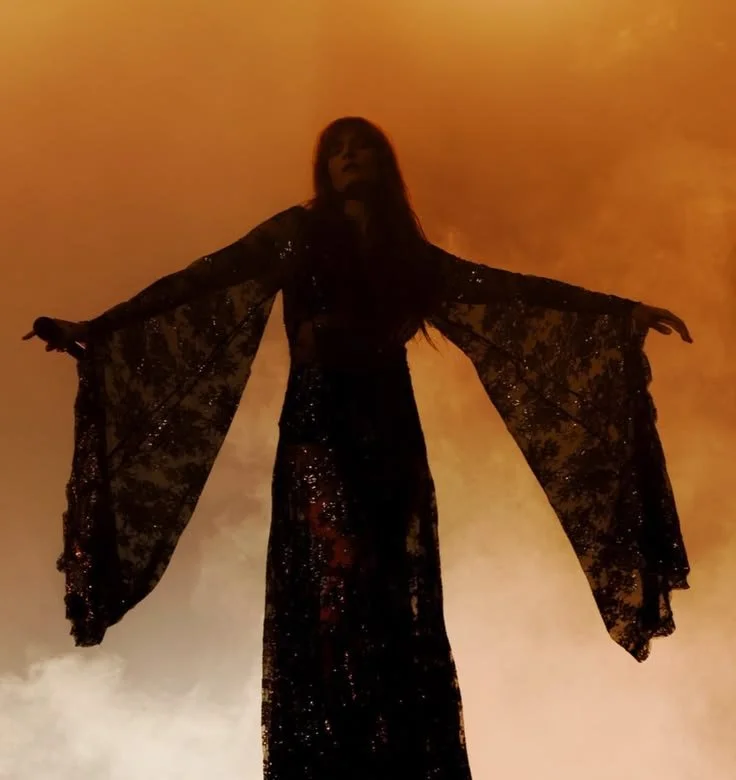
Florence Welch from Florence and the Machine performing at Pukkelpop Festival in Belgium in August 2026; Courtesy of Zina Kenens.
Possessing an independent temperament, Stevie Nicks launched her solo career in 1981 with the album Bella Donna, while simultaneously performing with the English band Fleetwood Mac, a group then globally renowned, most notably for their 1977 album Rumours. Frustrated by seeing her compositions pile up in what she called her "gothic trunk of lost songs", the prolific artist decided to bring them to life herself.
Throughout both her professional and personal life, Nicks has made a habit of employing the principle of "manifestation" within the lyrics she writes. This magical technique is particularly potent in written form, and its power is further amplified when spoken or sung aloud. Writing songs and singing them instinctively serves to doubly enhance the magic of this prophetic act; the ability to listen to one’s intuition and verbalize it to shape one’s destiny is, without a doubt, a form of witchcraft.
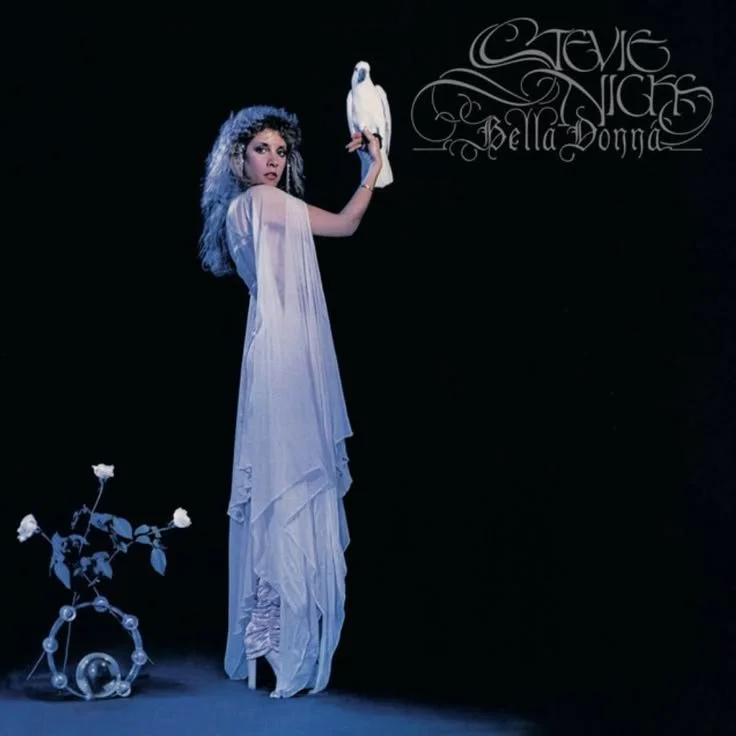
Cover of “Bella Donna” by Stevie Nicks in 1981; Courtesy of Herbert W. Worthington III.
Magic involves consciously programming one’s own energetic frequency to emit and attract a similar vibration, much like a magnet. When approached with a deep, sacred sense of purpose, it becomes a tool for liberation, allowing one to shift their perspective and view the universe as probabilistic rather than deterministic.
In his book Wicca: A Guide for the Solitary Practitioner (1988), the American author Scott Cunningham writes: "If you wish to be a magician, honor the earth and life, practice love, recognize that magic is the natural birthright of every human being, and use it wisely." By intentionally bringing about change, one can touch upon the divine, a process akin to engaging with a personal spiritual path or an esoteric discipline, such as astrology. Originally, in Antiquity, "witches" were often healers, herbalists, or midwives, respected for their knowledge of nature and plants. The persecutions that took place during the witch hunts in Europe (15th-17th centuries) devastated these women and the traditions they upheld. They were largely tried and executed because their practices were perceived solely as malevolent. From the 19th century onward, notably through Jules Michelet, author of The Witch (1862), and later the feminist movements of the 1970s, the figure of the witch has been rehabilitated. Today, many view her as a symbol of emancipation and the reclamation of feminine knowledge.
Witches are attuned to the energies surrounding them, the power of nature, and their own personal power. Much like these iconic female figures, Stevie Nicks and Florence Welch channel their energies toward specific goals within their music.
Nicks operates primarily within the realms of classic rock and pop-rock, incorporating influences from American folk music, most notably through her use of acoustic guitars. Meanwhile, the band Florence and the Machine falls under the categories of indie rock, baroque pop, and art pop, characterized by arrangements featuring harps, intense percussion, and choral vocals. For these artists, esotericism is not a rigid dogma, but rather a spiritual touchstone used to compose songs and guide their performances, which often take the form of ritualistic concerts.
For them, the occult becomes a creative process and a way to transcend the concert experience. While Stevie Nicks has often described her songwriting as a form of spiritual channeling, recounting how she would isolate herself at night by candlelight, allowing words to come to her as if dictated by an invisible force, Florence Welch employs symbols from tarot and mythology to structure her narratives, transforming her albums into mystical concepts.
Both artists approach the stage as a sacred space where they conduct a collective ceremony, seeking to evoke an esoteric catharsis within the audience. Florence Welch incorporates dance movements inspired by pagan trances, which connect her to her own music. She compares witchcraft to medicine and ancestors. In a recent interview for L’Officiel magazine, she says : “I wanted to study the different forms of healing, which led me down a path of exploring esoteric and pagan rituals. Songs can be incredibly prophetic, like subconscious warnings or messages to myself. But I often don’t know what I’m trying to say until years later, or until a prediction comes true and I don’t know what to do. So it seems like a kind of useless magic, as if the song is somehow speaking through me in its own language, and I am merely a conduit, completely oblivious to its wisdom.”
Paganism is the belief in multiple deities and/or the idea that nature and the elements possess a spirit. Today, artists like Florence Welch have created a form of neopaganism, drawing inspiration from and elevating ancestral traditions such as Wicca, a movement rooted in witchcraft that places a high value on personal spiritual experience.
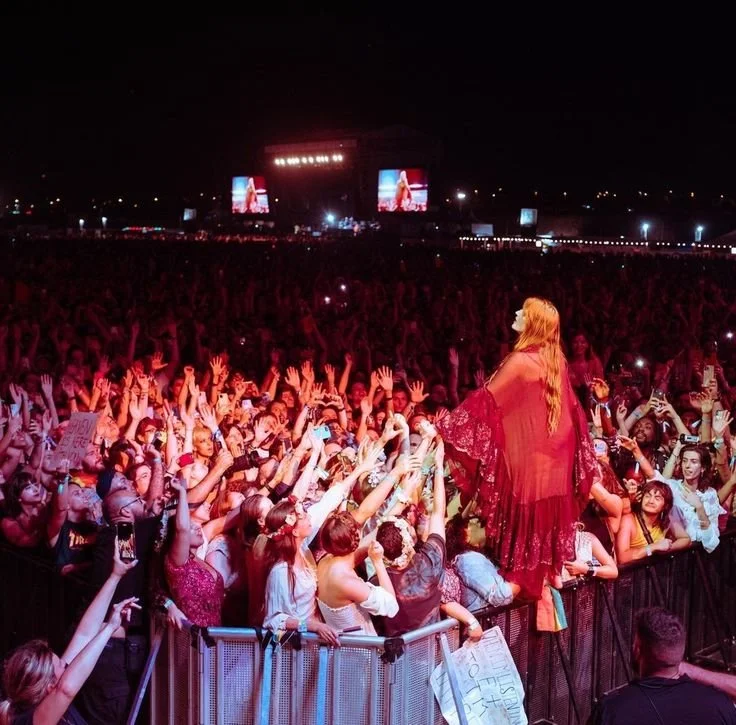
Florence Welch performing on stage in July 2022; Courtesy of Lillie Eiger.
The iconic track composed by Stevie Nicks, Rhiannon (1975), serves as a perfect example of how esotericism can infuse a work of art. Inspired by a Welsh legend she encountered in a book, Nicks wrote the song intending to tell the story of that particular entity. It was not until 1978, three years later, that she discovered the actual Celtic mythology. In the Mabinogion, a collection of Welsh folklore, Rhiannon appears as a goddess of the moon and horses, accompanied by three magical birds capable of lulling suffering to sleep. Stunned, Nicks realized that her lyrics, written through pure spiritual intuition, had precisely captured the very essence of this deity.
In live performance, Rhiannon transformed into a genuine, occult-tinged theatrical ritual. By the late 1970s, Nicks’s delivery of the song was so wild and possessed that drummer Mick Fleetwood described it as "an exorcism." Draped in black muslin shawls, she would enter a trance-like state, screaming the final lines, "Take me like the wind!" as if truly inhabited by the character. She used the stage to physically embody this force of nature, leaving an indelible, mystical mark on the history of rock music.
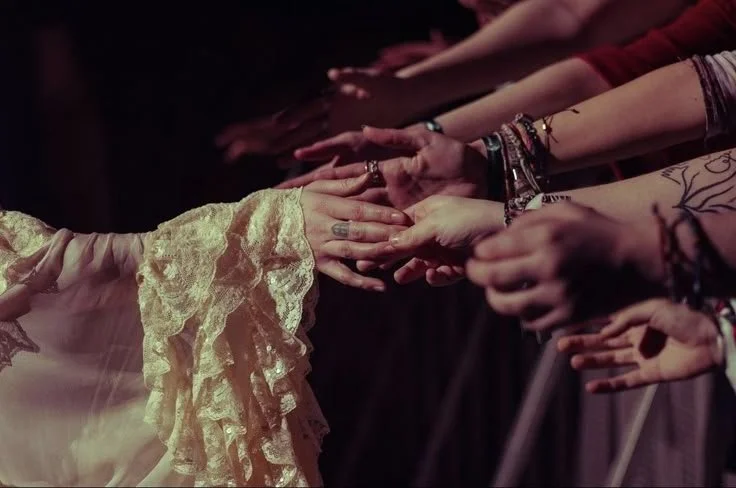
Rooted in inner experience, intuition, and contemplation - rather than in religious, secular, or philosophical reasoning - the practice of mysticism relies on introspection and, at times, altered states of consciousness to transcend the limits of ordinary perception. In this context, it operates through manifestation. By channeling one’s own energetic frequency toward a personal or collective desire and broadcasting it through songs on albums heard across the globe, one engages in manifestation in a universal sense. Nicks and Welsh understood that our thoughts and emotions directly shape our life experience. Much like the concept of the law of attraction or the power of intention, the idea that by perceiving the universe as energy and emotionally aligning oneself with the feeling of having already attained what one desires, one can manifest one’s wishes is a compelling one.
More broadly, the mystery of attempting to resolve something for which one lacks the key naturally piques curiosity. The two artists craft lyrics that function as incantations and riddles that transform their albums into collections of modern-day tales and virtuous spells intended for an entire people. All that remains is to listen closely.
Live of Florence and The Machine
Courtesy of Pinterest