U.S. vs. Canada, men’s vs. women’s hockey, or Trump vs. everyone?
By Annabel Gregg
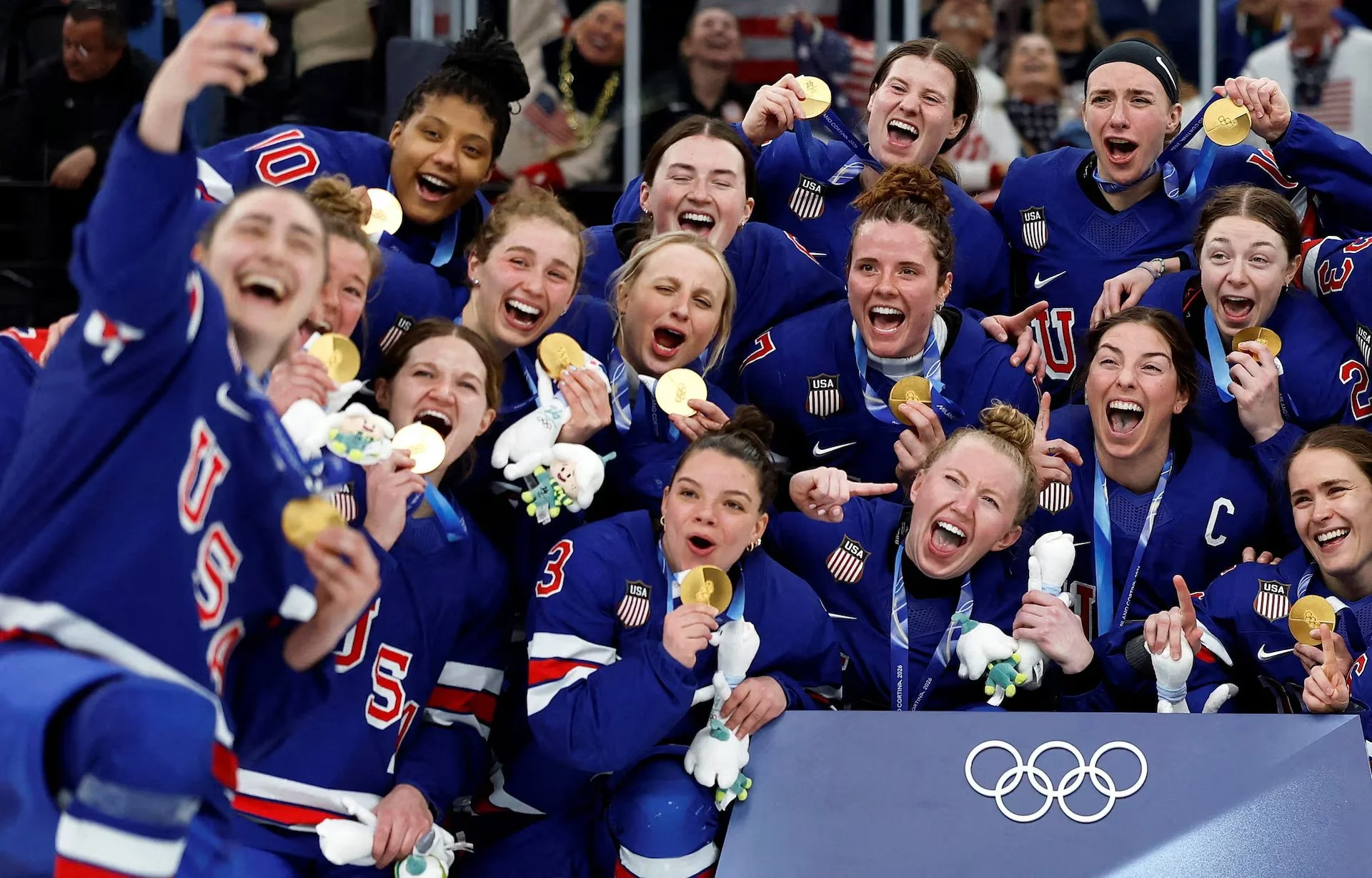
The U.S. women’s hockey team celebrates their hard-fought gold-medal victory over Canada on February 19th. Photo via Reuters.
Lights dim over the arena, making MSG feel cozy even with the requisite chill. Blue and red hues dance over the ice. A spotlight falls onto the singer, who stands on a little square of carpet. Both teams are in lines on either side of the arena, players leaning on their skates and swaying with reined impatience, just wanting to get on with the actual game.
Because we're playing Toronto, the singer (some off-Broadway guy) has to sing both teams' national anthems to kick things off, starting with The Star-Spangled Banner. The grown men around me take their baseball caps off or put their hands over their hearts. I absently tug on the oversized sleeves of my jersey (predictably, embarrassingly, it's #73 Matt Rempe: known for getting in fights, a humble height of 6'7", and not scoring a lot of goals) and wait for the rendition to wrap up.
Then, O Canada. Rangers fans, clad in red, white, and blue for seemingly more than one reason, erupt in a chorus of BOOOOOOs. You can even hear the twang of the New Yawka accent in some of them.
Giddy, I turn to my Dad. "Oh my god," I whisper, grinning wide and winsome. "Are we booing their national anthem?"
He shakes his head, but laughs a little incredulously. Nothing brings Americans together more than a common enemy. And for hockey fans, there is no more common enemy than Canada.
Almost a year later, the tables turn: the Canadian-dominated crowd at the U.S. men's hockey finals boo Team USA when they step onto the ice in Milan.
Their response?
It's early Sunday morning (for the Minnesotans, anyway, as they’re an hour ahead of me here in New York). The family group chat is blowing up: Go USA! 🏒🥇
A rivalry as old as time; America versus Canada, triumphant victory underwritten by a team chock-full of players from the Land of Ten Thousand Lakes. In overtime, the U.S. men's hockey team beat Canada to win the gold for the first time since the Miracle on Ice in 1980.
A few days prior, the U.S. women clenched victory from Canada: the first time since 2018, and only the third time in program history, losing to Canada literally every other time since the sport was brought to the Olympics in ‘98. A riveting game, with puck tricks, close saves, a nail-biting win also clenched in overtime, and a viral response by Team Canada after securing silver.
At a time when the country seems ripped in half, the wins momentarily seem like a small golden unifier: one thing guaranteed to unite Americans is shitting on Canada, facetious or not.
Then, FBI Director Kash Patel steps into the men’s locker room in Milan, wielding a phone with President Trump on speaker.
“We went over there with a job to win gold and d o it for our country and for everybody back here, and we were able to do that,” said Vincent Trocheck, forward for the New York Rangers, in an interview on Wednesday. I’d watched him play at that game against Toronto a year ago, cheered him on.
“It’s sad that it automatically gets turned into something political when all we really wanted to do was represent everybody here and everybody in our country as well as we could.”
I hear echoes of this sentiment when my dad calls me later that night. He’s a Minnesotan transplant now living in New York (why the hell else would I like hockey?). He’s in the car, I’m pacing the hallways of my apartment building.
Not long before our conversation shifts to hockey. Because I’m still seething from watching the State of the Union the night before, I say that I am mad at the men’s hockey team.
“I know,” he says, tsks to himself. “I was just so excited, and now I’m so mad it’s gotten so… political.”
He knows better than to bait the former poli-sci student.
“It didn’t ‘get political.’ They made it political. They get a call from a sex offender pedophile, get all giggly when he makes a joke about ‘I guess we’ll invite the women.’” I scoff. “Absolutely the [censored] not. The women won gold. They don’t need your invite. They don’t want it. Then the men still choose to go to the State of the Union, even after that. They didn’t have to go.”
“Well, yeah. Right, sure. Why was the FBI Director even in the locker—”
“And another thing—”
I’m mad because I want to root for Team USA. I didn't want this to be tainted: a rare hockey win in the limelight.
This did get political. But sports are rarely not political. Especially when the discrepancies between men and women are made as obvious as this.
The women's team declined the consolation invite to the White House.
After the locker room debacle, I wanted to see the men's team make some sort of course correction. Declining the SOTU invite seemed like the obvious choice, but even just a small apology could've defused the controversy. I'm a hockey fan: I wanted to root for them.
Instead, most of the team did get paraded out at the Presidential address, and most corroborated the honor in interviews before and after. When five Team USA players notably did not attend the State of the Union, I felt a glimmer of hope reignite. One of them, Jake Guentzel, declined the invite, and many thought it might be a snub at the President.
But on Thursday, Guentzel revealed that the reason he did not attend was just because of his job (the Tampa Bay Lightning played the Maple Leafs on Wednesday night, and Guentzel played... likely hungover from celebrating), and that he actually would've loved to go: "I was lucky enough to go in 2017 when Trump was in office."
Sure, everyone's entitled to their own political opinion, obviously. Including Olympic hockey players.
At a practice after the Olympics, Team USA assistant Coach (and Minnesotan) John Hynes: "It's not a political thing. On the team, there's Democrats, Republicans. It's more about the celebration of the team, and I think the life experience for the players... to go to the White House, meet the president, be at the State of the Union. It doesn't really have anything to do with politics."
While both teams’ Olympic performances deserve celebration, to claim that going to the White House, meeting the president, and being at the State of the Union are not political is either naively ignorant or willfully avoiding the issue.
The men's team had the world's attention on them, and at a moment when they had the opportunity to step up, they stumbled.
And what stings even more is that they stumbled at a moment when the sport was at an excitingly pivotal point in pop culture, and might've lost a chance to capitalize on it.
The idiom that "hockey is a small but mighty fandom" circulates among NHL fans often. It's a niche sport with dedicated, rowdy, but limited fans. Then, Connor Storrie whips out an impeccable Russian accent, and 600 million viewers find hockey hot. So much so that Storrie and Heated Rivalry co-star Hudson Williams were the official torchbearers of the Olympics. How can the move not be seen as a clear statement: hockey needs the sort of fans that Heated Rivalry brings? In the last two months alone, female interest in hockey rose by twenty percent.
A TV show featuring a gay love story invites the girls and gays into a sporting world that is notoriously homophobic and sexist. Off the coattails of the show finale, the Olympics offered an undeniable moment to bridge the divide. That inevitably would require inclusivity.
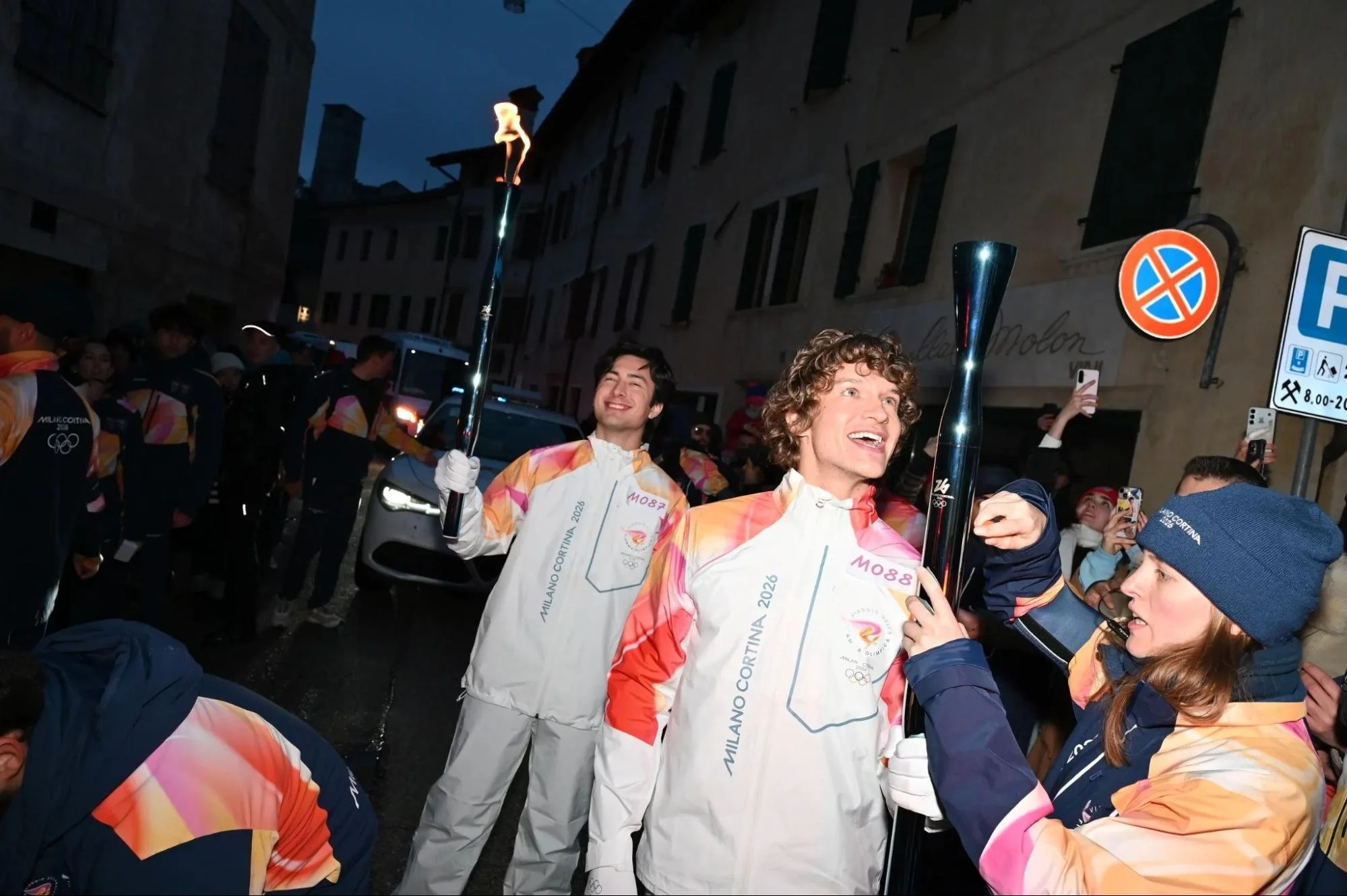
‘Heated Rivalry’ stars Hudson Williams and Connor Storrie carry the Olympic Torch in Milan. Photo via Vanity Fair.
In the locker room, at the State of the Union, the men's team failed to meet that moment. And by doing so, they threatened to taint both their win and the women’s.
In the back of the locker room during the Trump phone call, you can hear one of the guys yell out, "two-for-two." Both teams were excited for each other's win, no denying: Abby Murphy, a Minnesota Golden Gopher on Team USA, said that the celebration was “a huge, honestly, part for both teams and a really cool moment.” She espouses the great relationship between the teams, how they cheered each other on throughout the Olympics, and practiced together.
Unsurprisingly, the men's team wants this to blow over. But the women's team does too, because it's obviously taking away from the win. Minnesota Frost player Kelly Pannek after practice the other day: "I can’t wait ’til this blows over in a week and we can go back to each team being proud of what we accomplished. And proud of each other."
Early Saturday, an announcement broke that the Hughes brothers—Quinn and Jack, both critical to Team USA’s win, the latter even losing his teeth via a stick to the mouth to win the final—would be making a not-so-surprise cameo on SNL later that night. Fans complained, and some threatened not to watch the show.
I was excited for Storrie to host the episode, and even felt a little conflicted; if this would just be a PR ploy to win back the demographic they seemingly lost, it felt disingenuous.
Watching Storrie’s monologue, laughing at charming authenticity and funny delivery, and suddenly the Hughes brothers are on stage. Applause. Commendation. Obligatory jokes about them not actually watching Storrie’s show.
Storrie sighs, “I hope some hockey players watched it.”
Out walks women’s hockey stars Hilary Knight and Megan Keller. Studio 8H erupts in applause, an incredulous standing ovation. From my apartment, I leap out of my bed, clap and cheer as if they can hear me.
“Don’t worry,” says Keller. “We watched your show.”
And to even more applause, Knight says, “It was gonna be just us, but we thought we’d invite the guys too.”
From the grin he’s holding back the whole monologue, you can tell Storrie feels that he is part of a pivotal moment, not just lucky to be standing onstage next to four Olympians, but for all five of them to be representing what hockey could be: for everyone. “My shows speaks to people who are not always represented in hockey,” Storrie says.
Notably looking at the actor, Jack replies, “These gold medals aren’t just for us. They’re for all hockey fans. Yours too.”
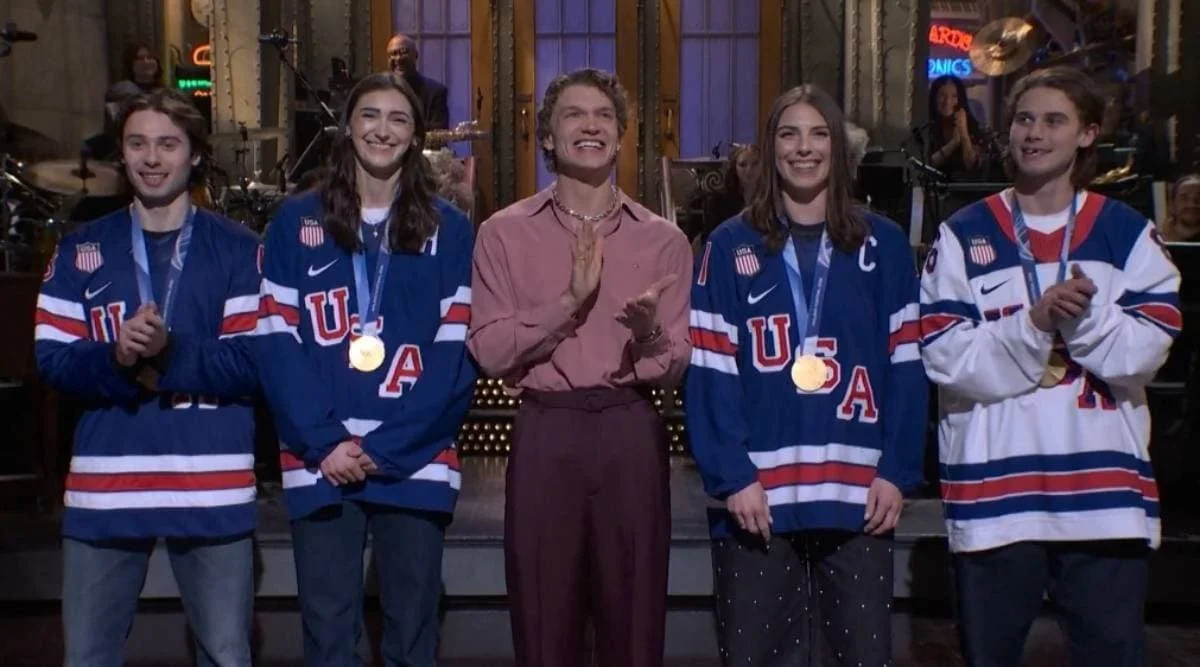
Quinn Hughes, Megan Keller, Connor Storrie, Hilary Knight, and Jack Hughes share the SNL stage on Saturday, envisioning a unified potential future of hockey. Photo from Faceoff.
We can move on from this moment and still want better for the sport.
“I think this is just a really good learning point to really focus on, you know, how we talk about women,” said Team USA Captain Knight on Thursday. “Not only in sport, but in industry. Women aren’t less than, and our achievements shouldn’t be overshadowed by anything else other than how great they are.”
On that note: Knight is now the most decorated U.S. women's hockey player after tying up the gold-medal winning game against Canada before going into overtime.
Knight plays for Seattle in the Professional Women’s Hockey League (PWHL), which drew about 740,000 fans to games last season, compared to the NHL’s attendance of 23 million. But 7.7 million people watched the women’s gold medal game, with a surge of 2 million turning on the TV when they went into O.T.
At a minimum, this reveals a market opportunity. But there’s more here: the sport itself can be a lot more than what it is now. Can mean a lot more to a lot more people, can support an underrepresented and under-supported demographic.
Hockey rocks. My genes are 50% Minnesotan, so it’s in my blood to love watching it. It's fun, it's gritty, it's unique. As a sport, it totally should have more fans.
As a culture, it clearly has work to do. But if it does, it might have an eager swath of new fans to usher in.
We defeated Canada across the board. Our next common enemy: misogyny in sports.
With great power comes great responsibility. If hockey wants to survive, it better get training.