
AI Anomie and Preventing Dystopia
By Annabel Gregg
I am lying on the couch, which is actually our bed and also our dining room table, because we are twenty-somethings in a studio apartment that has room for only one multifunctional piece of furniture. Windows are propped open, wind is fluttering through the screens, gloaming is settling over evening. We are about to watch How I Met Your Mother, a show I have watched in its entirety more times than I can count, and one that Carmelo has astoundingly never seen. In our kitchen, which is just the other side of our bedroomlivingroomdiningroom, he makes a smoothie to sip while we watch.
While I wait for him, I skim an article about a data center slated for development in an upstate town, one not that far from where I grew up. A few days later, I will lie down on the same spot and read another article about another data center, this one proposed for the city he and I live in.
He hops onto the couchbedtable with his fresh smoothie bowl, proud of his little creation.
“Whatchya reading?”
I tell him.
Slowly, Carmelo nods, takes a cursory bite of the fruity moosh. “I have to take a class on that,” he says.
“On what? Using AI?”
“Yeah, like how to wield it.” Quickly, he senses my apprehension. I work for our state’s environmental protection agency; ostensibly, I speak for the trees. He works in finance: “I don’t have a choice. I have metrics to keep up with. If I’m slower than the guy next to me, he’s the one making a bonus, not me. And I’m not getting left behind.”
We go back and forth, at first haltingly and then in a full-blown argument. His position, though taken grudgingly, is that the AI boom is here, ubiquitous, and inevitable. His industry is the one most likely to cast off ethical considerations in pursuit of “progress,” curating a culture that encourages its employees to get on the train or tacitly “get left behind.” There is, from his perspective, no time to stop and consider the harms caused by AI, because the harm caused to those in the industry is more immediate and apparent if they do not adopt this revolutionary technology.
And my position, also taken grudgingly, is that I do not blame him. The companies that have developed this technology deem us inefficient and deficient if we do not incorporate AI into our daily lives in every feasible way–our work, our relationships, our decision-making. The collective attitude is to ignore the naive voices of NIMBYist residents who fear data centers will destroy their electric grids, raise utility rates, or contaminate local water supplies, because p-r-o-g-r-e-s-s. They have a name for my camp over in Silicon Valley, as SF-insider and AI writer Jasmine Sun decodes: decels, a combination of “declarationist” and “incel” (also “doomers,” a play on either Boomers or Zoomers, not sure).
“You’re not going to convince me to just let someone else out-compete me,” he concludes. “I have no choice.”
And as much as I want to insist that he does, despite my (arguable) ease to take the contrapuntal decel position, I realize I can’t actually assuage the existential concerns of those that feel they have no choice. Even my own boyfriend.
My first thought is to seek the facts. That oughta do it! Many of us, including Carmelo, have a vague idea of the impacts of the AI boom: general environmental harms from sucking up all that energy, and rural and otherwise vulnerable communities being taken advantage of by money-hungry tech companies. But I want my evidence to be concrete, inarguable, and I want it localized.
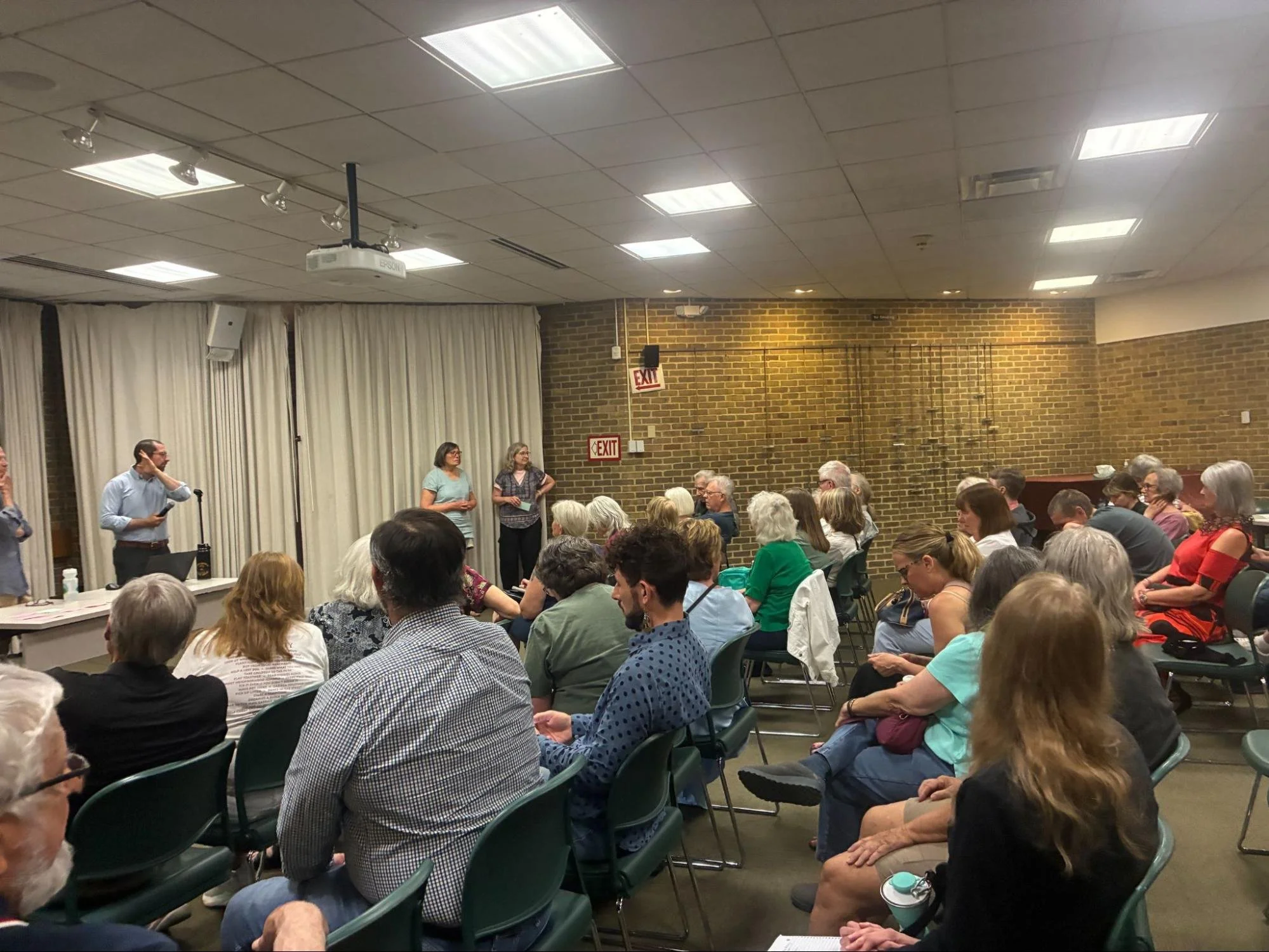
On the night that New York passes the nation’s first data center moratorium, Bethlehem Neighbors for Peace talk with experts about what the proposed Kenwood Commons data center means for the community.
HORNY LOCAL DATA CENTERS WANT TO CONNECT WITH YOU!
On a hot Thursday evening, I head to my local library, where a neighborhood coalition has convened to discuss the new data center recently proposed to be built in New York’s capital city.
Kenwood Commons—part of a larger $250 million development project for a vacant property in Albany’s South End, a state-designated environmental justice area—said their new data center might use up to 180 megawatts (MW) of electricity in a year, which, according to the engineer who came and spoke to residents, is whopping. Oliver Holmes, RPI’s resident P.E. for the last two decades, informs us that data centers are not new; RPI’s got one (and only uses something like 4 or 5 MW a year), our major local hospital’s got one, and so do a lot of other facilities that need to both store data and consume a lot of energy to operate (like a hospital, or college campus). But these hyperscale centers designed to make millions of computations per millisecond, in pursuit of things like mining for cryptocurrency or fueling AI, are. And they’re concerning.
He warns us that data centers are the next hot thing. They are indeed hot; the racks of computer chips running these data centers get so hot (around 120 degrees F) that they need thousands of gallons of water to cool them, or they’ll melt.
But it’s also just the trendiest thing for rich people to get richer. Developers are suddenly and voraciously buying up thousands of acres of land and siting projects, mainly in rural areas, likely contributing to a burgeoning “AI Bubble” akin to the housing market bubble of the 2000s. Nearly 1,000 hyperscale data centers are proposed for development nationwide.
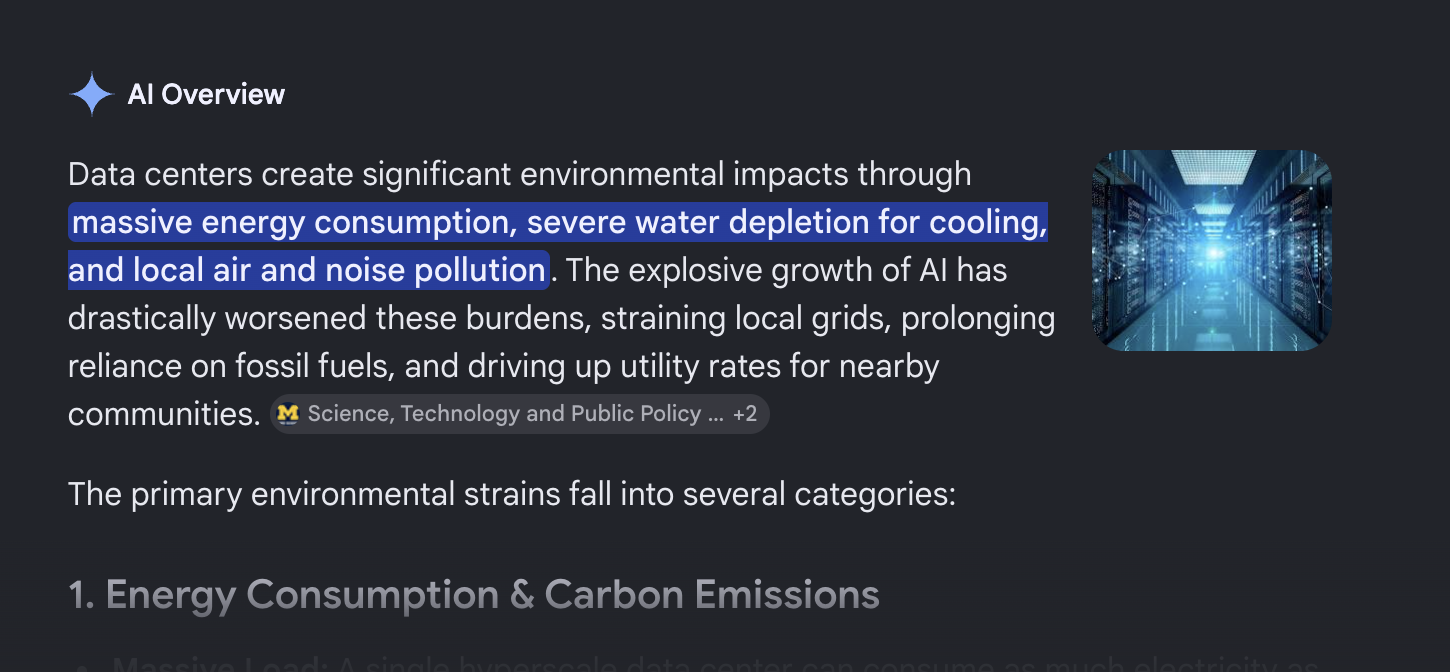
AI tells me that AI has a detrimental environmental impact (Source: Google).
SO WE OUGHTA DO SOMETHING, RIGHT?
So, unbridled AI development seems pretty indisputably harmful. But that does shit for us if the development remains just that—unbridled. The AI boom still feels inevitable.
Regulations on development are loose at best, and the attitude of the federal government seems to be to allow that to continue: prioritizing speed of ubiquitous integration rather than literally any consideration of environmental, social, or economic harms that could be caused by widespread development, or the sociological normlessness fostered by the de facto omnipotence of AI in all ways of life. Terminology like “AI supremacy” and “dominance over foreign entities” elicits the fear that is necessary to secure buy-in: if we don’t hop on this roaring train, we will get left behind. By China.
The White House kicked off June with its first attempt at tangible regulation, modestly reversing course on its previous no-holds-barred approach. Trump released an Executive Order granting the federal government oversight of certain new A.I. models before they are publicly released. The EO specifically calls on federal agencies like the Department of War to develop a plan for assessing and collaborating on what they call “covered frontier models,” AI models with advanced cyber capabilities (like Anthropic’s new Mythos model).
This likely comes after Anthropic was worried about opening its own Pandora’s box with Mythos—the new Claude designed to seek security vulnerabilities—and its potential to be exploited for just the opposite. Anthropic’s security tester says this new frontier model “has found vulnerabilities, and in some cases crafted exploits, sophisticated enough that they were both missed by literally decades of security researchers, as well as all the automated tools designed to find them.” Mythos looked at cybersecurity code structures that have stood for decades and found holes in a few seconds. “If these previously were mostly secure because it took a lot of human effort to attack them, does that paradigm of security even work anymore?”
And yet there are still hardly any holds barred: everything in the EO is voluntary.
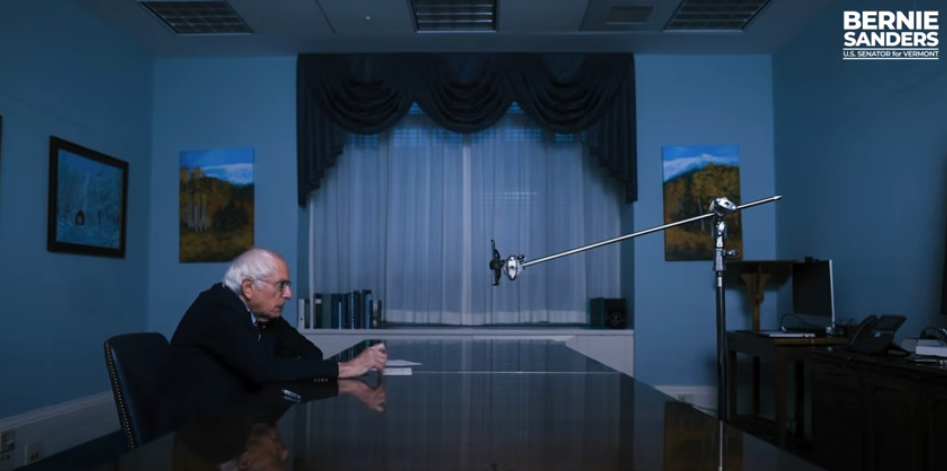
Senator Bernie Sanders (I-VT) in conversation with Claude, the generative AI bot created by Anthropic.
DURKHEIM AND AI ANOMIE
When you find yourself fearing the unknown, it can shift your thinking: maybe we do need to win this space race to nowhere. And I mean, AI can’t be all bad, right? It can help diagnose and treat cancer. That’s pretty sick. Speeding up the tedious process of coding seems to have a tangible public (and private) benefit (modernity’s westward gold rush seems to prove that). And a $15 trillion potential bump in world GDP sounds… good, I think?
Well, I know who that sounds especially good to. On June 1st, Anthropic, Claude’s mother company, covertly filed for an initial public offering, joining SpaceX and OpenAI in the cohort of AI companies planning to go public later this year. “Their I.P.O.s, which would be among the biggest ever, could create a tsunami of investment and employee wealth, and mint the world’s first trillionaire in Elon Musk, who owns about 50 percent of SpaceX,” reports The NY Times.
Ah, fuck. The train’s not only leaving, it seems, but hauling ass.
Even AI’s benefactors, the twenty-something entrepreneurs and programmers finding lucrative refugia in Silicon Valley, are purportedly experiencing this latent fear. “Even the people building AI don’t feel insulated from precarity. Nobody knows if they’ll end up above or below the API: whether you’ll be the automaters or the automated,” according to Sun’s insider tech world observances, but they’re still plowing forward in hopes they will catch the train, maybe even [help the robots] conduct it. The rest of us, the ones who did not anticipate a meta-human intelligence usurping our purpose in life, are inclined to feel even worse.
Carmelo and I talk about this. His semi-closeted reverence of Wall Street, a by-product of his own ambitions of upward mobility, prompts his example. Corporations are chains of staffers: at the top are the partners and presidents. Below them are the VPs. Below them are the associates. And below them are the analysts. Colloquially, the analysts don’t actually do any analysis. You could probably outsource the sort of computations and deck creation that those lower-level employees do to generative AI. If we’re recognizing that, higher-ups motivated to cut costs definitely are too. No sense of ethicality is gonna prevent them from cutting deeply into the base of juniors who are “making decks for the associates, who then hand those decks over to their VP to present to clients, with their partners in the room supervising.”
In this hypothetical, the professional jobs that remain are the higher-ups: the really educated and really experienced ones who drive the company. But this is what Brookings Institute’s Molly Kinder illustrates would still end up degrading companies in the long-term: you still need that deck-making junior workforce because, at the very least, they are placeholders. When those partners inevitably die and retire, you need the ladies-in-waiting who are ready to hit the ground running: “The people who would have been the next generation of partners, who would have spent ten years grinding through the associate ranks before making partner, never get hired in the first place” otherwise. You can’t just have masters: you need apprentices too. Otherwise, the Sith race dies.
And remember that there are essential jobs that AI truly cannot perform. The jobs necessarily human. I can’t help but think that there are some jobs, even in the cognitive-heavy professional sphere, that are irreplaceably human. Creativity is not something that AI employs. It can remember things, it can search things, it can compute things. But it can’t think of new things. Lawyers: effective legal reasoning takes strategy and novel case interpretations. Fashion, beauty: humans decide what looks good, an ephemeral and shifting target. Medicine: inventions take experiments, prompted by hypotheses, prompted by ideas. AI can pretend to care, but bedside manner only feels real when there’s actual empathy driving it. Ecology: you need to touch nature to restore it. AI has no senses. Writing: don’t even get me fuckin’ stawted.
This is a scary time. But when artificiality is threatening your career as much as your sense of self, it might be the best time to reconnect with what makes you human.
To reiterate a metaphor offered by Kinder, let’s break reality down into three sections. We’re in Reality 1 right now. Reality 3 is what the AI-at-full-throttle camp touts as the main reason to plow forward: a utopian society where AI has made the economy so efficient that there is a surplus of wealth. So much money we have to redistribute, so much extra time we have to find new great hobbies.
In between those two realities is Reality 2: the transitional one. Where all sorts of change happen—people lose jobs, yes, but also institutions are fundamentally changed. That transitional reality is where all of the policy decisions have to happen.
It might feel like we’re in Reality 2 in a psychological sense, but as Kinder points out, we’re still actually in Reality 1. AI hasn’t had a revolutionary impact on jobs yet, but it can and likely will. We are at a stage where we can decide what we need to before we reach the “empyrean reality.”
“…the transition is not the road to the destination. The transition partly is the destination, because the political and social forms that emerge from it will determine what kind of post-AI society we actually inhabit.”
I stumble upon a sentence that sums up the entire dilemma of this moment we’re in, and why everything feels like a sci-fi novel: “All this expansion of activity is generally acknowledged to be useful, but there is nothing obligatorily moral about it.”
That line isn’t from 2026, it’s from 1893. The Division of Labor in Society was written by French sociologist Émile Durkheim at the peak of the Industrial Revolution, when economies and societies were radically and rapidly shifting as a result of the new technologies mechanizing all industries, leading to mass specialization, and the world’s “unwitting submission…rendered to it.”
Durkheim helps us understand the crisis of consciousness that many of us are experiencing as a result of the normlessness beget by the AI revolution. We are suddenly unwittingly submitting to it. That feeling we have of truly not knowing—not knowing if we’re gonna lose our jobs to AI; not knowing whether crumbling rural communities should take the lucrative short-term buy-out offered by opportunist data center development proposals or protect their autonomy, drinking water supplies, and sanity; not knowing if the international race for AI domination will spur an energy demand so great that none of us can afford to own lamps anymore; of not knowing if we’re at the beginning of The End—is the result of a total overhaul of norms, what he sociologically (and, in French) coins as anomie.
A normative vacuum period. Folks during the Industrial Revolution experienced a similar norm-crumbling as a result of the completely new ways of life (‘sustain you and your family on a farm or something’ versus ‘get really good at one component thing and contribute to society as a functional whole’), which prompted similar philosophical and socioeconomic ponderances.
AI Anomie. That’s what we’re experiencing.
Kinder emphasizes we need to build “institutions, policies, and norms capable of holding the political and economic order together through a hard transition, or…the version of Reality 3 we eventually inhabit will be shaped by the populist backlash, the protectionism, the broken trust, and the political damage we accumulated by failing to manage the in-between.”
How do you fill a normative vacuum? How do you survive a tsunami? Well, frankly, you won’t even have a chance if you don’t hold your breath.
But you’d only consider even trying to survive if you have hope.
AM I CATHOLIC NOW?
In May, Pope Leo XIV released his first encyclical, Magnífica Humanica, the Social Doctrine of the Church. Never before would I have chosen to read an edict the length of a novella written by the world’s highest religious figure, if not for this one’s virality, relevance, and strikingly important guidance on AI (and all sins plaguing the earth, from genocide to slavery to war).
Did I read all 40k words? Yes. Did I zone out during the parts praising the Lord, or when he says we’d be doing this all in the name of God? Maybe, respectfully. Some Northeast Yuppie Atheist skipping the overtly Catholic parts shouldn’t be a shocker. But those parts are just as necessary as the rest: they are explicit calls to social action, exuded in the language Christians speak.
I am quite certain that a decade from now, juniors will be reading passages from the Magnifica Humanica for the APUSH test. I hope so, anyway.
The Pope calls the advancement of AI and digitalization the “res novae of our time,” alluding to the original encyclical published by Pope Leo XIII in 1891. While acknowledging that, generally, technological advancement can and has benefited humanity, he underscores that those in power are the ones who dominate, whether an “ambiguous tool” will “cause harm when not oriented toward the good.” Invoking Emmanuel Kant, he warns that unbridled technological progression in the name of optimizing efficiency means “persons end up being reduced to a means of achieving results, a resource to be used and exploited, and are no longer recognized as a proper end in themselves who should never be instrumentalized” (emphasis added).
Most notably and oddly reassuring to me is that Pope Leo characterizes this time as one of clear anomie:
We are living through a rapid phase of transition, a “change of era,” in which—while some are vying for the future of new technologies and others dedicate themselves to reflecting on the matter—most people are watching and waiting, observing from afar and merely hoping for the best. For this very reason, crucial questions impose themselves on our conscience and can no longer be avoided: Where are we going? Toward what goal do we wish to orient ourselves? What direction should we choose as a people and as a human community?
But he stresses that just because we may feel this dizzying normlessness, “a subtle temptation may emerge, namely the thought that the problems are too big and we are too small, and that our choices, therefore, cannot make a difference. This is a polite form of resignation, often disguised as realism.” No one is without responsibility, in his eyes. The answer is not us either saying “yes” or “no” to AI, but how we will choose to move forward into the new epoch: leaving a swath of people behind in the name of rampant progression, or slowing down to make it a sustainable journey. And we all play a role, whether we’re AI developers ourselves or just the ones relegated to use it (or choose not to).
Above all, Pope Leo stresses humanity’s ability to overcome what we’ve begun to create. He calls for sensible regulation, with justice in mind: “It is necessary to establish adequate regulatory tools capable of upholding justice and curbing the distorting effects of technological power.”

Pope Leo XIV throwing out the “6-7” gesture in the Vatican.
MOVING FORWARD
We need regulation. Regardless of what the White House may want, regulation is up to Congress, thank fuck.
We are getting hit with a tsunami. We need to at least try to hold our breath.
So far, the best policy lever I’ve seen offered to address this unprecedented socio-technological shift is a very simple idea: a pause. A little time to get our proverbial shit together, not a permanent ban. A moratorium on data center development would put a pause on these projects, giving governments time to figure out what needs to go into permits to protect residents, and residents time to stand up and say what belongs in their communities (or doesn’t). It also, honestly, gives companies time to fucking breathe. They need to figure out how to make AI sustainable, or that AI bubble really could burst.
The evening I spend at the library with my neighbors discussing Albany’s potential data center, my state legislators are gathered a few miles away, discussing the merits of a statewide pause. One of the speakers, Isaac, is from a community organizing coalition called Frack Action, and he tells us about the bill, introduced by the State Senator that reps Albany. With optimism, he tells the crowd that he has “not seen an issue get this amount of engagement since the early days of the fracking fight.”
And this, as we can see, is true–evidenced by the swift action taken on said bill, which had been dwindling in committee until just a few days prior. Someone in the back of the room urgently gets his attention, and neighbors play a game of telephone to reach the experts speaking at the front. A whisper into the engineer’s ear. Then, into the microphone with a modest smile, “I’ve just been told that the data center moratorium bill has passed.”
The audience claps, a wave of optimism after over an hour of doom and anomie. Very cool and very discreetly, I pump my fist. Now we’ve got six months to get our Governor to sign the thing into law. But New York, as it tends to do, makes history. We’re the first ones to at least try holding our breath.
Put simply, to create a world where AI isn’t causing harm, where our tools are oriented toward the good and not exploitation, we have to decide that that’s what we want them to be. Focusing on ethical decision-making can focus strategic research (like sharing pathology data for disease detection research) and craft legitimate regulations without plowing forward with environmental injustices and workforce destruction.
We cannot forget that artificial intelligence wouldn’t exist without the human intelligence that created it. The day after Trump announced his EO, Senator Bernie Sanders announced his idea to create the AI Sovereign Wealth Fund, proposing a 50% tax on all stocks of the leading AI companies, giving (American) humans a direct ownership stake in the technology that was "built on the collective knowledge of humanity."
AI isn’t a sovereign entity (yet). It was something humans created. For human advancement? In theory. But on this research journey, I feel more empowered that the right move ethically, environmentally, and economically is to just take a deep breath before we let the wave come crashing down on us. We’ve all got work to do to make sure we do this morally. To do anything else could be for human regression.
And so, Carmelo: I’m wrapping up this article on our couchbedtable. I did not use AI to write any of it. I’ll send it to you once Natalie publishes it. You will probably be at work.
The world will indeed look different as a result of AI, and because we are all specialized little cogs in this machine of humanity, we all have a role to play in the fight for new, just norms. My role, in part, was writing this article, probably. Yours, at least, is reading it and recognizing that your strengths are innately human. And that maybe you should write your own emails.
With love (something AI will never be able to do),
A.
My favorite place is together, by Anna Laura.
Author’s Note: For a variety of perspectives on this issue, I can’t recommend enough reading Jasmine Sun, Anna Mitchell, and Molly Kinder. I really learned a lot from their [fantastic, and often frontline] discourse on the AI Boom.