Coming of Age (Again): Subversive Girlhood in Shainberg’s 'Secretary'
By Zoe CN Smith
What does girlhood look like today? It’s an interesting question in an era where social media seems to be simultaneously curating a generation of eerily self-possessed tweens whilst also inciting a nostalgic adolescence in anyone in their mid-twenties and above (#yolo). In many ways, it’s reflective of the age-old paradox: the young can’t wait to grow up, and those who’ve crossed over look for ways to go back. We now know our development is not as linear as we might’ve thought, with recent studies finding our brain stays in the adolescent phase until our early thirties.
It’s pointed, then, that girlhood has become a dominant aesthetic. In music, we can see it in Olivia Rodrigo’s recent pivot to a subversive Courtney Love-esque#kinderwhore aesthetic, Sabrina Carpenter’s longtime hyper-feminine vintage branding, or in last summer’s born-again adolescent narrative of Lorde’s ‘Virgin’. It’s in debates around baby doll dresses on X, the critical resurgence of Lena Dunham’s Girls, and the now-established popularity of Sandy Liang bows and #coquettecore pumps.
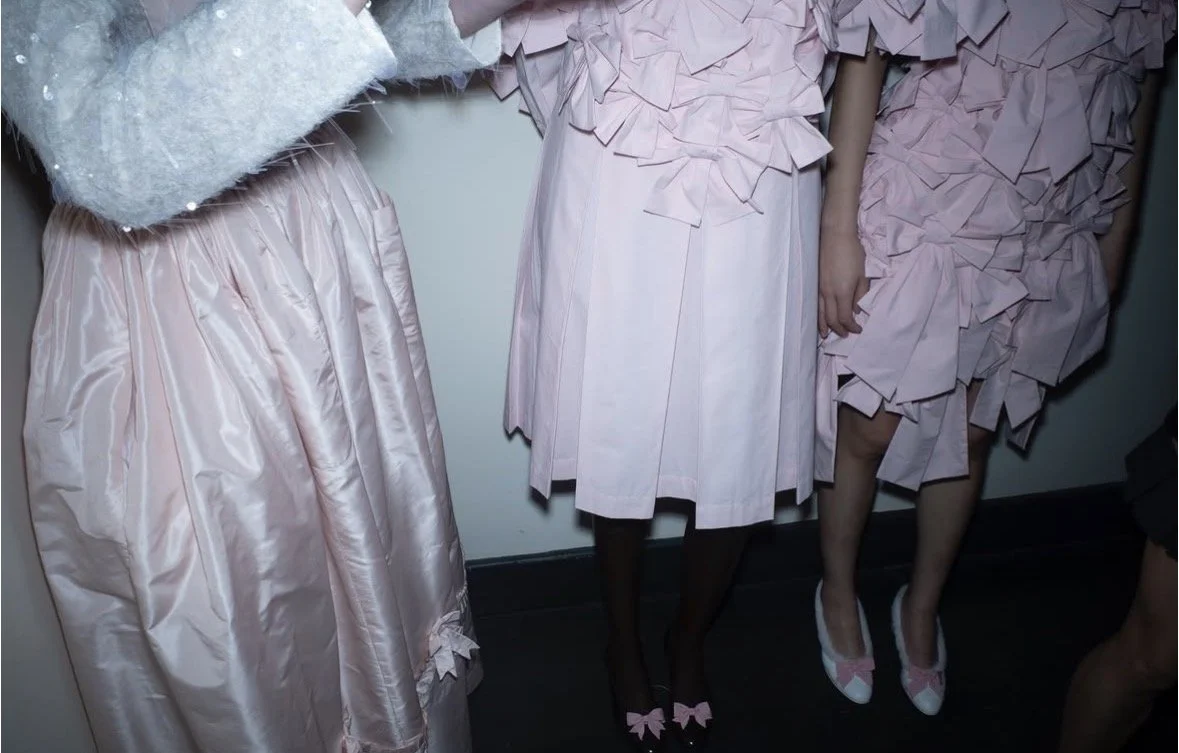
Courtesy of Sandy Liang via @stolenbesoss
This rise in girl-coded references comes at a moment when the political landscape around girlhood has become increasingly fraught. Against a dystopian backdrop of the Epstein files, barely legal OnlyFans content, and AI deep-fakes, to channel extended girlhood as an adult today is to navigate accusations of hyper-sexuality, catering to the male gaze or even promoting pedophilia, which is to say, that the anxiety around extended girlhood is far less interested in what it is and what it means, than with dictating what it should be. If the aesthetics of girlhood can be understood as a kind of rebellious fantasy or reclamation of a woman’s youth — not necessarily her girlhood as it was, but what it could have been, and still could be— it pushes back against the idea that messy self-discovery has an age limit. And nobody understands this better than the film Secretary (2002).
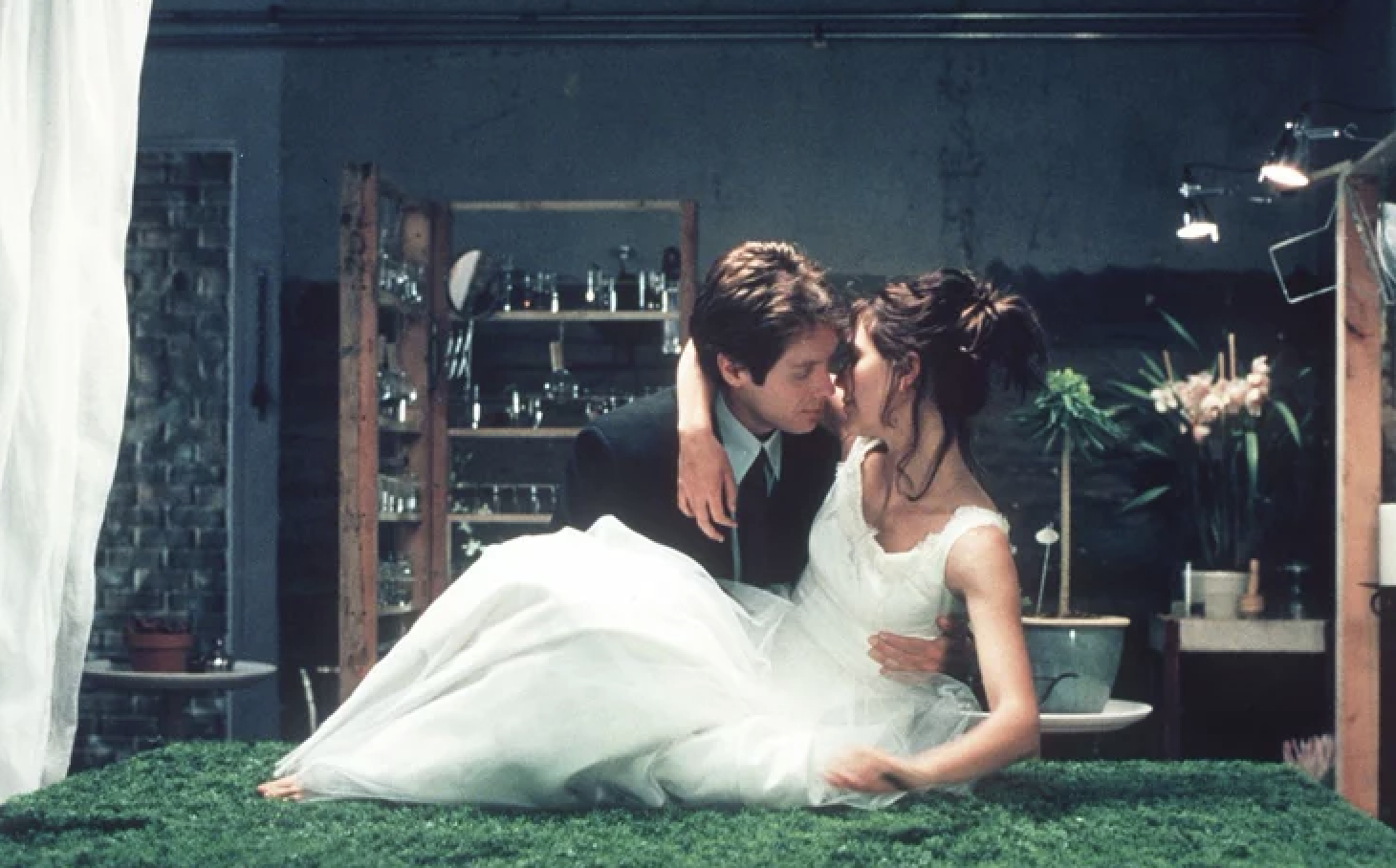
Loosely adapted from a short story by Mary Gaitskill and directed by Steven Shainberg, Secretary stars a young Maggie Gyllenhaal and a prototypical James Spader. It tells the story of Lee Holloway (Gyllenhaal) as she attempts to assimilate back into suburban life following a stint in a mental hospital. Despite being wracked with darker impulses that manifest as a continuous urge to self-harm, Lee begins to manifest a stable, albeit unsatisfying life for herself, living with her parents, dating a ‘safe’ acquaintance from high school, and earning top marks in a typing certification. It’s through this course that she soon leads her to the office of E. Edward Grey (Spader) to become his secretary. What begins as Grey’s annoyance at Lee’s office errors and desire for her obedience soon graduates to mutual arousal as they embark on a dominant-submissive relationship. For Grey, it helps him accept his inclination and overcome a fear of being loved for himself. For Lee, it’s a glorious coming of age where she finds radical agency.
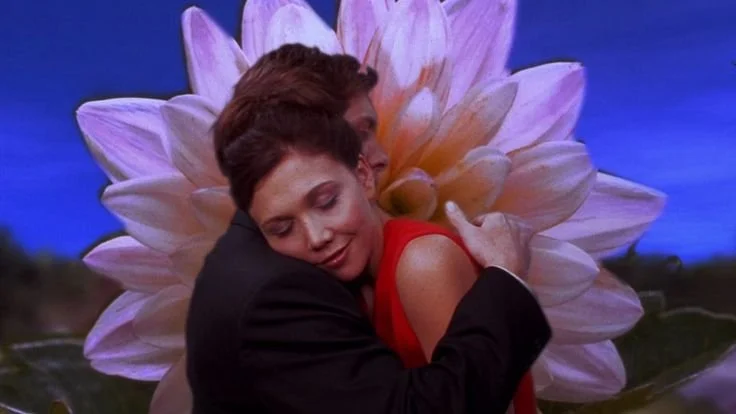
Secretary (2002)
Secretary’s depiction of girlhood is just as subversive as its representation of sexuality. The film deftly navigates the complexity of reckoning with girlhood as a woman, taking care to emphasise Lee’s autonomy as an adult whilst also celebrating her girlishness and whimsy. From the beginning of the film, it quickly becomes clear that Lee’s trauma has meant she’s had to forfeit a conventional childhood. She enters the world as if to continue her adolescence, simultaneously wide-eyed and naive, but also weathered by the pain she does know. This is reflected in the film’s nuanced portrayal of Lee’s extended adolescence. On the one hand, the film represents girlhood’s claustrophobia and the possibilities of its trauma. The bedroomLee returns to after her inpatient stay seems frozen in time to that of hers at thirteen years old: pink-purple butterfly walls, butterfly mobiles, and soft toys strewn on tables and vanity mirrors. Even the weapon she fashions for herself to self-harm is the sharpened foot of a plastic ballet dancer doll, carefully placed back next to a bottle of iodine in a ribbon and sticker-filled box.
And yet on the other hand, Secretary reminds us there’s joy in girlhood too. The film positions Lee’s extended girlhood as the very reason for her playful perspective on the adult world. She possesses all the qualities typically associated with a curious child— she’s expressive to a fault, open-minded, stubborn in her own determination, and resistant to being swayed by the opinions of others. Gyllenhaal deftly balances Lee’s rumpled, and almost adolescent self-consciousness with a burgeoning adult sensuality and an intense understanding of what she wants. She takes us through Lee’s journey as she embraces ‘good’ pain on her own terms, and the confidence and self-possession it helps her develop. The unwaveringness with which she pursues Grey is refreshing to see in a 2000s rom-com, let alone within the context of a dominant-submissive dynamic which presupposes his agency over hers. Far from imbalanced, we get the sense that Grey and Lee recognise something profoundly essential in each other.
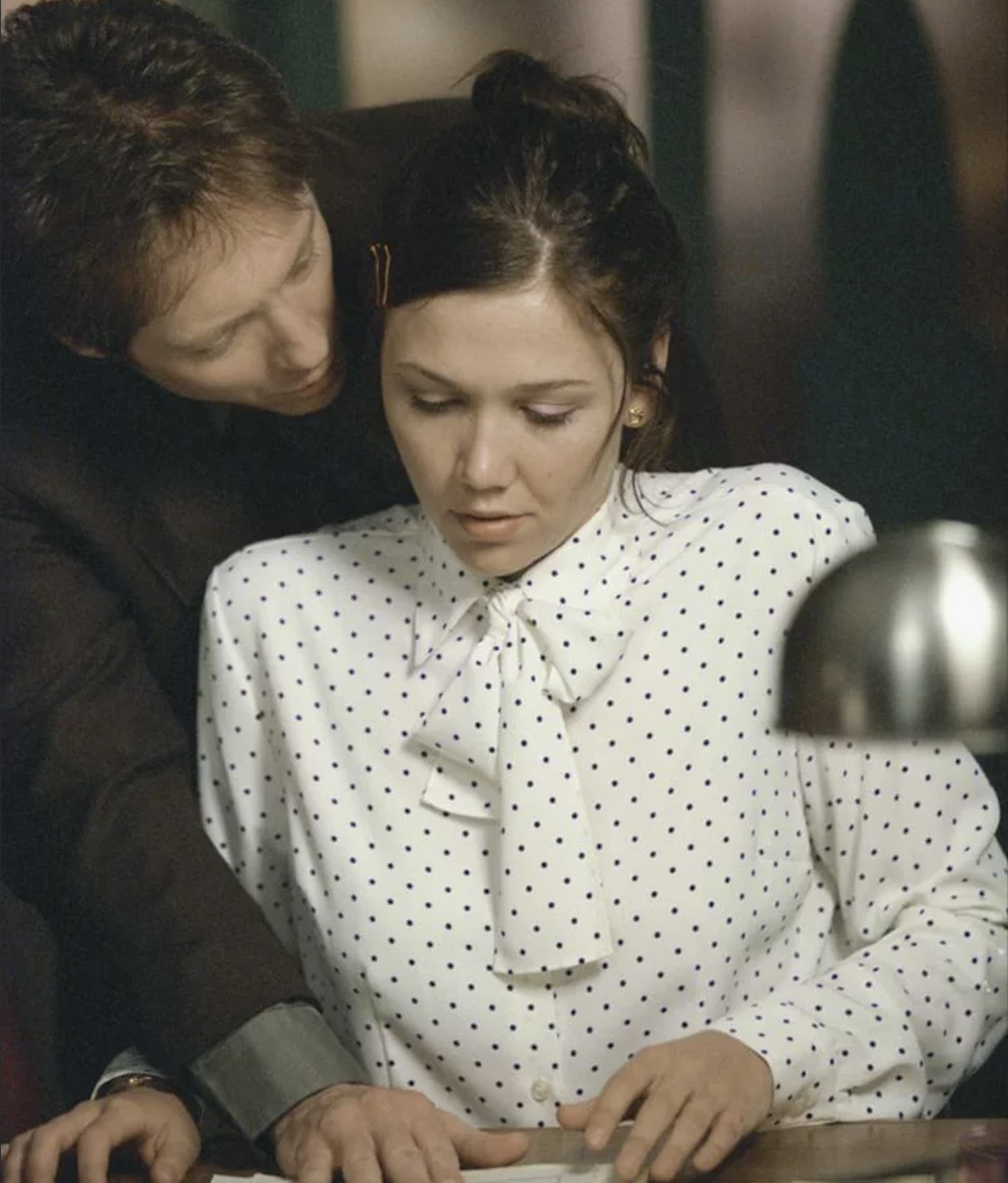
Secretary (2002)
The turning point for Lee and Grey’s relationship occurs in an intimate conversation in Grey’s office. Concerned by Lee’s plastered-up scars and flashes of her sewing kit, he asks to speak to her. The interaction is surprisingly tender. He asks her why she cuts herself. She says she doesn’t know. He reveals he shares a similar feeling. He asks her: ‘Is it that sometimes the pain inside has to come to the surface, and when you see the evidence of the pain inside, you finally know you’re really here? Then, when you watch the wound heal, it’s comforting. Isn’t it? The expression on Lee’s face says everything. She’s been understood in a way no one has seen her before. When Grey instructs her never to cut herself again, there’s no doubt in the mind of the viewer that she’s going to do exactly as he’s asked. Not just because it’s what he’s decided for her, but because he’s permitted her to be kind to herself, even if she doesn’t believe she deserves it. It reminds me of a similar moment from season 2 of Fleabag, when Fleabag confesses in the church:
I want someone to tell me what to believe in. Who to vote for and who to love and how to…tell them. I just think I want someone to tell me how to live my life, Father, because so far, I think I’ve been getting it wrong.
Whilst both Fleabag’s and Lee’s fantasies involve farming out their decisions to other individuals, it’s not so much about the total freedom or evasion of responsibility as it is about trust. Trust that someone has your best interests at heart and is capable of treating you better than you could ever treat yourself. That they will help you make the ‘right’ decisions. Of being someone who will take care of you when you don’t want to, and love you despite everything you dislike about yourself. Outwardly, it seems like both Lee and Fleabag are looking for a traditional parental role, a figure who can supply unconditional love and a sense of direction. In reality, the truth is more complex. The men they rely on are as tender and uncertain as they seem authoritative. Both Lee and Fleabag do, in fact, quickly learn what it is they want. Their inciting relationships don’t end up dictating anything truly new to them, only revealing what has always been there. In Lee’s case, it’s the realisation that there is a strength to her pliancy. She is not a passive customer.
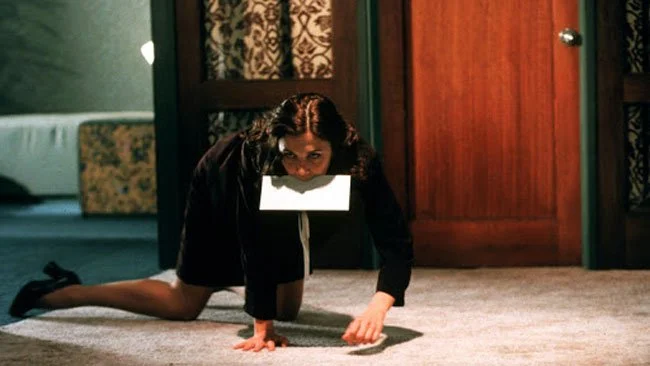
Secretary (2002)
In the years since Secretary’s release, Gaitskill has gone on the record to say that she saw the film as a Pretty Woman version of her story. This is true in the sense that the film is a positive, commercial romcom. Where the short story protagonist felt shame, Lee finds liberation. In the short story, the power dynamic is deliberately far more blurred and potentially even sinister. In the film, Lee is aged up, and the dynamic, whilst complex and imperfect, is portrayed as consensual, and if anything, desired more by Lee than Grey. And yet, in the process of ‘pretty woman-ifying’ it, the film version ends up offering something more radical — a work which subversively channels girlhood to skewer judgment on pain, pleasure, and how different women might find theirs. Mainstream feminism has fought for greater autonomy and independence throughout history, confirming everything that we’ve known all along: that women are strong, independent, and capable. To admit a desire for submission, to outsource your decisions to someone else, or even to outsource your pleasure and pain, seems like a betrayal of everything that feels traditionally empowering to women. In Secretary, Lee’s consensual submission is many things: an authentic expression of self, a turn-on, and above all, a reclamation of a lost girlhood. That’s why when she declares ‘I feel more than I've ever felt, and I've found someone to feel with, to play with, to love, in a way that feels right for me’ at the end of the movie, her words feel as radical as they are true. You believe her. The beauty of Secretary is that it reminds us that girlhood is a space for self-exploration. A space to play, to emote in ways which might otherwise be considered immature for your age, a place to shed the pressures of self-definition. In the process, Lee shows us that games aren’t just for children, and they can be whatever you want them to be. Sometimes, they might even be exactly what you need.