By Dani Carnivele
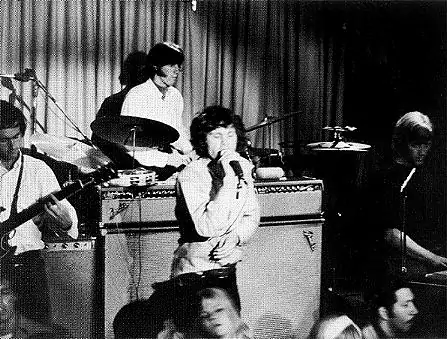
The Doors at The Whisky a Go Go (1966)
The Sunset Strip didn’t die. But we did stop revering it.
The scene that was once the beating heart of Los Angeles nightlife is now anything but alive. For a stretch of time, the Sunset Strip didn’t just host rock culture, it defined it. A few blocks of Los Angeles pavement held up an entire mythology of hairspray, leather, neon signs, and the belief that excess wasn’t a lifestyle but a form of truth. Bands didn’t just play shows there; they auditioned for immortality. Venues like Whisky a Go Go helped launch bands such as The Doors, drawing a wave of young artists chasing the same mythology of fame and excess. Over time, music on the Strip became less about sound than spectacle. Performance blurred into lifestyle, and lifestyle into escalation- where ‘rockstar’ identity was measured by how far limits could be pushed.
However, scenes don’t die in one clean moment. They erode slowly, then all at once, until you realize the noise has moved somewhere else. By the early ‘90s, the Strip was still performing its own fantasy of rebellion, clinging to glam’s exaggerated masculinity and spectacle, still acting like it was the center of something, but the center had already shifted.
It shifted north, into a colder, quieter place where bands like Nirvana weren’t interested in mythology at all. They weren’t building gods; they were describing damage. That difference mattered more than anyone in Hollywood wanted to admit. The decline of the Sunset Strip as a dominant rock scene was not just a genre shift, but the result of a culturally closed, male-centered ecosystem that prioritized image and excess over curiosity, ultimately failing to evolve as grunge redefined what emotional honesty in music could look like.
At its peak, the Sunset Strip wasn’t just a stretch of clubs; it was a fully self-contained identity machine built on glam, excess, and performance. Hair metal didn’t just celebrate excess; it depended on it. The music was built around escape, turning life into something louder, shinier, and easier to swallow. Sure, pain existed, but it was always turned into a party before it could even become a question, and scenes built on repetition rather than curiosity eventually calcified. The lack of curiosity isn’t “what’s next?”, but something more dangerous: what else is there to feel?
When grunge emerged out of Seattle, bringing with it emotional bluntness, alienation, and a rejection of spectacle, the Strip didn’t absorb it; it rejected it. That resistance wasn’t just about taste. It reflected a deeper cultural structure that centered the male ego, rewarded image over introspection, and struggled to make space for vulnerability as a form of artistic legitimacy. Bands, like Nirvana and Pearl Jam, weren’t offering a new version of rock excess; they were stripping it down until the fantasy didn’t work anymore. Distortion replaced polish. Ambivalence replaced swagger. Underneath it all was something the Sunset Strip had long stopped making room for: authentic, communal performance. The visceral, emotional honesty of live music sweeped away into the theatrical, performative void.
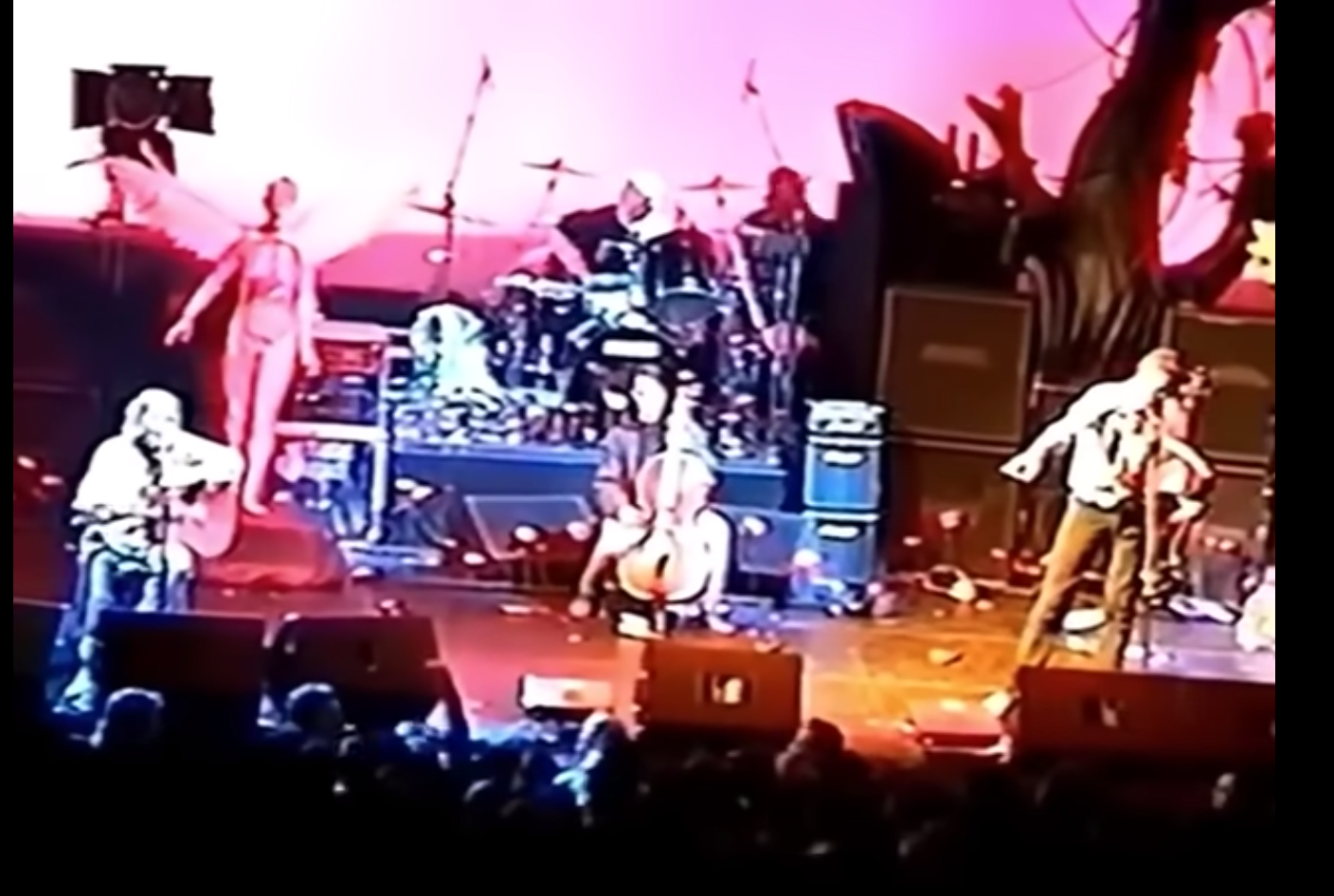
Kurt Cobain (1993); Source: https://www.youtube.com/watch?v=2gRKMXOi-HA
Kurt Cobain became an unwilling symbol of that shift. Not because he fit the role of “the voice of a generation”, but because he actively resisted the systems that tried to turn him into one. He spoke openly about discomfort, isolation, and the ugliness that rock culture preferred to glamorize and ignore. He pushed back in real time against the misogyny baked into the scene itself, calling out behaviors at shows, rejecting the idea that women are just decoration in the crowd or accessories around the band. That alone separated the energy from what the Strip had normalized for years. Where glam rock had built its identity around being seen, grunge kept insisting on what it felt like to be seen too closely. To have the feeling of being examined via a microscope under your skin.
The problem wasn’t taste; it was attention. It’s easy to say that grunge “ruined” the Sunset Strip, but it wasn’t that clean a fight; the scene shifted. The industry, audiences, and even MTV all moved on while the Strip, for all its volume, didn’t really look up long enough to notice what was changing around it because looking up would have required something it hadn’t practiced in a while: curiosity. Curiosity about why younger bands weren’t interested in the same fantasies. Curiosity about why audiences were responding more to honesty than to posture. Curiosity about whether the mythology of rock stardom still made sense in a world that was starting to feel less like a party and more like a pressure cooker. Instead, the response was familiar: dismissal, confusion, gatekeeping; too dark, too depressing, not “real” rock. What sounded like rejection was actually something else: a refusal to evolve.
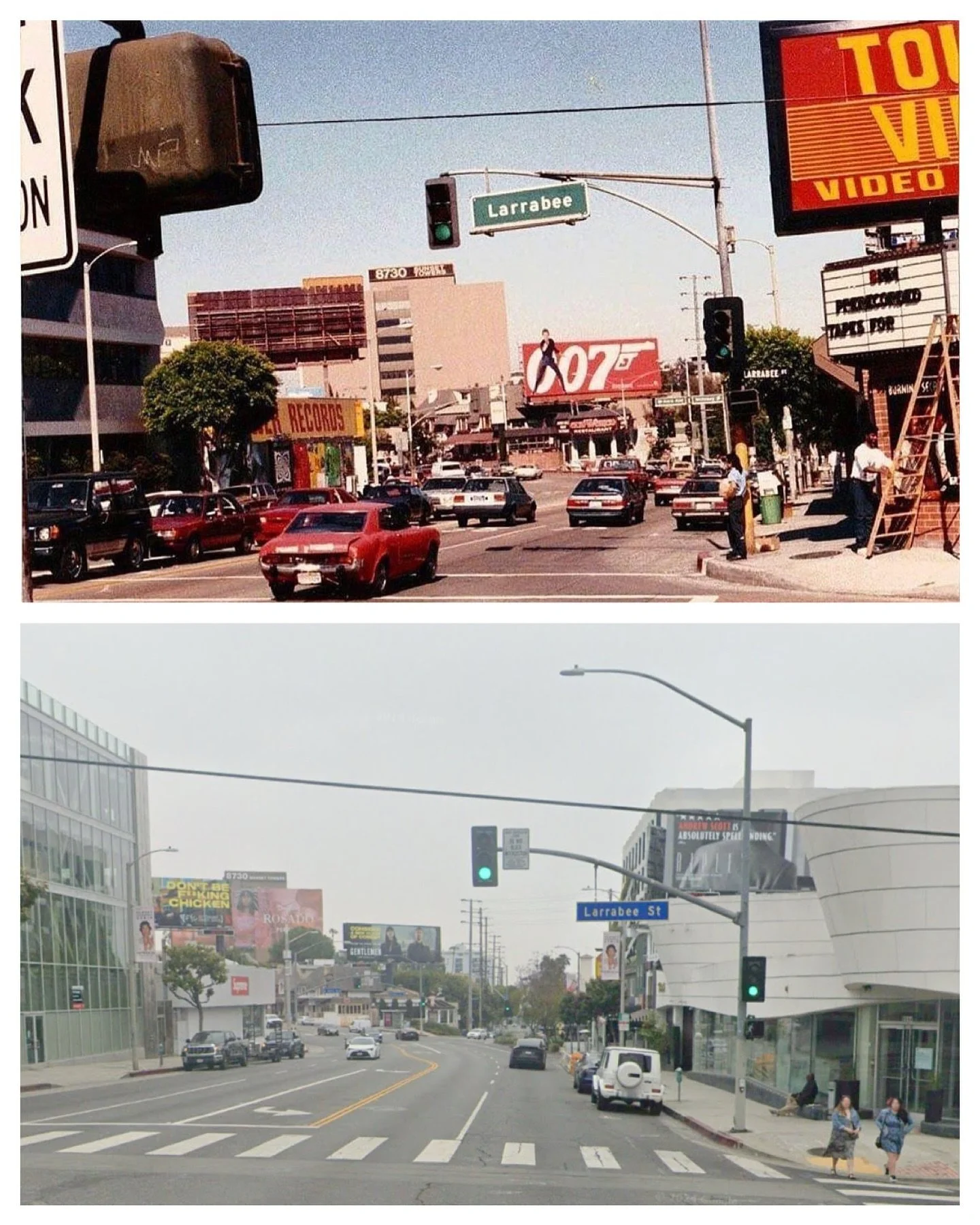
Sunset Blvd and Larrabbee 1989 (Top), Compared to 2025 (Bottom).
There’s a reason the Strip’s decline feels tied to something bigger than music trends. The culture itself was built around a very specific kind of masculinity: performative, dominant, self-referential. It rewarded being the center of the story, not questioning who got left out of it. The structure doesn’t just shape behavior; it shapes imagination and imagination is what curiosity runs on. So when a wave of music arrived that didn’t center on conquest, spectacle, or control- instead leaned into fracture, vulnerability, and critique- it didn’t just feel unfamiliar. It felt destabilizing.
Today, the Sunset Strip still exists, but mostly as an echo of its former self. The posters have given way to electronic billboards, marquee names to aging cover bands, and the neon signs that once defined the boulevard now sit above empty storefronts awaiting demolition for hotels and luxury apartment complexes. The feeling that something is being invented there has mostly faded.

Electronic Billboard Over Whisky a Go Go (2026).
What remains is the afterimage of a scene that once believed it would never stop being the future. Culture doesn’t stay still for belief systems; it migrates toward wherever people are paying attention differently, and at some point, people stopped paying attention to the Strip at all.
Excess can sustain a party, but only curiosity can sustain culture.