Do You Really Want to Be the Final Girl?
By Catherine Murphy
Horror movies have always told us who to be afraid of and who needs to be protected. Scary stories are used to create moral tales, and slasher films in particular are famous for punishing characters for their actions. Those who partake in sex, drugs, and rock and roll find themselves brutally victimized by the killer. But we need someone to root for, to serve as a foil to these promiscuous teens. Enter the final girl: she's virginal, well-behaved, and, most importantly, the sole survivor. The Final Girl Trope brought representation previously unseen in the horror genre. Finally, there was a role for women beyond just being the helpless victim. She's allowed to fight back, but it comes with the cost of her agency. She can live so long as she doesn't have sex.

Texas Chainsaw Massacre (1974)
Carol Clover, a film professor who coined the term "final girl," cites The Texas Chain Saw Massacre (1974) as one of the earliest appearances of the trope. The film centers on five teenagers, Sally (Marilyn Burns), Jerry (Allen Danziger), Pam (Teri McMinn), Kirk (William Vail), and Franklin (Paul Partain), who visit the grave of Sally's and Franklin’s grandfather. Along the way, the group encounters the now infamous Leatherface (Gunnar Hansen), who, along with his family, murders the young adults one by one until only Sally is left. Against all odds, she is finally able to hit a ride away from the chainsaw-wielding killer. By surviving, Sally fits one of the most obvious requirements of the trope: being the final girl standing. And in many ways, she is her own savior. Unlike the others, she outsmarts her captors and manages to escape. But in the end, she still relies on another man to deliver her to true safety. We can see the bones of the final girl archetype in Sally, but since she hit the screen, there have been some additional requirements for survival.
Halloween (1978)
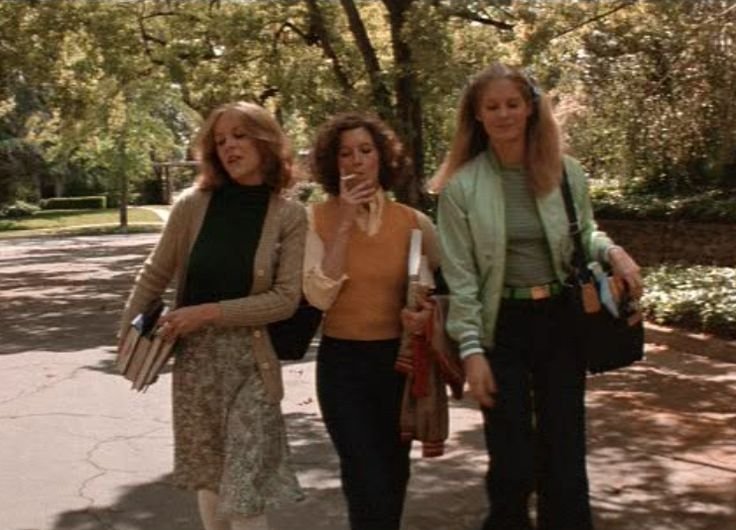
While Texas Chainsaw may be the first of the final girls, Halloween (1978) may bring us one of the most famous. Lori Strode (Jamie Lee Curtis) is a textbook final girl. As the film builds suspense of the voyeuristic Michael Meyers (Nick Castle), we get our own glimpse into Lori’s life. She’s an idyllic suburban girl who’s more concerned with her forgotten school books than her friends’ dating lives. While she’s off fulfilling a traditional maternal role, the teens around her are looking for casual sex. The good girl babysitter barely makes her way to the end while her peers perish, but while she's a survivor, she's not much of a fighter. Dr. Loomis (Donald Pleasence) is the one who must come to the rescue in the final act. Lori can do enough to fend him off, certainly a commendable feat, but there isn't that satisfying moment where she overpowers the stalking killer. Not like Scream.
Scream (1996)
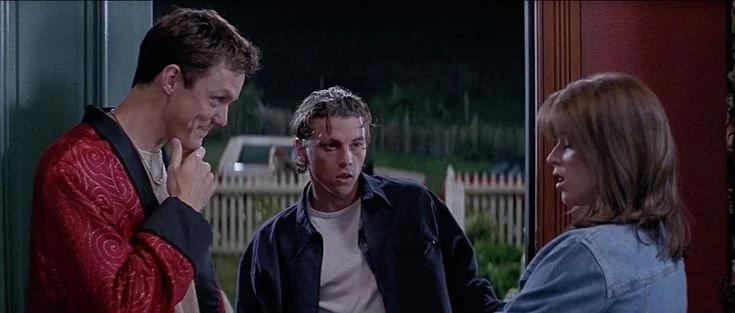
By the mid 90s, audiences had started to recognize and grow tired of formulaic slasher films. They craved something new. And this is exactly what Wes Craven’s Scream (1996) delivered. The film pushes against several horror cliches, finding a way to parody the genre while holding to the spirit of scary movies. Still traumatized by the death of her mother, final girl Sydney Prescott (Neve Campbell), finds herself with relationship problems that only escalate when she starts to suspect her boyfriend Billy (Skeet Ulrich) might be responsible for the murder of classmates. In the movie’s climax, the town’s high schoolers deal with the growing violence the only way they know how: a major party. One of the teens (Jamie Kennendy) is a self-professed horror movie aficionado. As everyone gathers around to watch Halloween, he explains the rules of surviving a slasher: no drinking, no drugs, and no sex. As he lists the requirements, we see each rule being broken. The third by our very own final girl. After struggling with intimacy, Sydney finally feels ready to lose her virginity to her boyfriend, only for him to be attacked soon after.
In a normal slasher, this promiscuity would be a death sentence; at first, it seemingly is for Billy. That is, until we discover he, along with friend Stu (Matthew Lillard) have been responsible for the murder leading back to Sydney’s own mother. With the help of news reporter Gale Weathers (Courtney Cox), Sydney can kill both Stu and Billy, giving us not one but two final girls. Both these women are allowed to be flawed and make mistakes. They’re also given sexual agency. Sydney isn't just allowed to have sex; it's almost like losing her virginity that allows her to discover the killer. And in the end, Sydney and Gale do the saving all on their own.
Bodies Bodies Bodies (2022)
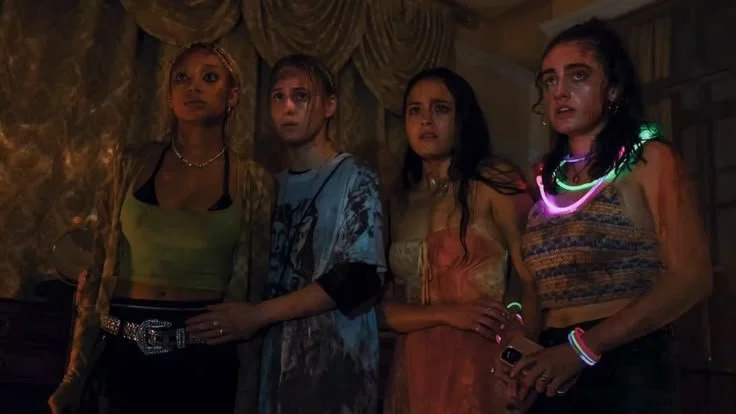
Representation in media is important, but it's not enough to just see someone who looks like you on screen. There are plenty of one-dimensional female characters who may look like you or me, but who aren't reflections of me or the women in my life. Having female leads fight their way out is just the beginning. Films like the Scream franchise, the X trilogy, and even Bodies Bodies Bodies (2022) are steps in the right direction. They reimagine what a final girl can look like. Like most media, there is still much room for growth and inclusion of women of color, queer and trans women, and disabled women. There's nothing wrong with feeling empowered by the final girls of the past, and there's nothing wrong with wanting more from them, either. But as we've recognized the stereotypical shortcomings of horror, new leading ladies have taken back their agency in full. Without conditions.