Dreams On Canvas: Wifredo Lam at the Museum of Modern Art
By Julia Krys
When strolling through a museum, apparently, the average person looks at any given piece for no more than ten seconds, enough to have a passing glance at color and shapes. Just a moment’s window into the work that envelops an artist's life.
As I passed through the halls of the Museum of Modern Art’s Wifredo Lam exhibit, When I Don’t Sleep, I Dream, it was basically a challenge not to linger at each piece at length, as if he painted each in a trance that supersedes time.
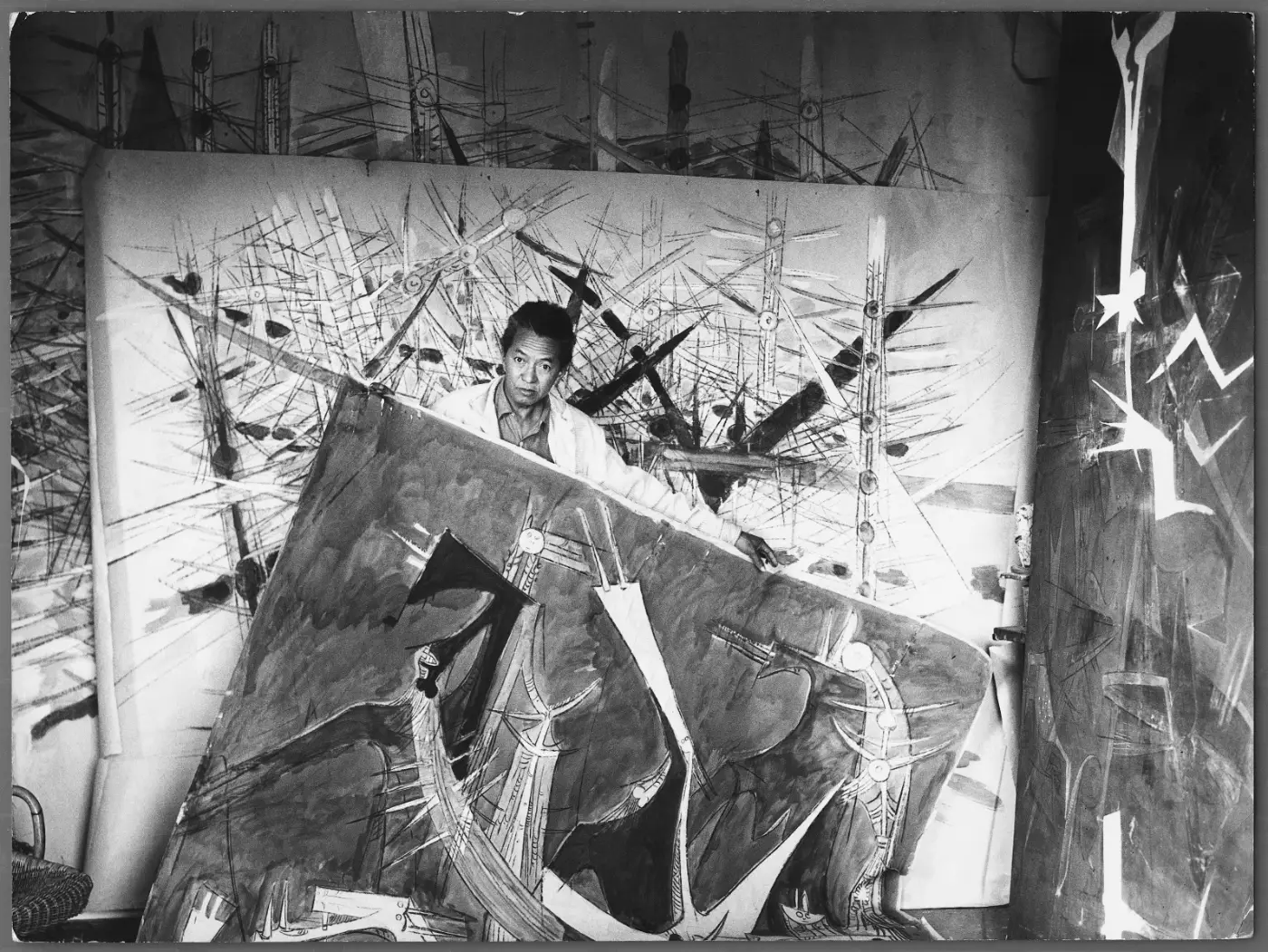
Wifredo Lam in his studio in Albissola, 1963. (Source: https://zolimacitymag.com/wifredo-lam-exploring-a-famous-cuban-artists-cantonese-roots/)
A full exhibit highlighting a Cuban artist at MoMA is the first of its kind. Wifredo Lam was born in Cuba in 1902 and painted his way through war-torn Europe to become a transnational pioneer of early modernism. He began his career in Spain and befriended Pablo Picasso. Picasso had trailblazed an avant-garde concept (one that now receives significant criticism) known as exoticism, a movement rooted in the European fascination with and appropriation of non-Western cultures. Learning about Picasso and Lam’s friendship made me wonder less about who influenced whom artistically and more about how Lam navigated being both a subject and a participant in a movement that often treated people like him as aesthetic inspiration rather than collaborators. As a Chinese and Afro-Cuban artist working in European circles, Lam occupied a space that European artists were imitating but could never authentically inhabit. For many of his peers, cross-cultural imagery was a stylistic experiment; for Lam, it was his lived reality. His work, therefore, reads not as an extension of exoticism but as a quiet correction of it, reclaiming imagery and spiritual symbolism from the outside gaze and placing it back into the hands of someone to whom it belonged.
Lam fled war for the first time in Spain when the Spanish Civil War broke out, and for the second time in France when the Nazis invaded Paris. After fleeing the capital, Lam found himself on one of the last trains out and wound up in Marseille. This is where he met André Breton, a founder of the Surrealist movement. While in southern France, he took part in collective drawings, or “exquisite corpses,” in which a paper was passed around, and each artist added to the larger image. Drinks were involved, of course. This form of group improvisational visual art was completely new to me. It is emblematic of how Surrealism moves toward the irrational subconscious, embracing something far more bizarre.
Although Lam never fully identified himself as a Surrealist, its principles have a natural connection to Caribbean culture, which cultivates poetic imagination and often embraces the surreal as everyday reality.
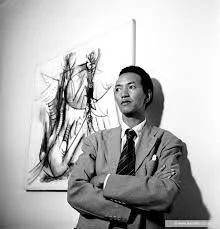
Copyright: © Lee Miller Archives, England 2013. All rights reserved. www.leemiller.co.uk
I first came across La Jungla (The Jungle) in a high school art history class. The disparity between seeing it on the page of a textbook and stepping into a room where it occupies a floor-to-ceiling display cannot be understated. It felt as though I was transported into a jungle simply by standing in front of the massive piece that Lam is most known for. La Jungla was painted during Lam’s first year back in Cuba after nearly two decades abroad. The piece melds human bodies with animalistic figures along a backdrop of sugar stalks, a powerful image containing centuries of Cuban history. It evokes African figures transported to Cuba via the slave trade and forced into the sugarcane industry. The dense landscape is almost hard to distinguish; each viewer mirrors the figures themselves as they search for meaning and perhaps refuge in the painting. Drips of paint running down certain sections of the piece allow the viewer a window into the moment Lam’s brush met the canvas in a rush, as though this lack of precision in not allowing paint to dry was its own form of exactness. We are transported to the moment moisture overtook the stroke.
From here, Lam invites Afro-Cuban religions into his work. The worship of spirits in practices like Santería was born out of the descendants of enslaved people. This form of spirituality remained connected to their homelands and sought to maintain a link to the histories people no longer had direct access to.
Lam visited Haiti and discovered the similarities between Haiti’s and Cuba’s struggles for freedom and their celebration of Black identity. The Caribbean was colonized by different European nations, but there is significant overlap in their histories. As artists and intellectuals tried to make sense of the world post-World War II, Lam wanted to create a new canon of work outside of Caribbean landscapes. With pieces like Nativité (Nativity), Lam borrows Western frameworks and recontextualizes them to bear meaning for non-Western audiences, utilizing imagery like horns and eggs that are associated with rebirth. The art he created in the late 1940s explores how those shared sentiments exist beyond the cultures of the colonizing countries.
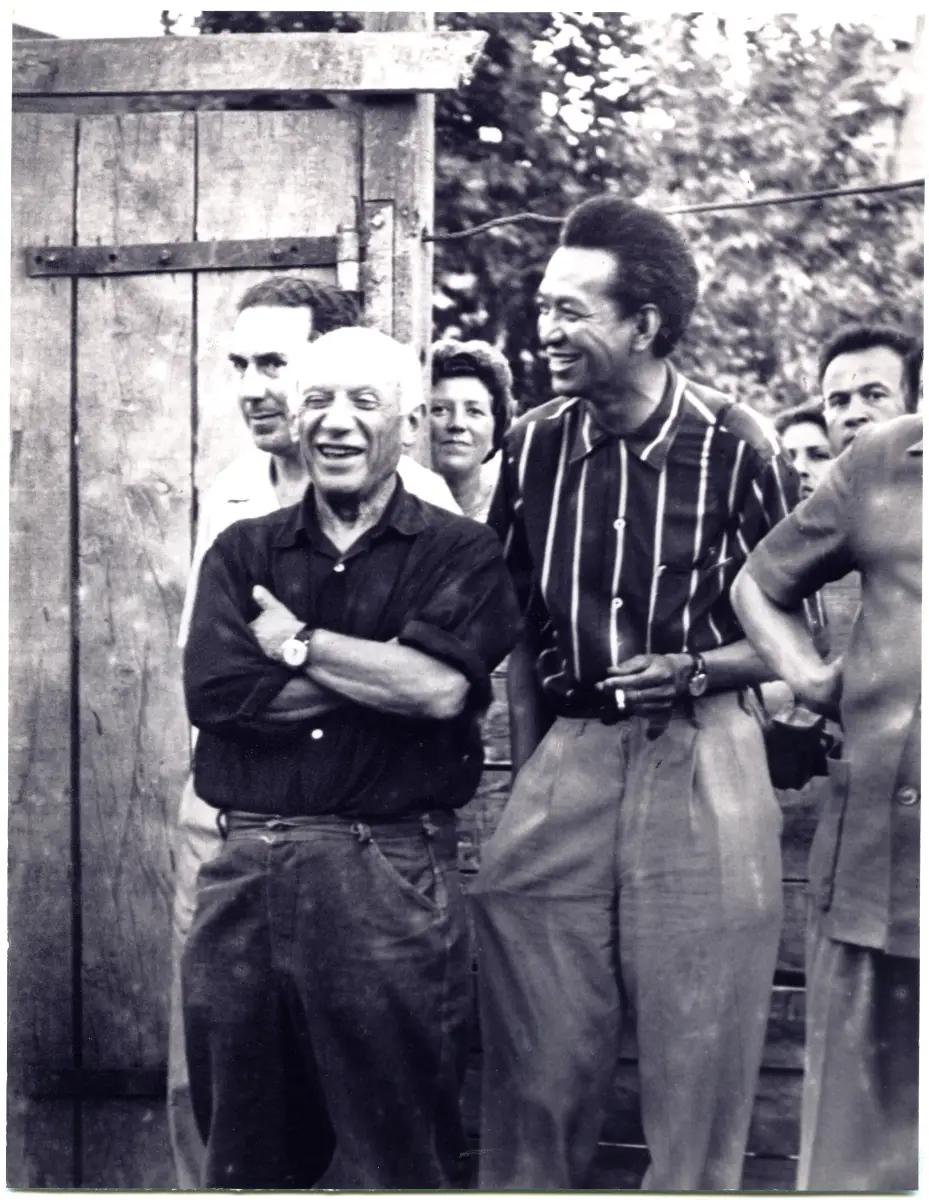
Portrait de l'artiste à Albissola, 1963© Archives SDO Wifredo Lam (Source: https://zolimacitymag.com/wifredo-lam-exploring-a-famous-cuban-artists-cantonese-roots/)
Much of Lam’s work was done quickly on paper. The use of paper was born out of necessity, as he often could not afford more expensive materials. Yet it also served the purpose of adding more movement to the piece, as each stroke can be distinctly seen. Lam’s most expansive work on paper, Grande Composition, was no exception. Though most artists begin their process on paper with charcoal or pencil and later remove it, Lam leaves these marks visible. He adds watered-down oil paint to the raw brown paper and leaves negative space behind. As large swaths of brown paper remain in the background, black figures emerge. Grande Composition contains so many visible layers of creation that the drama of its making is on full display.
The dreamlike quality that occupies Wifredo Lam’s work highlights his own role as an outsider in the world of art and the ways in which he had to dream in order to create. He was a dreamer. When I Don’t Sleep, I Dream is on display at MoMA through April 11.