Ignoring Izzy is What You Need!
By Kelly Darroch
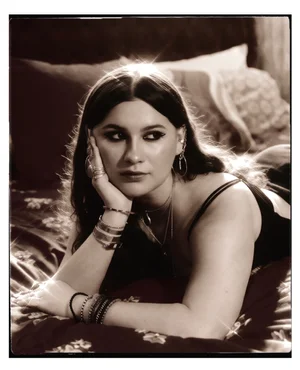
If you’ve ever yearned for a theatrical and immersive live rendition of “Lost in the Supermarket” but The Clash just couldn’t do it for you (probably because they broke up 4 decades ago), London-based band Ignoring Izzy has eagerly stepped in to devour a leek on stage and toss a radish or two at the crowd, all whilst executing an infectious, genre-bending instrumental and vocal performance.

Ignoring Izzy; Image Provided by Ignoring Izzy
The six-piece band comprising Isadora (Izzy) Pulman (vocals), Alex Wrey (guitar), Finn Kverndal (synth/keys), Freddie Graham (sax), Joseph Smith (bass), and Kiry Valambhia (drums) is the intersection of many hyperspecific musical areas of expertise. While the band may contain her name, Pulman, who created the band with Wrey and Kverndal, is eager to dispel any rumors of this being her solo project.
I sat down with three of the six members (Pulman, Kverndal, and Valambhia) just yards away from the Guildhall School of Music & Drama, a common link between the many musicians of London. This is also where Pulman and Graham both received their master’s in electronic music. This followed just weeks after they released their debut single, “What I Need,” a sensual extravaganza that brews sonically like an infectious incantation. Against the backdrop of London, where the ghost of black midi reverberates through the streets at the mere mention of math rock or post punk, Ignoring Izzy is ready to take it in stride and capitalize on their peculiarity with a refreshing enthusiasm.
Pulman, Wrey, and Kverndal all met during their undergraduate studies at the University of Bristol. What might have resulted in a more immediate convulsion of musical teamwork was quickly postponed by the significant mask (both literal and figurative) of Covid-19. Despite living in the same halls their first year, there was not ample opportunity for collaboration on campus. Even as lockdowns lifted halfway through their second year, the pandemic left a stain on the remainder of their studies. Pulman, who had been gigging since she was eleven, found it rather difficult to break into the Bristol music scene, especially having a full year of making connections in the community stripped from her.
As university life started to take on a routine of normalcy, studies had amped up, and so had everyone’s busy schedules. Creativity still burst through in spouts, as Pulman was releasing bedroom pop tracks, Kverndal was a prolific DJ presence in the halls, and Wrey garnered a reputation as the guy with the eclectic instrument collection in his flat. Wrey and Kverndal actually started a comedy punk band together at Bristol called Chip Fish.
“Terrible, terrible band,” said Kverndal. “But we loved doing it.” Chip Fish is no longer kicking it, but in the past year, Ignoring Izzy has certainly been making up for lost time.
In September of 2023, Pulman and Wrey moved to London around the same time and began to write together. They meticulously sifted through the hundreds of recordings on Wrey’s looper, chopped them up, and produced six demos. After a nearly one-year lull of leaving the demos untouched, they decided to revisit them with a clearer vision in mind: a band. The turnaround was quick. A slightly smaller arrangement of the band was formed in January 2025, and Ignoring Izzy played their first gig in February.
In the past year, the band has taken on a life of its own, a diversion from what any of the members could have expected if you asked them a year ago. This is owed to the highly varied musical interests of each member.
In Pulman’s back pocket, she has more than her resume with her master’s in electronic music; she also has an immeasurable passion for Klezmer and Yiddish song. Having grown up in a culturally Jewish family of musicians and creatives, Klezmer was a staple in her upbringing. Between Klezmer and her obsession with Portuguese Fado music, Pulman has looked to artists ranging from Mariza to Forshpil (a psychedelic prog rock klezmer ensemble). An understanding of herself as a musician through tonality and harmony truly came into view after it became clearer that her music was shaped around her Jewish heritage. Her previous singer-songwriter efforts simply did not click in the same way that they did when she began studying and engaging with Klezmer and Yiddish song more intensely.
“I remember even when I was younger, and I was trying to write a song like Taylor Swift when I was 12, it always came out sounding Klezmer-y,” explained Pulman. “I was like Klezmer Taylor Swift!”
Ignoring Izzy is Pulman’s more traditional rock band outlet, but her days are filled with involvement in various groups. She sings in the Idrisi Ensemble, a medieval Mediterranean vocal music group, as well as Babette the Band, who perform ethereal medieval folk music. Pulman also works as a part of the UK branch of Make Freedom Ring - a classical musicians’ collective that fundraises aid for Palestine through fundraising concerts. They center on amplifying the voices of and providing a platform for Middle Eastern musicians and Middle Eastern classical music.
“I feel a sense of responsibility to be involved in ensuring that we don’t neglect Palestine and continue to raise awareness, especially as artists,” said Pulman. “It’s just important to me to keep making sure that something like my music is interwoven with activism, where it can be, especially as a Jewish musician.”
Pulman’s background is just one slice of the cake that contributes to the magic of Ignoring Izzy. Kverndal, as Pulman described, is a “dance music aficionado.” In fact, he even released dance music under an alias for years. Kverndal’s first love, however, was classical music and French Impressionist composers. This heavily informs his decisions while writing synth parts for the band because that’s what his “hands are used to.”
This love for dance music is shared by Valambhia, who realized during the interview that he was attending the same Overmono show that Kverndal was in just a few days. In terms of drumming, Valambhia has more of a metal background, but got more into modern jazz after moving to London.
Wrey is majorly influenced by Gypsy jazz (or manouche jazz), an upbeat genre heavily associated with Romani guitarist Django Reinhardt, with a unique harmonic structure that centers around the acoustic guitar. This blend of American jazz and Romani music traditions is distinguished by its instrumentation of guitar, violin, and upright bass. He is also extremely into post-punk, as is their bassist, Smith, who also contributes to several punk, indie, and dance music projects.
Graham (saxophonist), who, similar to Pulman, received his master’s in electronic music, is primarily a folk and soundscapes artist.
This fusion of interests has produced a pleasant surprise for the entire band.
“I mean, everyone says this about their own bands, but I think I wasn't anticipating making something so peculiar genuinely,” said Pulman. “I just knew what I was going to bring to it, and that didn't feel particularly odd, but I guess we all maybe thought that, and then it came together to be something super odd.”

Ignoring Izzy Live at The George Tavern in London; Image Provided by Ignoring Izzy
Part of the charm of Ignoring Izzy is the memorable live performances that they deliver, and this is not lost on them. It is why they felt such an overwhelming pressure to translate these live performances into a recording that replicated an akin listening experience.
While Wrey, Kverndal, and Pulman do the bulk of the initial writing, the final product is always the result of every member giving their two cents, and is often developed through the many live gigs they partake in. It usually begins with a riff from Wrey (who Kverndal describes as a “loop pedal machine). Then Pulman will chop it up, break it apart, and write to it, and Kverndal will arrange the majority of the track before everyone ultimately has a go at it.
The evolution of “What I Need” followed a similar progression, but there was one key component: the high hat preset from Wrey’s looper. There is a large visual and color element to Pulman’s musical visions. The combination of Wrey’s riff and the high hat sent Pulman straight into a burlesque club, which resulted in a song that the band leaped to agree is “really horny.”
“I really like leaning into the silliness with lyrics now, and just like the absurd,” said Pulman.
Pulman specifically had in mind a particular scene from The Goodbye Girl (1977), directed by Herbert Ross, in which an out-of-work actor takes a job as a doorman at a burlesque club. The enchanting lights and the abundance of nipple tassels contributed to a developing color palette that fueled Pulman’s writing. The more the song grew, she even found herself transported to One-Eyed Jacks, the brothel in David Lynch’s Twin Peaks.
After much persistence and allowing the song to crystallize through performance, they added the desired layers and achieved a recording they felt did the song justice. The band also gives much credit to their producer, Nathan Shawyer, who they believe has an “ability to really capture a live sound.”

Image Provided by Ignoring Izzy
The theatrics of performance are of the utmost value to Ignoring Izzy. It’s what makes their music feel larger than life. They don’t feel the need for any kind of gimmick; they merely acknowledge the enjoyment they personally find in a magnetically strange performance. One example of this is Ignoring Izzy’s unreleased Supermarket Tune, officially known as “Death in the Supermarket.” The tradition of “throwing veg” during the song can undoubtedly be categorized as magnetically strange. They’ve experimented with different vegetables in each iteration, and the concept has continued to evolve, even in our conversation. A future potluck-style BYOV (Bring Your Own Vegetable) Ignoring Izzy gig may be hitting London in the future. They might even make a stew during their set. As Pulman said, “The lore is growing.”
The city of London, while incredibly vast, can feel like such a small world — especially the music scene. Ignoring Izzy expressed nothing but love for the community of fellow musicians. It can, however, be difficult to create authentic, fresh art in a city with such an oversaturation of creativity at every corner. This is just more reason for Ignoring Izzy to lean further into their eccentric instincts and embrace an open mind for any and all suggestions from one another.
In the spirit of open-mindedness, they entertained several potential ideas during the interview. Kverndal, who has a past in choral singing, proposed a spin-off track of plainsong or medieval chant, “in a tasteful way, obviously.” Pulman, Kverndal, and Graham have also considered pulling together their minimal memory of counterpoint and fusing it to see where it takes them. As the most recent addition to Ignoring Izzy, Valambhia hopes to experiment with the drum machine and bring in some more electronic music production bits. Wrey has expressed wanting to incorporate the guembri and the sitar, which reminded Pulman that Kverndal should “whip his flute out a bit more,” which she quickly backtracked to clarify her statement in a literal wind-instrument sense.
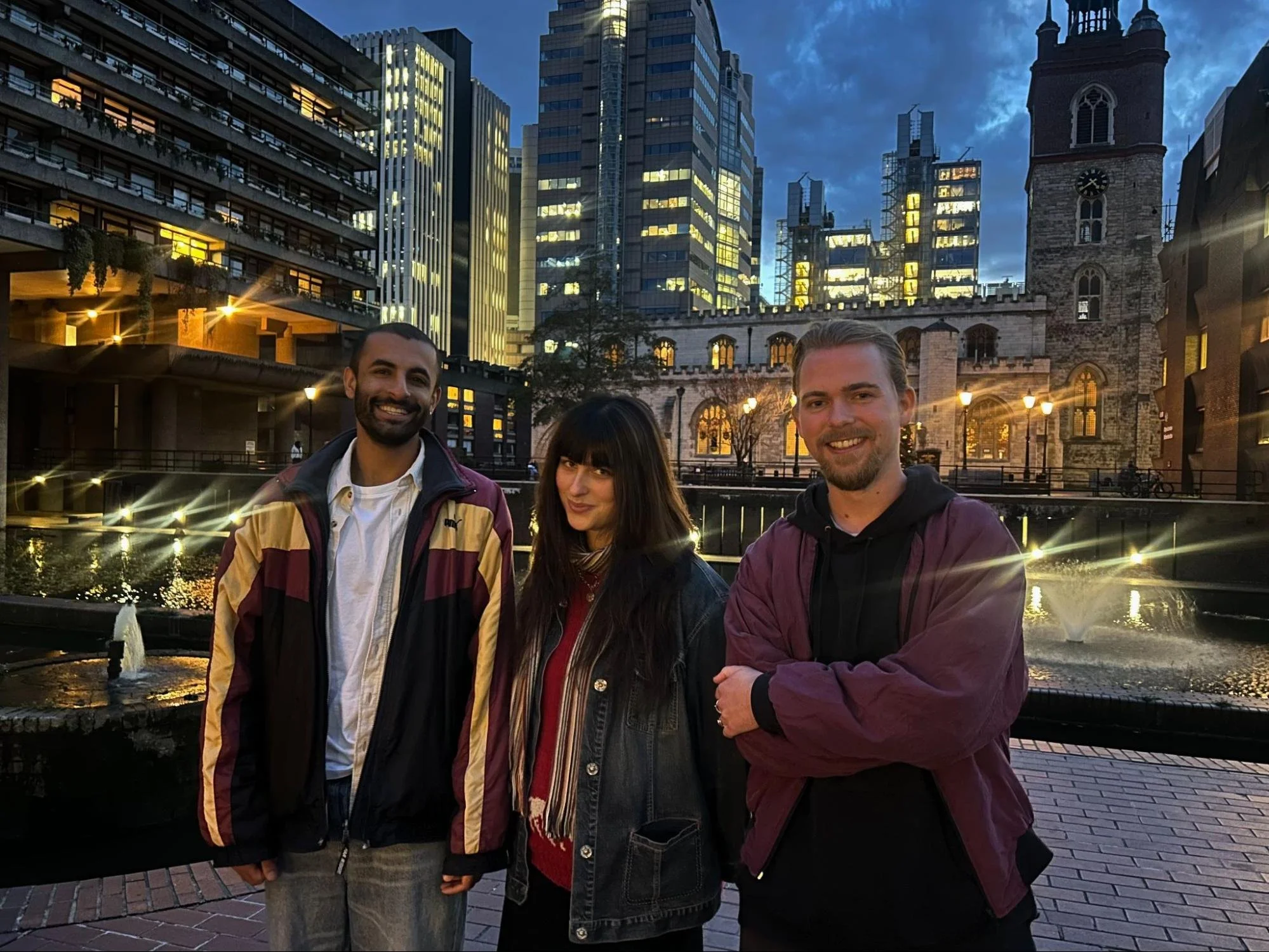
Valambhia, Pulman, and Kverndal at the Barbican Centre; Photo Taken by Kelly Darroch
As for the upcoming year, there is a new music video and single in the works that they hope to release within the next few months. Ignoring Izzy is gearing up to gig often and see what opportunities arise, but they have their sights set on bigger performances, some festivals, and playing outside of London, which they have yet to do.
The power of Ignoring Izzy lies in their willingness to lose control and let their instincts run wild. Whether you’re standing five feet from their stage with a carrot at your feet or blaring them in your headphones, their music invites you to do the same.
Instagram: @ignoringizzy
Streaming Platforms: Ignoring Izzy