What 25 Twenty-Five-Year-Olds Have To Say About Being Twenty-Five
By Annabel Gregg
Earth Day. The sun, a boon that Upstate residents cherish after an annually unforgiving and S.A.D. winter, sets over a podunk town in New York State. The last few days of news feature controversy over the opening up of coastal waters for energy extraction, whatever the Federal Reserve’s gonna do to cut interest rates, and Tiger Woods. A young couple, the ones who just bought the shoebox on Church Street a few weeks ago, decides to plant a tree in their brand-new backyard: mark the occasion, and their territory. They take turns hucking dirt out of, then back into, the hole. Pass their shovel back and forth between them in shifts (who has two shovels?).
The root ball’s in the ground when the radio talk show host’s water breaks. Don’t they say that movement helps induce birth? At the moment she goes to tell her betrothed, their dog—who’s been trotting around the yard and desperately watching his owners dig a hole without his help— smells the sudden hormone release from Female Owner and bolts to her side to protect her from nothing, snapping his leash in the process.
The beat reporter, who agreed to plant a tree only because his nine-months-pregnant wife said it’d be nice to watch it grow up with the baby, can relish a sweet “I told ya so” as much as the next guy, but holds his tongue because his wife is now in fucking labor. He can’t remember what he says to the cashier at Kmart, or really if he says anything coherent at all, but he is vaguely aware that he threw a ten-dollar bill at the pimple-faced kid and ran outta there without a receipt for the new leash, or change.
Feels like one of those mornings where he accidentally drank way too much coffee, caffeine making his hands shake as he helps his wife into the car, but he’s actually pretty sure he hasn’t had any coffee today. Then the radio talk show host tells him to “please hurry the hell up” with putting the dog on the leash (because, once again, she is now in labor), so he hurries the hell up.
Once secured, Male Owner scruffs the fur in between the ears of the mutt—who stares longingly at Female Owner in the car and smells another human over there too, New Smaller Owner in belly but almost not in belly, he wants to go with them to wherever the family is taking Car Ride—and tells the dog to protect the house while they’re gone. He resigns to his fence post, watching the 2.5 of them skirt out of the driveway with haste.
Hours pass. Enough hours where Earth Day turns into the wee hours of April 23rd. Born on this day are two things that planned to take the world, and particularly my Alternative Rock radio station deejay of a mother, by storm: Fat Boy Slim, who released their infamous “Weapon of Choice” music video featuring Christopher Walken, and me.
Roughly twenty-five years later, the child of that young couple is having an anxiety attack. She is pretty sure that she has—cough, cough—a genetic propensity for these occurrences, but that fact doesn’t really do shit for her right now, and it certainly won’t help her find the key fob she (permanently) lost to get back into her apartment building, abandoned somewhere on the street in a mental fog farrago.
There are only a few weeks until her twenty-fifth birthday. Quarter-Life Crisis flashes in front of her eyes like a cutesy neon sign in Las Vegas, at once mocking and reassuring.
The coin only derives value from its relation to the whole; four quarters to a dollar. Four stupid silver circles, emblazoned with Washington’s vignette, dance in front of her, then spin like tops in front of her poor hallucinating brain, clatter onto the crumby Albany sidewalk. A morbid reminder: you have to do this whole thing three more times.
As a spring baby, I’ve felt that this quarter of the year annually brings renewal. A break from the shackles of monotonously, wontonly gray winter that inspires a new, more optimistic perspective. Turning twenty-five, the universal symbol of “Grow the Hell Up”, added extra motivation to figure out a) where and how the hell am I supposed to be, and b) am I supposed to feel like I can do this thrice more?
I always pictured my parents in their mid-twenties when they had me, married with already established (or precursor-to-established) careers and thus established minds and spirits. And according to Census data, that was pretty much the average for yuppies back in the day: established. Thus, I couldn’t ask Pete and Donna, or anyone else who was “at one point” twenty-five.
How else to figure out how a twenty-five-year-old is supposed to be, other than to ask them outright?
Twenty-five 25-year-olds responded to the survey that Gut Instinct socialized (thanks, gang). I read all the responses with a sense of parasocial camaraderie to all of my anonymized peers. I registered pretty quickly that we all can learn from each other. Here are the four main takeaways I gleaned by asking around.
Sourced Through Pinterest
#1: We’ve still got learning to do.
About once a week, I worry that I’m getting dumber.
And in some ways, I might be.
The idiom about how our frontal lobes stop growing when we turn twenty-five gets passed around like a pacifying pack of social gum. But when I asked folks my age if they felt like the part of their brain associated with cognitive function and emotional regulation had actually fully developed, only 19% were confident that it had.
The keyword is feel there; none of us have the means to go and get an MRI or whatever to measure the functionality of our gray matter. But turns out, our feelings about our own cognitive capacities are, in a sense, right.
First, note that science is actually pretty skeptical of that whole “end of the line at 25” idea for frontal lobes. But we’re also just looking at it wrong. When I say that I feel dumb, it’s because I haven’t been challenging my brain enough. I have a feeling a lot of us are in the same boat. We’re settled into a job (92% of respondents are employed in some capacity), a routine, and sure, maybe we learn something new every once in a while from a TikTok, or from a coworker explaining something to us that they learned via a TikTok, but in our twenties, we’re not stretching and strengthening our brains the way we used to when we were in school every day. And this stuff isn’t contained to one little region of your brain, either.
Neuroplasticity, arguably defined as a measure of the brain’s resilience—its reflexiveness and adaptivity—is extremely important for “feeling smart,” and protecting our brains. And I know those fleeting whims I get of “maybe I should learn Spanish,” or “it’d be, like, aesthetic to take up chess,” come from my brain subconsciously begging me for more playtime.
There is hope in that our brain’s period of structural growth is not over. Up until around age 32 does our brain continue developing key neurological functions. We all still exist in the window of time where our brains are adept to learn things and want to build their neural networks. They’re hungry. If we feel rather slow lately, it might be because we’re all in that post-academia phase where we forget that learning is essential to living.
So, while we still can, learn. Exercise that neuroplastic-y like a goddamn rubber band. Some ways to do that: the exact little nudges your brain is giving you. Study a new language, try hobbies that demand brain function like chess. Even aerobic exercise was found to aid in neuroplasticity enhancement. Do things you don’t know how to do.

Sourced Through Pinterest
#2: Our regrets all fall within a spectrum, and getting over them boils down to “grabbing the bull by the horns.”
On regret.
For the young people who took the survey, it’s a spectrum. There is, of course, the one extreme: a blanket sentiment of complete lack thereof, that life simply “is too short for regrets.” Move the needle a little further and you’ll get the perfunctory, “I don’t think of them as regrets since they’ve made me who I am.”
Some responded with straightforward and minor ones, like taking drugs, spending too much time soaked in blue light and unearned dopamine, or drinking Celsius on an empty stomach. More weighty answers focused on regretting how they’ve treated other people (exes they’ve hurt, friends they wish they could speak to again) or treated themselves (self-sabotage, forcing oneself to grow up too early, or generally just not cutting oneself enough slack).
But many responses seemed to have a more subtle thread, an itchy hem on an otherwise harmless garment: regretting not hitting the ground running. Not grabbing the steering wheel of life at a younger age. Not embarking on things sooner, like school or the sobriety journey. Not learning to take risks earlier. Not learning discipline, work ethic, and the value of independence when they were younger.
In other words, they got hit with a cloying realization that they needed to grab the bull by the horns.
As a recent entrant into the Twenty-Fivers Club, I recently got the same anvil dropped onto my head. After that quarter-life crisis right before my birthday—ostensibly, a mental health rock-bottom—my own age was made dizzyingly apparent: not even really the number, but the demographic category I could no longer debate my belongingness to: I was now an ADULT. Er, really, I had the capacity to act like one, and the lack of generational excuses to not try to do so.
I immediately wanted to be a functioning human. Strong and independent and free of the anxiety-disordered thinking I’ve been rockin’ since adolescence. That feeling of wanting to get one’s shit together does inevitably invoke a sense of urgency. Why didn’t I figure this all out sooner? And if I had, wouldn’t I be further along?
Maybe. But to quote the peace-sign-wielding, sunglass-donned folks that reminded us NO RAGRETS: the last 9,125 days (give or take) spent living have made you who you are. It got you to this realization right now. You control the future, that’s all. Why regret the past?
We can only take it day by day, but we can be more intentional with our decisions. Every day. We can be validating and self-forgiving while also being self-motivating and recognizing when we’re slacking or slipping into old habits. The more we invest now, the better off we are down the line.
And yes, I am already feeling better since beginning to seriously invest, even though I’m writing this on my period and am very tempted to go back to Disheveled Mentally Unstable Annabel.
Grabbing the bull by the horns means recognizing that nobody is coming to save you. Only you can. (Asterisk: this does not mean isolate yourself in the woods or in an office and work on yourself in a vacuum—friends, family, and professionals all want to be in your life still, and at a minimum, support from afar). But it also means not regretting that you didn’t decide to do this sooner: you decided to do this now. And you’re committed to it. We’re 25, for fuck’s sake! We’re spring chickens! We’ve still got time to establish ourselves! And we will. (We kind of have to.)
Twenty-five-year-olds can recognize that we’re adults, and that we’ve got to shift things into a higher gear. But another thing I’ll note is that we are doing so with optimism…
#3: We are on the up and up.
Nine in ten respondents said they like their life now more than their life five years ago, and 77% envision their life five years down the line will be even better.
Even facing down a sociopolitical tsunami of recession, inclement civil and foreign war, crumbling social security, an active Gestapo, and the spiderweb of late-stage capitalism threatening to dismantle life as we know it, we are an optimistic bunch.
We’re the kids that grew up with The Hunger Games, the ones that harbor core memories associated with that invigorating feeling we got listening to President Snow whisper the one thing greater than fear: hope.
We are proud of ourselves. When I asked, most respondents mentioned that they were most proud of how far they’ve come and how far they hope to go: their career climbing, their degrees, starting their own businesses, and the struggles they overcame.
We are climbing toward a better future. It’s a self-fulfilling prophecy, too, because we believe that the future can and will be better.
I’m reminded of Deja Foxx’s campaign for Congress this past year, running as a 25-year-old. In a stacked Arizona primary, the vocally Gen-Z candidate came in second (to the late incumbent’s daughter), and I won’t be surprised when she inevitably announces her next run. But the activist known for smacking down pundits in TV interviews and getting arrested protesting the SCOTUS decision to overturn Roe v. Wade, touted the on-the-nose campaign slogan “crashout or Congress” to describe her run.
In an interview with Teen Vogue, Foxx explained that, “The response to me as a teenager was often that people were glad the future was in my hands. Throughout the years… I got clear-eyed on the fact that if people were gonna tell me they were inspired by me, they needed to give me the tools to make change. They needed to make space for young people to be in real positions of power.”
We know the future is in our hands, and we want to play a part in it. We’re eager to get to work.
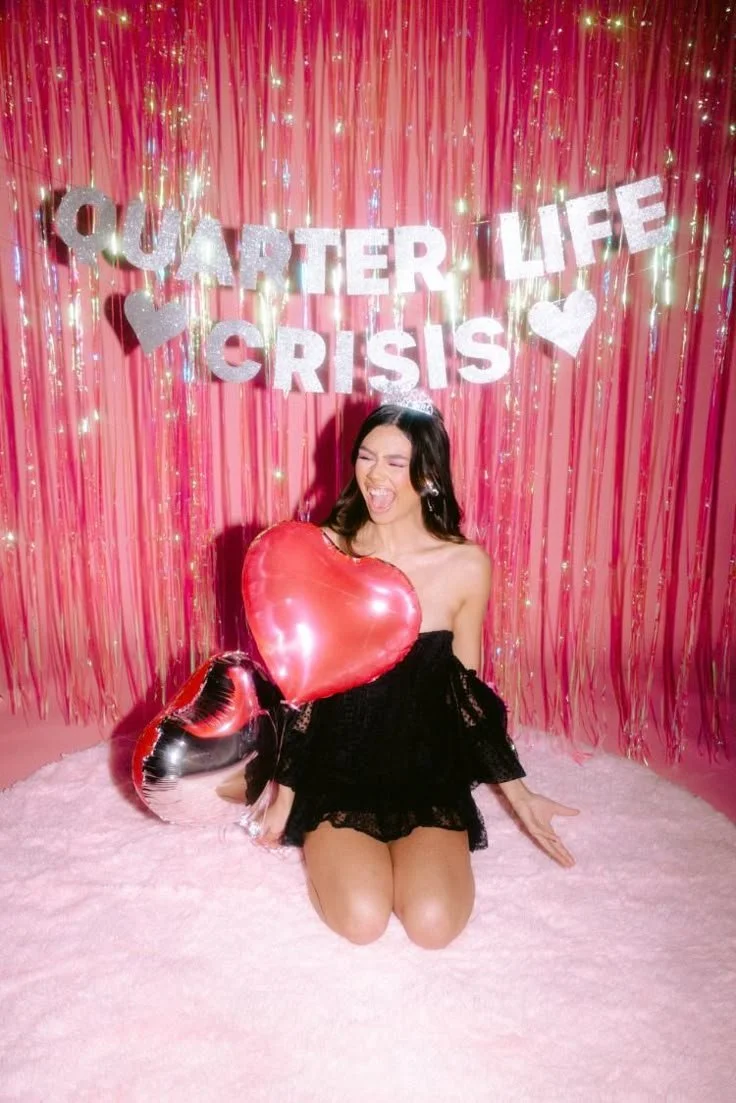
Sourced Through Pinterest
#4: That quarter-life crisis is inevitable, and necessary.
So, back to my crashout I mentioned at the beginning of the piece. Admittedly, it wasn’t an abnormal occurrence, but this one was a truly pinnacle crashout. The days following it were some of the roughest I’ve had in a while. Stripped of histrionics, I was in physical shambles for the thirty-six hours following. I couldn’t stomach food and felt nauseous drinking water. I cried for hours on end, my nervous system’s desperate attempt at regulation. But as I came back into myself, along those lines of ‘grabbing the bull by the horns,’ I knew I couldn’t go into the next quarter of my life having breakdowns like this regularly. Because it meant that I wasn’t being there for myself, wasn’t upkeeping my sanity. I didn’t have the tools to operate independently, from a mental health standpoint. I took time to reflect on what was needed for me to feel comfortable with myself, and after some hard days and weeks, I can confidently say I’m on a better path. As I build my toolbox, life feels a lot more optimistic, and I feel like I can take on more in the name of self-progression.
76% of the twenty-five were at least pretty sure they’ve had a "quarter-life crisis” already.
Are we surprised? I won’t delve into an analysis of why this might be the case because we hold these truths to be self-evident. But I can offer a takeaway that I didn’t want to accept for a long time: we’re just gonna keep having crises if we don’t make internal changes. We’re not resilient if we’re never tested, and stories without conflict are boring as fuck.
We are stronger than we think. ‘Crises’ are signals our body is sending to our mind that something’s gotta give. Only then are we truly motivated to give something. And then, we grow.
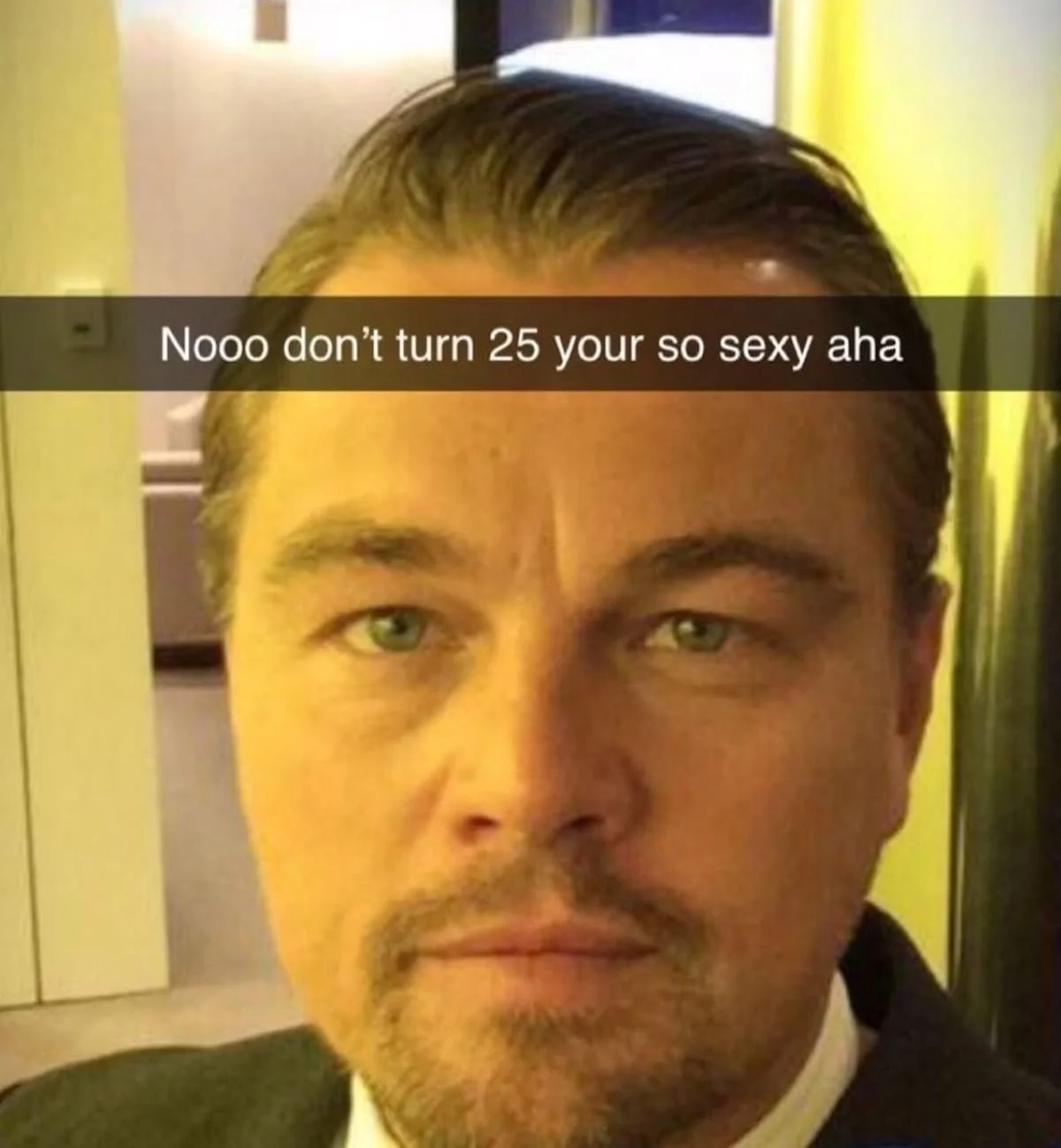
Sourced Through Pinterest
Special thanks to Natalie and Stella for collecting survey responses, and to Aedin, Max, Gabby, Elahn, Sarah, Kayla, Mia, Joshua, Jessy, Shelby, Yazi, Ariana, Sophie, Callie, Juliet, Sakura, Kiana, Maya, Mary, Hannah, Isabella, Veronica, Angela, Katherine, Ari, and Ashley, the (approximately) 25-year-olds that took the survey we released on Gut Instinct's Instagram in April. For transparency purposes, 80% of respondents were female (the male brain thus remains largely unexplored, but I won’t pretend like I would’ve been the best candidate to dissect that anyway).